
The ‘Güeras Aliadas’: How two American women are helping locate migrants lost in the ICE labyrinth
A pair of North Carolina residents have launched a project that has helped more than 200 families connect with loved ones who were detained by federal agents

On December 24, while preparing the traditional Christmas Eve dinner at their home in Oaxaca, Mexico, Fernanda froze upon seeing a TikTok video showing the arrest of migrants in Alabama by agents of the Immigration and Customs Enforcement Service (ICE). One of the detainees appeared to be her father. The video was from the day before. She ran to tell her mother and they tried to contact him, but the calls did not get through and there was no response to the messages they left him.
Fernanda’s father had emigrated to the U.S. four years before to improve the family’s finances. There was no doubt it was him. With no news, and without knowing where to look for information or who to turn to, the days that followed were harrowing. As a last resort, Fernanda asked the TikTok search engine how to locate a person detained by ICE. The social network directed her to Las Güeras Aliadas. “I thought that maybe it was a fraud, that they would scam me, ask for money. But I thought it wouldn’t hurt to try and I filled out the form. And Devyn contacted me on WhatsApp.”
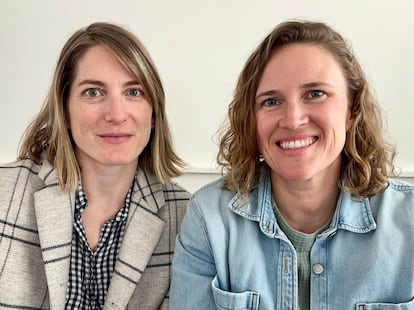
Devyn Brown and Kathryn Coiner-Collier are behind Las Güeras Aliadas, a project to locate migrants detained by federal agents and to put them in contact with their families. The idea arose in November, during the immigration crackdown that the Trump administration launched in Charlotte, North Carolina, where they live. About 200 Border Patrol agents were deployed to the city in a campaign that lasted until December and resulted in more than 400 arrests. Brown, a teacher, and Coiner-Collier, a social worker, took to the streets to protest against the presence of the agents and distribute whistles and pamphlets with information on migrant rights.
Outraged by the raids and keen to help, the pair made informative videos that they posted on social media. Coiner-Collier had extensive experience helping migrants in court and had worked at the infamous Dilley detention center. Brown had experience working with Latinos. Both had lived at some point in Latin American countries. A few days later, a woman from Honduras contacted them asking for help in locating her husband, who had been detained. The request was the first of many. The two women realized the barriers foreigners faced in locating their loved ones who had been arrested by ICE, and decided to help them.
Brown and Coiner-Collier had two advantages: they are U.S. citizens and speak Spanish. Both are important factors given the barriers encountered by those who have to deal with the administration to locate their relatives: not understanding the language, the fear of identifying themselves (many are undocumented), the lack of a U.S. telephone number and no bank account in their name. Most of the people who contact Las Güeras Aliadas live outside the U.S. “We thought we had the ability to contact ICE agencies without feeling afraid, and we could communicate in Spanish. It was obvious that people needed this service and we decided to focus on that. Without advertising ourselves, we were contacted by about 30 people asking for help,” explains Coiner-Collier.
Since setting up in November, the pair have helped around 200 families locate their loved ones, providing relief to those who are consumed by the anguish of not knowing where they have been taken or what condition they are in.
Las Güeras Aliadas have had to learn on the job. The first step is the location of the detainee and that means consulting the Online Detainee Locator System (ODLS) website, where it can take days for the names of those detained to appear. If that site fails to turn anything up, they try the Detention and Removal Information Line (DRIL) and, if that also fails, they contact the various ICE offices across the country, where they rarely find anyone to talk to. If they are lucky and someone answers the phone, there is a high probability that they will not solve anything, as Brown demonstrated in a video of one of those calls that went viral.
@inmigracion.ok Güeras Aliadas: Un proyecto social voluntario liderado por dos ciudadanas estadounidenses dedicadas a localizar a familiares detenidos por ICE 🧊. Estas aliadas brindan un apoyo vital para que las familias logren comunicarse con sus seres queridos en momentos críticos 📱❤️. El proyecto ofrece orientación y acompañamiento estratégico para superar las barreras del complejo sistema migratorio 🇺🇸⚖️. Su misión principal es mantener a las familias unidas y asegurar que nadie enfrente este proceso en total soledad 💪. Con empatía y compromiso, demuestran que la solidaridad ciudadana es una herramienta clave para proteger y fortalecer a nuestra comunidad 🌎✨.
♬ original sound - Inmigración OK Abogados - Inmigración OK Abogados
Once the center where the detainees are being held has been located, which generally takes a few days, the next step is to put the family in contact with their loved one. As the detention centers are run by private companies, each has its own communication system for detainees. The first thing is to open an account for them and deposit some money so that they can make calls, but this usually requires the Alien Registration Number. Some do not have it and most families are unaware of it. “In four months, we have come across dozens of private communication systems. Some ask you to have a credit card, or a bank account, others to scan your ID or your image, which many do not want to do because they are undocumented,” explains Coiner-Collier. The hurdles have been exacerbated because, thanks to the 287(g) agreements that establish a collaboration with local prisons, it is even more complicated to communicate with detainees.
To solve the problem, the two women use their own account, using funds largely from donations from across the world. ““To receive a donation from Denmark with a note that says ‘thank you for your work’ is overwhelming. Our country has the power to help everyone because we are the wealthiest country in the world, so it is very surprising to have to receive donations from all over the world. For everyone to see how the government is treating people and still want to help,” says Coiner-Collier.
Donations run parallel to the dissemination of their videos. Las Güeras Aliadas say that since January, when TikTok was bought by Michael Del, the owner of Oracle and a billionaire friend of Trump’s, their video streams have plummeted. If before this, a video got 20,000 hits, it now gets no more than 400 views and there are videos that do not receive a single one.
Dissemination of the videos on social media is essential for reaching remote places in, say, Honduras or Guatemala. But not only there. Carolina Remicio found Las Güeras Aliadas on TikTok in Toronto, Canada, where she lives. For this Peruvian woman, the Güeras “are people who fell from heaven.” Remicio was desperate because she did not know how to locate Maciel, her son’s partner. “I tried to look for her, but the pages were in English and I don’t speak English. There’s very little we could do from here.”
The young couple, who had been living in the U.S. for just over a year, wanted to move to Canada to escape the immigration crackdown. On January 5, they were detained at the airport. Remicio’s son was released, but Maciel was turned over to ICE. Brown took over the case, tracked her down and Maciel was able to talk to her family from the various detention centers she was sent to in New York, Louisiana, Arizona and Texas.
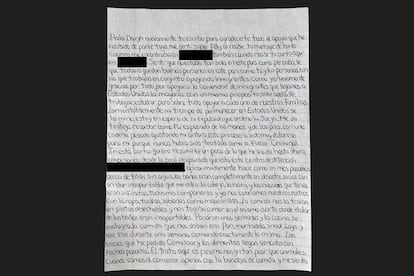
Maciel was removed twice from the plane on which she was to be deported, after having signed the petition for self-deportation, which she did in order to put an end to her confinement. In a letter sent to Brown, she described the mistreatment to which she was subjected: “We spent about four days without water. The bathrooms were a complete mess, dirty, with an unbearable smell that hurt my head and nose. The nausea was endless. We had to eat in the room where the smell was unbearable.”
She also complained about the quality of the food, which was often past its sell-by date. For a week, there was only bread, mortadella and Lays snacks. “The treatment here is terrible, they yell at us like we were animals,” she said. In such difficult times, the contact that Las Güeras establish provides the hope detainees such as Maciel need. “I am writing to thank you for all the support I have received from you. I felt like I wasn’t as alone in this country as I thought,” she said in the letter. Maciel was finally deported to Peru on March 25.
A message from Las Güeras also gave Fernanda and her father hope. After locating him, Las Güeras wrote to him to give him a phone number where he could reach his daughter. From that moment on, communication was almost constant until he was deported, on March 5, after two months of confinement, lack of food and a lack of the medicines needed for his hypertension. Now he is in Oaxaca and Fernanda hopes to meet Brown one day to thank her personally.
Las Güeras have volunteers, but they regret not having the time or resources to be able to train as many as they would like. About 60 people have collaborated with different tasks, a number that now sits at around a dozen. Many more have offered to collaborate, but the two women don’t have the time to train them. Both are professionals and mothers of young children who themselves are keen to help. “My five-year-old son knows what we’re doing and wants to participate. He likes to draw pictures on the letters we send. Being a mom doesn’t go against the work we’re doing, it’s part of it,” Brown says.
Besides the work they’re already involved in, Las Güeras are planning a new project, compiling the testimonies of those who have been detained and also of their families. “A platform so that people like us, the güeros, can know the truth of what is happening, not what the government says is happening,” they say.
Sign up for our weekly newsletter to get more English-language news coverage from EL PAÍS USA Edition









































