
Separatist movement in Canada’s Alberta province finds allies in Trump’s circle
An association is collecting signatures for an independence referendum in the country’s conservative stronghold
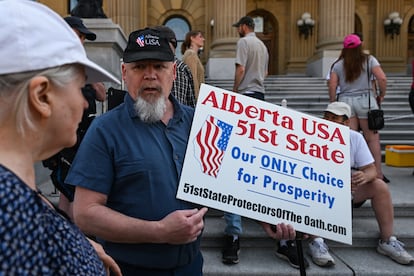
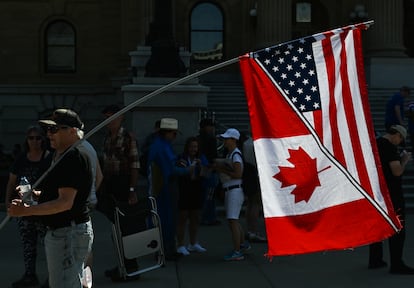
In the middle of a trade war and Donald Trump’s threats to make Canada the 51st state of the United States, Canadians are watching in astonishment as figures close to the president embrace a minority separatist movement in the province of Alberta. Secret meetings with representatives of the U.S. State Department, the open support of figures from the MAGA movement, and the possibility of a referendum this fall — for which signatures are already being collected — paint a picture in which many see the shadow of foreign interference.
Located in western Canada, Alberta possesses the world’s fourth-largest proven oil reserves, behind only Venezuela, Saudi Arabia, and Iran. The province is a conservative stronghold in a country governed by the Liberals for over a decade, boasts the highest GDP per capita, and is a major contributor to federal finances. However, energy and environmental policies driven from Ottawa have generated increasing tension between the province and the federal government, in a relationship that some Albertans consider exploitative.
Although support for independence remains a minority in the province, alarm bells rang when it became public knowledge that several leaders of the Alberta Prosperity Project (APP), the organization spearheading the separatist movement, made three strategic trips to Washington in 2025 to discuss the region’s potential sovereignty. Its co-founder, the controversial lawyer Jeffrey Rath — a proponent of conspiracy theories about an alliance between China and Canada to thwart secession — has revealed in recent interviews that he met with State Department representatives to discuss potential U.S. support for Alberta should the independence initiative succeed.
Rath claims to have discussed logistical issues such as the use of the U.S. dollar, border security, and even a $500 billion loan to finance the transition to a sovereign state. He also stated that at least one of these meetings, held in December, took place in a secure room at the State Department, where electronic devices are not permitted.
Although both the White House and the State Department have tried to downplay the meetings, asserting that no high-ranking officials participated and no commitments were made, for Patrick Lennox, former intelligence manager for the Royal Canadian Mounted Police and a PhD in international relations, this latest meeting is particularly troubling: “You don’t walk into a secure room by accident. There was a reason why the meeting between APP and those who met with them at the State Department was held in a secure environment.”
“It’s completely out of character when you consider the history of the relationship between Canada and the U.S.,” Lennox continues. “I can’t think of any other U.S. administration that would have agreed to such a meeting with a group in Canada that threatens to break up the country. The only way to understand it is that they see it as a way to make the threat of the 51st state a reality.”
A “natural partner” of the US
In recent months, several figures in Trump’s circle have spoken out about Alberta. The most controversial comment came from Treasury Secretary Scott Bessent, who, on a television program, described the province as a “natural partner” of the United States, highlighting its “great resources.” Within Trump’s media ecosystem, political commentator Brandon Weichert, on Steve Bannon’s War Room podcast, described Alberta as the “key piece” in the president’s plans for the Western Hemisphere, asserting that when Trump talks about annexing Canada, he is actually referring to Alberta. These voices have been joined by those within the MAGA movement, who support Albertan separatists on social media, portraying them as victims of Canadian oppression.
Maria Popova, a McGill University associate professor of political science and expert on Russia’s war against Ukraine, finds strategic similarities with Moscow’s 2014 use of separatists in the Donbas region as a Trojan horse for its expansionist interests: “A much larger neighbor, showing interest in what is actually a very fringe movement, and trying to turn that fringe movement into a separatist one with an appearance of legitimacy,” she explains. “They seemed to emerge from nowhere and have been presented as what I have called in some texts ‘instant separatists.’”
Pandemic separatism
While Albertan separatism may not have been “instant” — secessionist movements have existed since 1930 — it has always been a fringe movement. The pandemic and government restrictions, says Lennox, created fertile ground for its resurgence: the APP was born out of what the former intelligence manager calls “collective paranoia.” The organization, which describes itself as “educational,” says it seeks to mobilize citizens for a referendum on the province’s sovereignty and independence. “They are not a political party in the strict sense. Nobody elected them, except themselves,” Lennox points out.
Tanya Clemens, a grain farmer from southern Alberta, recounts that it was precisely during the pandemic — “when we saw the federal government overreaching and making decisions without allowing us to ask questions,” she says — that she began to take an interest in local politics and collaborate with the APP. This is also the case for Chris Scott, owner of a roadside restaurant and gas station in the center of the province, who joined the APP, eventually becoming its interim CEO, after being arrested for violating restrictions imposed to prevent the spread of Covid-19.
Both Clemens and Scott identify as conservatives and defenders of individual liberties, which they say are threatened under the Liberal government. They both cite a certain historical resentment, speaking of centuries of conflict with Canada, although they admit to having been unaware of the movement until 2021.
But if the pandemic ignited the spark of separatism, the April 2025 federal elections, won by Mark Carney’s Liberals, detonated the bomb. Adam Derges, an Edmonton-based financial advisor and evangelist for the separatist cause, asserts that “woke ideologies have changed the country’s values in a very drastic way,” explaining that, in the run-up to the elections, many like him hoped that a Conservative victory could “undo much of the damage the Liberals have done to the economy, to culture, to crime — to everything.” After losing the election, Derges saw independence as the only way to live in a territory entirely governed by Conservatives.
Three months after Carney’s victory, the APP submitted a petition to the local electoral body to initiate a public consultation on a possible referendum asking Albertans if they want “Alberta to become a sovereign country and cease being a province of Canada.”
The petition was approved in January, and the separatist group Stay Free Alberta claims to have already gathered the 177,732 signatures needed to activate the process, which must be submitted to Elections Alberta for verification before May 2.
Meanwhile, in Canada, political analysts, academics, and even various First Nations groups have been warning since the beginning of the year about the need to take action against U.S. interference in the form of disinformation and possible illegal financial support.
Sign up for our weekly newsletter to get more English-language news coverage from EL PAÍS USA Edition









































