
The Indigenous leaders who saved Guatemala’s election have spent a year in jail on ‘terrorism’ charges
Amnesty International considers Luis Pacheco and Héctor Chaclán, who prevented the derailment of the election result in 2023, to be prisoners of conscience
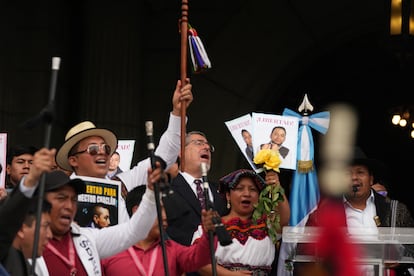
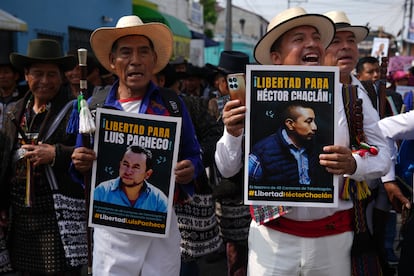
Luis Pacheco and Héctor Chaclán completed a year in prison in April after being charged with terrorism, illicit association and obstruction of criminal proceedings, a situation that has led Amnesty International to declare them prisoners of conscience. The pair are representatives of the organization known as the 48 Cantons of Totonicapán, which brings together a battle-hardened Indigenous people from west of Guatemala City. The 48 Cantons is one of the strongest organizations of the Indigenous movement in the Central American country, and led the 2023 social protests that defended the electoral results in which Bernardo Arévalo won the presidency.
Back in 2023, the country ground to a standstill when various sections of society demanded Arévalo’s victory be respected and the attorney general, Consuelo Porras, be forced to resign. The public’s indignation erupted after raids on the Supreme Electoral Tribunal, the seizure of the electoral records and the beginning of an investigation against the center-left Movimiento Semilla – Seed Movement –Arévalo’s party. The first to demonstrate and defend democracy were the 48 Cantons, triggering a wave of protests that were generally peaceful and involved dances and recreational activities while closing the main roads in and out of the capital. There was also a sit-in that was maintained in front of the Public Prosecutor’s building.
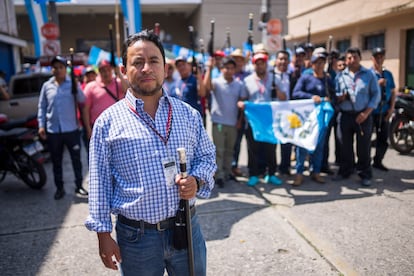
On April 23, 2025, Luis Pacheco, former president of the 48 Cantons, was serving as deputy minister of Energy and Mines when he was arrested along with Héctor Chaclán, former treasurer of the Indigenous organization. A judge tried them for the crimes of terrorism, illicit association and obstruction of criminal proceedings, and remanded them in custody. He also ruled the case be kept confidential, with hearings behind closed doors. “The accused probably participated in actions that could have intentionally interfered and violated the proper functioning of the justice system,” the Prosecutor’s Office stated.
Juan Castro, from the Indigenous Peoples Law Firm and lawyer for the accused, explained that the Prosecutor’s Office in charge of the case presented 160 sources of evidence, including wiretaps, screenshots of media outlets and disinformation on social networks, where interviews that Mayan leaders gave at public events had been compiled. “That is the main piece of evidence used by the Public Prosecutor’s Office,” Castro said. Divided into eight folders, the case file includes photographs of Pacheco and Chaclán taken in different parts of the city.
“What is striking is the tracking. A specialized team follows them everywhere; the team even takes pictures of them in the places where they were eating. They chase them in vehicles and had them observed while they were outside the Public Prosecutor’s Office,” said the lawyer.
Lidia Tzunum, Pacheco’s wife, states that the former president of the 48 Cantons was a loving father and that, after long days of activism, he came home to play with his children. “He would lie face down on the bed and the children would scratch his back as if it were a blackboard. On Sundays he liked to prepare a churrasco (grilled meat) watch television and eat popcorn,” she said.
“In 2023, when he had been in the resistance [on strike] for four days, the threats began,” Tzunum added. “There was the night when an alert was activated: it was said that they were looking for his family and that there were a huge number of riot police. The communities were alarmed and organized themselves into protective rings and they knocked on the door and told me to leave because they were coming for me; it was the neighbors who gave us refuge in another house. That escape, with my children and all the people with sticks, was traumatic and my children are still paying the price,” she said between sobs.
Amnesty International have declared Pacheco and Chaclán prisoners of conscience, a status granted to people imprisoned for expressing their ideas, exercising their rights or due to their identity. “Luis Pacheco and Héctor Chaclán should never have been imprisoned. Their arrest and prosecution constitute arbitrary punishment for having participated in peaceful protests and for representing their community. Every day they remain in prison compounds the violation of their human rights”, said Ana Piquer, Americas director at Amnesty International.
Amnesty also demanded the “immediate and unconditional” release of Pacheco and Chaclán, who are currently in Mariscal Zavala military prison. Days before the first anniversary of their detention, a court decided to extend the preventive detention until September, while the pair continue waiting for the legal process to be completed. The Public Prosecutor’s Office will appoint the new attorney general on May 17, after President Bernardo Arévalo chose Gabriel García Luna as Consuelo Porras’ successor. Now it remains to be seen whether justice finally comes for the Indigenous leaders who mobilized a country to save its weak democracy.
Sign up for our weekly newsletter to get more English-language news coverage from EL PAÍS USA Edition









































