
Mexico intensifies seizure of synthetic drugs with raids in Sinaloa, Sonora and Guerrero
The government dismantled a clandestine laboratory and confiscated over 41,000 liters and 12 tons of chemical substances, in actions that come after US pressure for greater results
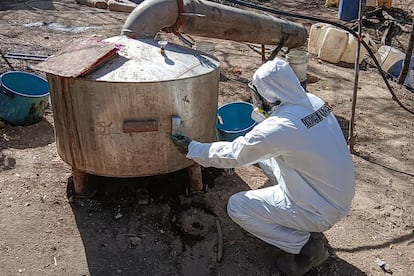

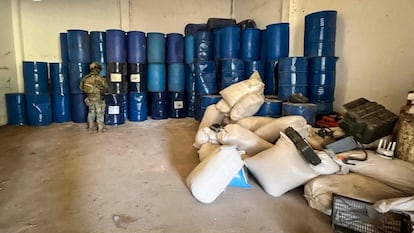
The Mexican government has dealt another blow to drug trafficking. In separate operations across three states—Sinaloa, Sonora, and Guerrero—authorities reported the seizure of more than 41,000 liters and 12 tons of chemicals to be used in drug production. The announcement includes the dismantling of a clandestine laboratory in Guerrero and 11 other methamphetamine production sites in Sonora. In Sonora, between the towns of Culiacán and Mexicali, a vehicle containing 212 kilograms of methamphetamine was seized by the Army and the National Guard. Mexico’s efforts to combat drug trafficking have intensified, coinciding with increased pressure from the United States in recent weeks for more results in the fight against drug cartels.
One of the blows to criminal organizations announced this Thursday is apparently linked to Los Chapitos, a faction of the Sinaloa Cartel. Authorities connected the seizure of approximately 25,000 liters and more than 12 tons of chemicals in Guerrero, and the dismantling of a clandestine camp for the “simultaneous production of methamphetamines, designer drugs known as ‘tusi,’ and synthetic opioids,” to Inés Omar Coronel Aispuro, alias “Coronel.” Aispuro is one of the people who helped El Chapo Guzmán escape from the Altiplano prison in 2015 through a tunnel, the second time he managed to escape from a maximum-security prison. “Coronel,” who is the brother of Guzmán’s wife, Emma Coronel, has a criminal record for drug-related offenses, including the production, storage, and trafficking of marijuana, and for firearms possession.
The tense relationship with the U.S., whose president has repeatedly asserted that Mexico is governed by cartels, had its latest episode on Monday with a 15-minute phone call between Claudia Sheinbaum and Donald Trump. Following the call, the Mexican president reiterated that the threat of U.S. intervention on Mexican soil is not a possibility, having rejected Trump’s proposal once again. “[He] didn’t insist either; it was more along the lines of, ‘If you want us to help you more with our forces in Mexico...’, ‘No, I’ve already told you before that’s not on the table,’” she said. The U.S. has remained silent on the matter. So far, Trump has not commented on the call.
Through his social media accounts, Mexico’s security czar Omar García Harfuch emphasized that the operation in Guerrero “directly impacts the financial and operational capabilities of criminal groups and prevents millions of doses of drugs from reaching the streets.” Mexico’s Security Cabinet also announced on Thursday the capture of a member of the Sinaloa Cartel. According to the authorities’ statement, Daniel Alfredo N., aka “El Cubano,” was arrested in Sinaloa. He is accused of leading a criminal cell affiliated with the Sinaloa Cartel and of being responsible for distributing synthetic drugs to the United States. The government indicated that Daniel Alfredo N., who is wanted by the FBI, is subject to an extradition order for drug trafficking, money laundering and organized crime.
Despite large drug seizures and even the extradition of major Mexican drug lords to the U.S., the pressure continues. The Mexican government insists on emphasizing cooperation with its neighbor and framing the relationship within a cordial tone, but Monday’s meeting also demonstrated that the demands are not diminishing. In her morning press conference on Monday, the president acknowledged that the U.S. president had demanded greater results. “He felt that more could be done, and I said, ‘Yes, indeed, more can be done, but we continue to work on it,’” Sheinbaum stated.
Information published this Thursday by The New York Times indicates that Washington’s pressure is also intensifying for Mexico to allow the entry of U.S. special forces into its territory. According to government sources consulted by the newspaper, the Trump administration is interested in carrying out drone strikes, especially to destroy clandestine laboratories. A source quoted by the newspaper indicated that Trump had suggested the participation of U.S. personnel in operations in Mexico, which would be led by the Mexican military, as early as last year. The proposal was reportedly revived by the president after the U.S. incursion into Venezuela on January 3. The presence of U.S. troops in Mexico is a sensitive issue in a country that is constantly defending its sovereignty. In an attempt to appease its northern neighbor, The New York Times reported that Mexico has offered “more information sharing” and “a greater role in command centers” for the U.S.
Since his second inauguration on January 20, 2025, Trump has been clear that Mexico is not doing enough to combat drug trafficking. The president has stated that this causes the deaths of between 250,000 and 300,000 people annually in his country, referring to deaths from overdoses, primarily from fentanyl and other opioids. Thus, while the administration announces a new crackdown on organized crime, the Republican’s obsession with drugs and cartels keeps the tension with Mexico alive.
Sign up for our weekly newsletter to get more English-language news coverage from EL PAÍS USA Edition









































