
Claudia Sheinbaum curbs Trump’s interventionist appetite
The Mexican president is withstanding pressure from the Republican to send U.S. troops in and acknowledges her government ‘can do more’ to combat drug trafficking
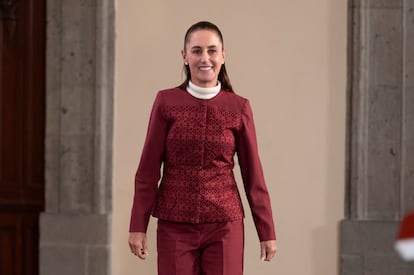
A new lifeline for Mexico arrived in a 15-minute phone call. Monday’s conversation between Claudia Sheinbaum and Donald Trump allowed the Mexican president to dismiss the possibility of U.S. intervention in the country, as the Republican politician has threatened on at least three occasions following Washington’s illegal incursion into Venezuela and the barrage of threats against the region. Sheinbaum withstood pressure from Trump, who, both publicly and privately, proposed sending U.S. troops to “help” in the fight against drug trafficking. The Mexican leader rejected the proposal. “[He] didn’t insist, but rather said something along the lines of: ‘If you want us to help you more with our forces in Mexico...’ ‘No, I’ve already told you several times that’s not on the table,’” Sheinbaum recounted from the National Palace. The president did acknowledge, during the call and later publicly, that her government could put more pressure on organized crime: “He felt that more could be done. I said: ‘yes, indeed, more can be done, but we continue working.’”
Since January 3, the pieces of the Mexican government have been moving with pinpoint precision. The U.S. attack on Venezuela and the capture of Nicolás Maduro made Trump’s threats of military intervention in the region a reality, supposedly in the name of “defending” the interests of the United States and “its hemisphere.” Since the Republican returned to the White House, Mexico has been one of his favorite targets. Faced with this siege, Sheinbaum has remained cautious. She has no other option. Thus, the Mexican leader refuses to debate with Trump in public — unlike other leaders such as Colombian President Gustavo Petro — and opts for one-on-one conversations. This Monday she reaffirmed this approach: “Under these conditions, it is always better to seek dialogue rather than through the media.”
In the first year of Trump’s second term, the two presidents have spoken 15 times and met once, in Washington, for the 2026 FIFA World Cup draw, with both countries among the co-hosts. As acknowledged by high-ranking Mexican officials, since the tariff dispute, “everything is decided in those few minutes of conversation.” In addition to this public discretion, Sheinbaum has spent the last year delivering on her duties regarding security and migration. As a close advisor to the president summarized to EL PAÍS: “We haven’t made a single mistake.”
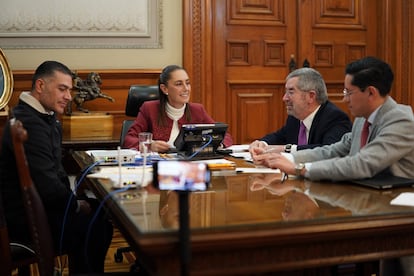
In the call with Trump, Sheinbaum reviewed Mexico’s progress in combating insecurity, especially regarding fentanyl trafficking (the volume of which crossing into the U.S., she said, has decreased by 50%), the capture of criminal leaders, and the destruction of drug production labs. Moments before the conversation between the two heads of state, the Mexican government reported the seizure of 700 kilos of drugs in three labs in Durango, Sinaloa, and Michoacán. The murder rate in Mexico has also fallen to its lowest levels in a decade; compared to October 2024 alone, when Sheinbaum took office, homicides have decreased by 40%. Furthermore, with 40,000 arrests in 14 months and a northern border secured by 10,000 troops, irregular migration to the United States has also plummeted — another of Trump’s key requirements.
With this report submitted, Mexico has also made its own demands. The government has called on the Trump administration to take measures to reduce the trafficking of weapons that end up in the hands of criminal groups, an issue that was also part of Monday’s conversation between the two leaders, which Sheinbaum described as cordial. In particular, the Mexican president has asked for respect for the country’s sovereignty.
This demand was present throughout the conversation with Trump, who has threatened to attack drug cartels directly on Mexican soil. “The people of Mexico need to know, firstly, that their president will never negotiate sovereignty or territorial integrity. Never. Secondly, that we seek coordination without subordination, as equals. And thirdly, that this is permanent,” she stated at a press conference after the call. On Sunday afternoon, Foreign Minister Juan Ramón de la Fuente and U.S. Secretary of State Marco Rubio also held a telephone conversation as a prelude to the call between the two leaders. That conversation focused on “the need for stronger cooperation to dismantle Mexico’s violent narcoterrorists networks and stop the trafficking of fentanyl and weapons,” according to a statement from the U.S. government.
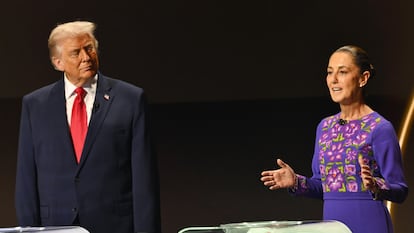
Sheinbaum stated that she herself asked De la Fuente to arrange the meeting with Trump after his repeated threats to violate Mexico’s sovereignty. The president added that her U.S. counterpart directly asked her about her position on Washington’s intervention in Venezuela and the kidnapping of Maduro. According to her account, Sheinbaum told him that the Mexican Constitution is clear in its rejection of violations of the sovereignty of other countries. Mexico and other Latin American nations, as well as Spain, have spoken out against renewed U.S. interventionism and the risks of geopolitical instability in the region.
The president said that other issues — such as joint investments and the situation of Mexican migrants in the U.S. — were left for a future call. She also announced that the group of high-ranking officials from both countries that monitors bilateral issues will meet for the third time in Washington on January 22 or 23. The continuation of these meetings reinforces the Sheinbaum administration’s position in the face of a situation that, from within her administration, is acknowledged as “extremely delicate”: “Cooperation, yes; subordination, no.”
Sign up for our weekly newsletter to get more English-language news coverage from EL PAÍS USA Edition









































