
La Unión Tepito, the cartel enriching itself through Tren de Aragua’s sexual exploitation networks
The arrest of six alleged members of the Venezuelan gang exposes the collaboration between organized crime groups in Mexico City
The bodies of Stephanie and Susej were what exposed the cesspool. The two young Venezuelan women had been brutally murdered in July 2024 in southern Mexico City. Their attackers had tried to burn them to cover their tracks, but the double femicide left no doubt: it bore the mark of the Tren de Aragua criminal organization. In the wake of the crime, investigations and news reports about the Venezuelan gang followed. And arrests began. Although the Mexico City Security Secretariat tried to downplay its role, police operations proved that this criminal network, after spreading across the continent, was already operating in Mexico. The most recent arrests have gone a step further and are revealing how La Unión Tepito, a Mexico City cartel, has profited from the sexual exploitation carried out by Tren de Aragua in the heart of the country.
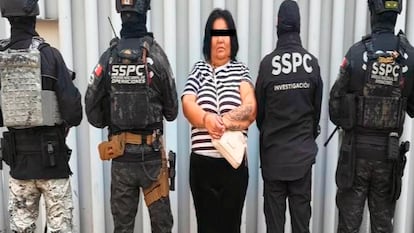
On Tuesday, the Federal Security Secretariat reported the arrest of six alleged members of Tren Aragua. All are Mexican; five are accused of extortion, human trafficking, and drug trafficking, and the last, Bryan Betancourt, is also charged with organized crime. These arrests add some key pieces to the puzzle, especially regarding the collaboration between the Venezuelan gang and La Unión Tepito.
The agency headed by Omar García Harfuch identifies Lesli Valeri Flores Arrieta as the liaison and negotiator between the two criminal groups. The 40-year-old Mexican was responsible for collecting a portion of the profits Tren de Aragua members made from the sexual exploitation of women. The Venezuelan gang’s modus operandi is well-known after a decade of operating throughout the continent. Tren de Aragua members reach agreements with local cells to allow them to operate in their territory in exchange for fees and certain restrictions. For example, according to experts consulted by EL PAÍS, Tren de Aragua only traffics Venezuelan women. The gang has proven adept at exploiting the mass exodus from the country and has turned the journey of migrants to the United States into a strategy for recruiting victims whom they then integrate into their sex trafficking networks.
These women were also controlled by Lesli Flores, according to the Security Secretariat, which found a notebook in the accused’s possession containing names and the extortion payments she charged them. Flores also sold drugs to members of Tren de Aragua, as well as to the exploited women. She did not do this alone, but with her family.
Federal authorities have arrested two of her sons and two of her daughters-in-law in the Venustiano Carranza borough of the capital. Jorge Romero Flores, Giancarlo Romero Flores, Valeria Pineda Arredondo, and Diana Ortega Pérez were involved in “the production and distribution of narcotics in various boroughs of Mexico City, supplying members of the Tren de Aragua gang,” according to police. They were also “responsible for extorting women who are sexually exploited, and for other acts of extortion.”
According to information obtained by EL PAÍS, Lesli Flores’s mother also participated in this criminal network; as did her nephew, Vladimir Ruis, who is also under arrest; Adriana Trejo Ramírez, who distributed drugs and extorted the women; and Luis Ángel Sánchez Gallardo, an accomplice who was also arrested. This money was handed over to two men identified as “Jossep” and “Don Neto.”
The sixth person arrested in the operation was 33-year-old Betancourt, whom the Secretariat considers “a key figure within the criminal structure, serving as the financial operator for the Tren de Aragua organization.” According to the agency, this Mexican national provided his bank accounts for receiving and sending money “derived from illicit activities in order to conceal its origin and destination.” Betancourt also provided housing for members of the criminal group and victims of sexual exploitation.
The debt
Security reports indicate that women enter Mexico by land, primarily through Tapachula, Chiapas. This city, known as the capital of the southern border, has for years been the epicenter of a migration crisis where thousands of migrants, trapped and waiting to regularize their status, coexisted with the deep reach of organized crime, which controlled the city’s entrances and exits through extortion, mass kidnappings, disappearances, and executions.
After passing the first stop — which requires Tren de Aragua to make a payment to the cartels operating in Chiapas — the victims are taken to Mexico City. In the capital, the women are sexually exploited and forced to pay the criminal organization a debt ranging from $12,000 to $14,000 for entering the country, according to the Security Secretariat. They must also pay approximately 12,500 Mexican pesos (about $650) weekly for “lodging and use of the territory”; this payment is made via bank transfers or in cash.
The federal agency notes that “once this debt is paid, many of the victims continue their journey to the United States.” Others, like Stephanie and Susej, are killed before reaching their destination, often while trying to escape.
Sign up for our weekly newsletter to get more English-language news coverage from EL PAÍS USA Edition









































