
Mexico gives FIFA a blank check for 2026 World Cup matches
While the US and Canada have reached various agreements with certain tax benefits at the national, state, and local levels, a 2015 document will provide blanket exemption for the tournament games in Mexico City, Monterrey, and Guadalajara
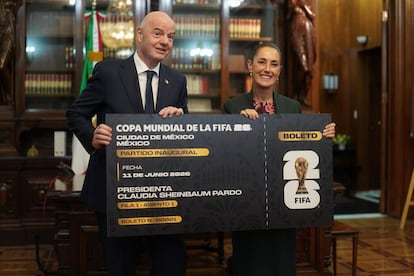

The International Federation of Association Football (FIFA) and any companies it designates will not pay any taxes during the 2026 World Cup matches to be held in Mexico City, Monterrey, and Guadalajara. This is stipulated in Mexico’s 2026 Federal Revenue Law. One of its transitional articles states that companies “participating in the organization, development, and execution of activities related” to next year’s World Cup, which Mexico is co-hosting with the United States and Canada, are exempt from paying taxes. Of the three countries, only Mexico has granted FIFA a full, nationwide exemption. The tax agreements reached by the United States and Canada are not comprehensive and are implemented at the national, state, and local levels.
“It was an agreement signed with FIFA in 2015, during [Enrique] Peña Nieto’s administration,” President Claudia Sheinbaum said a few days ago during her daily press conference. “These exemptions were signed, so it was a contract already in place with Mexico; we changed some of the terms that had been agreed upon at that time, but it was a signed contract, and therefore it is enshrined in law because that’s how it has to be,” she pointed out. The World Cup will be held in June 2026, with the United States as the main host country, staging 78 matches, with 13 in Canada and another 13 in Mexico.
This exemption is particularly noteworthy given that the Mexican government is engaged in a campaign to increase tax revenue without implementing any tax reforms. The strategy involves raising specific taxes and reducing opportunities for financial mismanagement. In a context of economic slowdown and increased spending on social programs, this effectively grants FIFA and any other entity it designates throughout the country a blank check.
In Mexico, according to Senator Raúl Morón Orozco of the ruling Morena party, speaking to the sports news network ESPN: “It applies to all companies directly involved in organizing the World Cup. All those participating, all companies promoting the World Cup. Also television stations broadcasting or reporting on the World Cup and all hotel and travel groups, etc.”
According to the transitional provision, FIFA itself must present to the Mexican Tax Administration Service (SAT) the names of the individuals and legal entities participating in the organization and staging of the World Cup who will benefit from this scheme. It establishes one exception: companies on the SAT’s blacklist for outstanding tax debts will not be eligible for this exemption.
In 2022, ESPN obtained a copy of the 93-page document in which the government of Enrique Peña Nieto made commitments to FIFA. Titled “Government Guarantees Related to the 2026 FIFA World Cup,” it was signed by Alfonso Navarrete Prida, then Secretary of the Interior, and benefits the Mexican Football Federation (FMF), the FIFA 2026 World Cup and its subsidiaries, regardless of whether or not they have their tax domicile in Mexico, as well as the FWC Legacy Fund 2026. The document was signed in 2015, three years before FIFA awarded the 2026 World Cup to Mexico, the United States, and Canada in June 2018.
In the United States, FIFA has negotiated tax exemptions separately with each of the 11 host cities, most of them years after the World Cup was awarded. In Atlanta, Georgia, an extension of an existing tax exemption on match tickets was approved in 2022, with no public information on further exemptions. The Athletic, the sports supplement of The New York Times, obtained a copy of the New York City Host City Agreement, in which FIFA requests “minimizing non-refundable taxes in good faith” and states that all municipal taxes will be covered by the host city.
A separate case is the city of Santa Clara, California, home to Levi’s Stadium, where six matches will be played. An agreement signed in 2025 clarifies that “the city has not agreed to subsidize any law, tax, or fee related to the World Cup events and reserves the right to approve or reject any proposal.” According to state media reports, the City Council spent over a year negotiating with FIFA to “protect the city’s finances and taxpayers.” All obligations are being transferred to the Bay Area Host Committee, a non-profit organization dedicated to attracting sporting events to the San Francisco Bay Area, because a series of agreements was allegedly made with FIFA without the City Council’s knowledge or permission.
In Canada, this tax arrangement has sparked public discontent after the agreements between the cities of Vancouver and Toronto with FIFA were revealed through freedom of information requests. The deal is similar to those made public in the United States: municipal taxes paid by the city and a good-faith reduction of non-refundable taxes, in addition to providing FIFA with top-quality office space. Toronto’s current mayor, Olivia Chow, has repeatedly criticized the onerous terms of these agreements.
Sign up for our weekly newsletter to get more English-language news coverage from EL PAÍS USA Edition









































