
Netanyahu under fire for Iran failures and a ceasefire brokered behind his back
The opposition is attacking the Israeli prime minister, while he insists that Israel has its ‘finger on the trigger’ and will fight the Iranians again if necessary
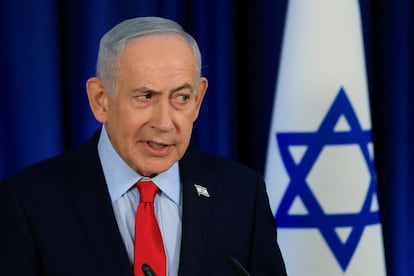

A message in Hebrew began circulating on social media early Wednesday morning, when Donald Trump announced the two-week ceasefire with Iran that includes the reopening of the Strait of Hormuz: “Remember that you spent 40 days going down to the shelters just to open a sea route that had always been open.” The text reflects the astonishment and anger of the population at seeing how the hostilities that Benjamin Netanyahu initiated on February 28 alongside Trump, predicting a definitive victory and the end of the regime in Tehran, have abruptly ceased without achieving a single objective and after negotiations in which the prime minister had no say.
It took Netanyahu 18 hours to address the nation, speaking in Hebrew on such a crucial matter. Until then, he had only issued statements in English. His appearance late Wednesday offered no new information and did nothing to change the political and social mood. He insisted that the cessation of hostilities does not mean the end of the war with Iran and that Israel will return “to fight if necessary.” “We have our finger on the trigger,” he declared.
Amid calls for his resignation, he insisted that Israel is “the winning side” and ridiculed those who refuse to acknowledge the “tremendous” military achievements in Iran prior to the truce.
The same political opposition that enthusiastically embraced his war zeal now vehemently criticizes him for his irrelevance, miscalculation, and prolonged silence. The feeling, on both the left and the right, is that this whole ordeal was unnecessary. Lebanon is paying the price. Amid the tug-of-war over its inclusion in the ceasefire, the Israeli army has killed more than 250 people in Lebanon in its largest bombing campaign of the war in yet another desperate act of aggression by Netanyahu, which could sink a ceasefire brokered behind his back.
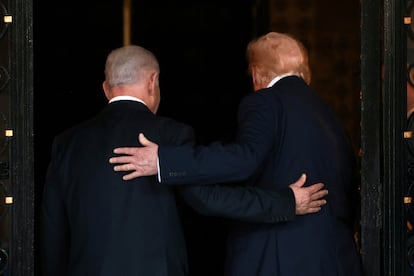
The cessation of hostilities leaves the Israeli leader in a difficult position just six months before elections in which no poll predicts a repeat of his coalition with the ultra-Orthodox and ultranationalist sectors; one recent poll even gives the Jewish opposition parties just enough of a majority to oust him from power. A senior Israeli official, quoted anonymously by state television, indicated that the announcement of the agreement was a “surprise” and came “at the last minute, when everything seemed to be in the works.” Netanyahu denied this in his address, speaking of a “coordinated” decision with Washington that clashes with past events.
Pakistan’s Foreign Minister, Ishaq Dar, accused Netanyahu on Tuesday of trying to sabotage his mediation efforts by attacking Tehran when “both sides were about to sit down to negotiate.” And, according to the online news outlet Axios, he called Trump on Monday to urge him not to agree to a ceasefire and to continue fighting, while the Israeli military intensified its bombing campaign against all kinds of civilian infrastructure, including bridges, petrochemical plants, and universities.
Nor do the archives help the Israeli prime minister. In June 2025, after launching another war with Iran, which the U.S. eventually joined and which lasted 12 days, he touted “a historic victory that will endure for generations.” Israel, he said, “eliminated two existential threats” of “annihilation” by nuclear weapons and 20,000 ballistic missiles.

Instead of generations, the triumph lasted eight months. On February 28, Israel and the U.S. launched a new war, again amid negotiations with Tehran to avert it. The initial surprise attacks killed Iranian Supreme Leader Ali Khamenei and other political and military leaders. All parties in the Israeli parliament, except the Arab formations, and an overwhelming majority of the Jewish population supported the campaign. A poll by the Institute for National Security Studies at Tel Aviv University put support at 91%. Another, by the Israel Democracy Institute, put it at 93%.
The moment of truth
It was a time for grand pronouncements — often peppered with biblical references — and calls for Iranians to take to the streets and seize power. “We have an organized plan with many surprises to destabilize the regime and bring about change, and many more objectives […]. To the Iranian people I say: The moment of truth is approaching, and if you rise up, the day when Israel and Iran will once again be courageous friends will not be far off,” Netanyahu asserted as late as March 7.
As the weeks passed, Israel’s political and military authorities found few achievements to capitalize on: epically presenting bombings on targets previously considered “neutralized,” shifting the focus to the destroyed Iranian launchers (which can be rebuilt in days or even hours) while rationing missile interceptors and verifying, day after day, how the plan to topple the regime from the air fared even worse in the real world than it did in its presentation at the White House.
Netanyahu began backtracking on regime change (“ultimately, it depends on the Iranians,” he said), and leaks began to spread, assigning blame and pointing to one culprit: David Barnea, head of Mossad, the country’s renowned foreign intelligence service, for allegedly promoting an unrealistic goal. Foreign Minister Gideon Saar admitted last week that he could not “promise” that this would be “the last war” with Iran.
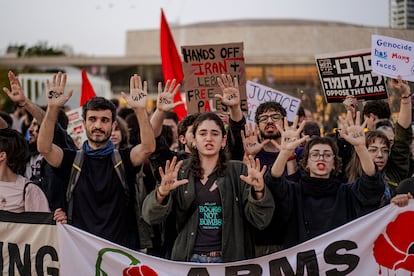
Popular support has declined. In the latest poll by the Israel Democracy Institute, released last week, it had already fallen to 78% among the Jewish majority. The decline was most pronounced among those who initially supported Netanyahu “clearly.” Meanwhile, opposition grew, from 4% to almost 11%, reflected in the largest anti-war demonstration in Tel Aviv.
This Wednesday, the ceasefire announcement, with Netanyahu awaiting Emperor Trump’s decision like a gladiator in the coliseum in a Hollywood movie, has transformed doubts into fierce criticism. The opposition reproaches the prime minister for having promised a clear victory that has ultimately amounted to nothing.
Gili Cohen, diplomatic correspondent for Israeli public television, expressed the general sentiment thus: “The U.S. president keeps making promises: that the solution to the enriched uranium problem will be perfect, that there is a new regime in Iran […] and that we may be one step away from the Golden Age of the Middle East. Just yesterday he was talking about [returning Iran to] the Stone Age, now it’s gold. That’s Trump. The question is: What about us?”
“Political disaster”
Former prime minister and opposition leader Yair Lapid called it a “political disaster.” “Israel wasn’t even at the negotiating table when decisions were held that directly affect our national security,” he said. “The military did everything asked of it, the population demonstrated incredible resilience, but Netanyahu failed politically and strategically, and he didn’t achieve any of the goals he set for himself. It will take years to repair the political and strategic damage Netanyahu has caused due to his arrogance, negligence, and lack of strategic planning.”
Yair Golan, leader of The Democrats (the coalition uniting the historic Labor Party and the left-wing Meretz party), also highlighted the gap between expectations and reality. “Netanyahu promised a ‘historic victory’ and security for generations, and in reality, we have suffered one of the most serious strategic failures in Israel’s history.”
In a narrative all too common among the opposition to Netanyahu, Golan (a decorated reserve commander) applauded the army and the civilian population while criticizing the government: “Civilians died, soldiers fell. The Armed Forces fulfilled their duty decisively and made progress, but the government of Netanyahu, [Bezalel] Smotrich, and [Itamar] Ben-Gvir [ultra-right-wing ministers] failed once again to turn it into victory. None of the objectives were achieved: the nuclear program was not destroyed. The ballistic missile threat persists. The regime remains intact and even emerges stronger from this war.”
Also in the opposition, but from right-wing positions, former defense minister and leader of the Yisrael Beiteinu party, Avigdor Lieberman, has expressed his disappointment with the ceasefire and his skepticism about the negotiation process it opens: “Any agreement with Iran without renouncing the destruction of Israel, uranium enrichment, ballistic missile production, and support for terrorist organizations in the region means that we will have to resume another campaign under more difficult conditions and pay a much higher price.”
Sign up for our weekly newsletter to get more English-language news coverage from EL PAÍS USA Edition









































