
Paul Preston: ‘Franco didn’t win through military brilliance. He wanted to exterminate the Republican people’
Author of the canonical biography of the dictator, the British historian has spent more than half a century immersed in the study of the Civil War, the dictatorship and the Transition
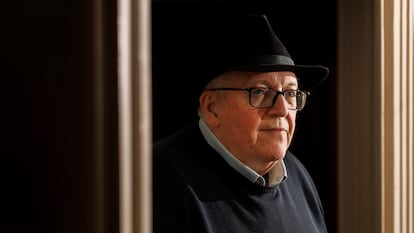

Paul Preston, 79, admits that he increasingly dislikes talking about Francisco Franco, a figure he has studied for so many years and yet cannot find any appealing angle to. Yet the historian — one of the foremost experts on Spain before the Civil War, on the war itself, and on the decades that followed — reluctantly acknowledges that his voice remains essential for understanding that era.
Author of three masterful biographies — Franco: A Biography; Juan Carlos: A People’s King; and El zorro rojo, la vida de Santiago Carrillo (El Zorro Rojo: The Life of Santiago Carrillo) — Preston has continuously updated the first as historiography has shed new light on the dictator’s darker side. He believes there is little left to reveal about Franco, but maintains that it remains crucial to combat the myths surrounding him.
Question. Has the perception of Franco’s figure changed, both inside and outside of Spain?
Answer. Certainly, in the English-speaking world, at least before the publication of my biography, he still enjoyed good press. Here [in the U.K.] there was an anti-communist political establishment that always had a great deal of sympathy for Franco. For a long time, there has been talk about the extent to which Franco triumphed thanks to the help of Hitler and Mussolini. And there is no doubt about that. But the help he received from British policy has not been sufficiently discussed. The objective of the famous “policy of non-intervention” was to neutralize the Republic and thus aid Franco’s military coup.
Q. For the past 50 years, you have been dismantling established myths about Franco.
A. The people who wanted to study with me were already left-wing and anti-Franco. We all worked together to make known all the evil things Franco did. But it’s clear that there was a whole toxic legacy surrounding the man, and we had to make an effort to dismantle it.
Q. Starting with the myth that he was a brilliant military leader and strategist…
A. That’s a clear example. He wanted to win a civil war, but he didn’t win it through military brilliance. His objective, as he said in interviews, was to conquer Spain inch by inch. What he wanted was to exterminate the Republican people, and that meant the elimination of a number of fellow citizens that was massively cruel.
If you compare him to great figures of the era like [Nazi Germany’s Ervin] Rommel or [British Army officer Bernard Law] Montgomery, he doesn’t measure up. Military education in Spain was 50 years behind the rest of Europe because it hadn’t participated in the major wars. It was fortunate for the country, yes, but it gave the military a colonial warfare mentality. That’s what Franco did: treat the southern population the same way he had treated the Moroccans when he was in Africa. Cruelly.
Q. Over the years of reviewing Franco’s biography, you’ve admitted that at first you didn’t fully grasp the extent of corruption in both Franco and his regime.
A. Exactly, the regime he created was a regime of plunder. There was a myth, which I also believed when I began to study him in the 1970s and 1980s of the last century, that Franco was a man above greed. Later, in more updated editions of my biography, or in my book A Betrayed People, I speak clearly about the corruption and enrichment of Franco and his family, which is staggering. And this isn’t my own doing; Ángel Viñas already wrote an entire book on this subject.
Q. Many of the myths surrounding Franco, which persist in segments of the population and continue to resurface, are the result of an effective propaganda machine.
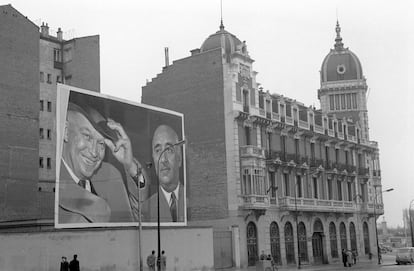
A. I think — and perhaps this is just my own obsession — that the massive brainwashing campaign he launched across the country starting in 1939 hasn’t been sufficiently acknowledged. This whole “fake news” thing isn’t something Donald Trump invented; it’s something many regimes have done. But with Franco, it was on a grand scale. He controlled the media. He dominated the education system through the Church. He had almost 38 years to create the image of the “savior” of Spain, the sentinel who never sleeps, always watching over the safety of all Spaniards. All of that is a lie, of course.
Q. Was it his own doing? Did he have that strategic and intellectual capacity?
A. He was intellectually mediocre, but he had a whole apparatus around him. At first, he relied on a group of Falangists [members of Spain’s fascist-inspired political party] who were very helpful in building the new regime. Later, he relied heavily on intellectuals like Dionisio Ridruejo and Fermín Yzurdiaga, neither of whom I particularly admire, but very intelligent people nonetheless. And then there’s something I find very difficult to say, but it’s true: Franco was incredibly cunning. A major contributor to [Benito] Mussolini’s downfall was Franco himself, who managed to convince the Italian that the greatness of the fascism he so loudly proclaimed had to be demonstrated by helping the rebels win the Civil War. I don’t like to speculate, but I do think it’s very likely that if all the Italian war materiel he used and left in Spain had been used in North Africa, the Italians wouldn’t have been so easily defeated by the British.
Q. And yet, you are not comfortable defining Franco as a fascist, an adjective that has become almost permanently incorporated into political discourse.
A. The use of the word fascist is a problem for me. If you ask me what a fascist is, I would say that the clearest example is Mussolini’s National Fascist Party. Everything else is different. The problem with the word is that it’s used as an insult. Today we say that Trump is a fascist. But of course, I’m a university professor. When I was at Queen Mary University of London, I taught a course on the nature of fascism, and I always asked to what extent Nazism is fascism, because the problem is that it’s much worse. And Francoism, in many respects, was also worse.
Furthermore, fascism had a rhetoric of destroying everything old, something Franco lacked, as he supported large landholdings and the aristocracy. His bloody side, which many associate with fascism, stemmed in his case from being a colonialist military officer, an Africanist. “Without Africa, I don’t understand myself,” he would say. The same sentiment was echoed by Belgian and British military officers of the time. That’s why I’m uncomfortable using the word “fascist” when referring to Franco.
Q. There is a perception, among supporters of the Franco regime and even among well-meaning people, that what Franco did wasn’t comparable in scale to a figure like Hitler.
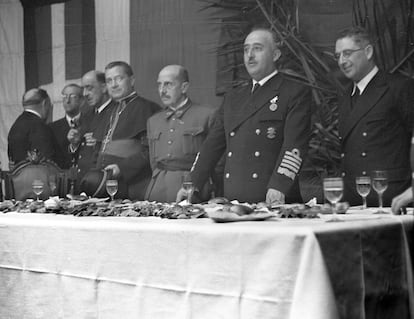
A. One of the things that distinguishes Hitler from Franco, for example, is the scale of their operations. The percentage of fellow German citizens (and I know this is a sensitive subject) — I mean the number of non-Jewish Germans killed by the Nazis — was proportionally lower than the percentage of Spanish citizens killed by the Franco regime, both during the war and in the subsequent period. In his famous interview with the American journalist Jay Allen, a few days after the uprising began, Franco told him: “I will save Spain from Marxism at any price… Soon, very soon, my troops will have pacified the country and soon all this will seem like just a bad dream.” And when Allen replied: “Does that mean you will have to shoot half of Spain?” a smiling Franco answered: “I said at any price.”
It’s very difficult to find direct evidence of Franco’s actions. There are always instruments that act on his behalf. His responsibility for the bombing of Guernica is immense, but it’s impossible to find a direct order originating from him. The details of that massive atrocity were drawn up by [Wolfram] von Richthofen, the head of the German Condor Legion.
Q. When judging Francoism, its defenders refer to a second phase of the regime, which they consider more authoritarian than dictatorial, in which the country grew.
A. That’s correct from an objective point of view, because there is clearly a chronological development of the Franco regime. Its operation during World War II was not the same as immediately afterward. In that first phase, when the eyes of the world were focused on other things, atrocities occurred in Spain, appalling repression, the concentration camps. It was a horrible time.
From 1945 onwards, however, Franco had to change his image for his own survival, and the team surrounding him proved brilliant. All the ministers were replaced, and the Falange, which had previously been openly fascist with FET y de las JONS [Traditionalist Spanish Falange Party of the Councils of the National Syndicalist Offensive], became the Movement, a bureaucratic entity that began to leech off the state. This transformation was also reflected in the eyes of other countries. With nuances, of course, because there were British, French, and American conservatives who thought Franco was wonderful, but there were others, like a Labour government in the United Kingdom, that abhorred him. But they were also pragmatic.
Q. And then there is the providential circumstance, for Franco, of course, of Spain’s perceived importance during the Cold War.
A. All the military in the West think of Spain as an aircraft carrier with access to the Atlantic and the Mediterranean. And they believe that, in the event of a Soviet invasion, the only place where they could stop would be in the Pyrenees. This idea allows Franco to continue surviving politcally, but he also has to contribute something to that end. That’s why, with the Law of Succession, the image is created that Spain is not actually a fascist regime but a monarchy. Although if you read the details, it’s ludicrous, as when it details the reasons why Franco has the right to name his own successor of royal blood. The genius behind all of this is [Luis] Carrero Blanco, who convinces him that he is more than a king, because he has created a kingdom.
With the Pact of Madrid, the Americans were interested in rearming Spain as part of their defense strategy against a perceived Soviet belligerence. And that’s where the money starts coming in, especially from the United States.
Towards the end of the 1950s and the beginning of the 1960s, a point was reached where change was necessary because the economy needed a better-educated workforce. I have no problem with those who say that the Franco regime of the 1940s wasn’t the same as that of the 1950s or 1960s. Of course not; it had to evolve.
Q. Are there any current historiographical revisions that are more lenient toward Franco?
A. Most of the works I receive, either sent to me or acquired by myself, are quite critical. The major biographies, and the more detailed works, are generally very critical of Franco. Another issue is the disconnect that can exist between the subject matter and what people are then willing to swallow. It’s the same thing that has happened here in the United Kingdom, with figures like Nigel Farage or Boris Johnson, who have never stopped fabricating lies. I would point to flaws in the education system. And social media, which has given authenticity and legitimacy to any nonsense.
I was recently having lunch with a close friend who, in a way, is the Paul Preston of Italy. An Englishman living there whose opinion carries a lot of weight. He was lamenting the same thing: how it was possible for [Itlalian Prime Minister] Giorgia Meloni to say certain things and for people not to question her. And our conclusion was the same: social media and its immediate impact.
Q. Now that there’s a far-right nostalgia for Franco that proclaims support for Israel, it’s worth asking about the dictator’s antisemitism.
A. Of course he was antisemitic, but here again he was an expert at manipulating his image. He made an effort to give the impression that the courage of a number of Spanish consuls in Eastern Europe who had indeed saved Jews, in Hungary, Romania, or Bulgaria, was actually his own merit; he took credit himself. But then you read the articles he wrote in the newspaper Arriba, under the pseudonym Jakin Boor, and they are crazily antisemitic — almost Nazi.
This is partly a result of the Catholic education of his time, but the International Anti-Communist Entente, founded in Geneva, has also been largely overlooked. Primo de Rivera gave Franco, [Emilio] Mola, and a small group of generals subscriptions to the organization’s magazine. He also constantly sent them reports that spoke of Jewish evil. Spain is one of the few countries where you can still buy the Protocols of the Elders of Zion [a fabricated antisemitic document created in Tsarist Russia]. I remember stalls at the Madrid Book Fair, linked to the Falange, where you could find that book. And in editions that looked modern.
Q. Have Spaniards been told all the details of the relationship between Franco and Spain’s emeritus king Juan Carlos I?
A. That’s very curious, when you say “been told.” By whom? Who could tell it, if not Juan Carlos I himself? I had already read a lot about this topic because I wrote their biographies. At the very beginning, when he was a child, Juan Carlos was a hostage. You could tell because, as a teenager, he spoke of many people as if they were second fathers. According to him, he had had a lot of second fathers. Because his own father had abandoned him, using him as a pawn in the great game of chess to save the monarchy.
But it’s also clear that Franco, who never had a son, began to develop a certain fondness for him, even though he never stopped troubling the Bourbon family. There was a moment, well before 1969, when he confided in Carrero Blanco that Juan Carlos was going to be his successor. The Minister Secretary General of the Movement, José Utrera Molina, tried to convince Franco not to trust him, but the dictator paid no attention. He truly believed that everything was already settled.
Q. Was King Juan Carlos a supporter of Franco?
A. Something that has been said a lot is that Juan Carlos never allowed anyone to speak ill of Franco in his presence. In the first version of the biography I wrote about him, I didn’t want to interview him because I knew he could influence me, with his overwhelming charm.
When the book came out, he read it, liked it, and invited me to lunch. It lasted almost a whole day, and it was fantastic. He talked to me about Franco, not critically, but with humor. In other words, he wasn’t a staunch Franco supporter. Was he a democrat? I don’t know, but he was very aware that if he didn’t help create a democratic regime in Spain, the monarchy wasn’t going to survive. He had no choice. But he always treated Franco with great respect. Even after his death, he treated his wife and daughter with great respect.
Sign up for our weekly newsletter to get more English-language news coverage from EL PAÍS USA Edition









































