
Spain’s emeritus king on his undeclared fortune: ‘It was a gift I did not know how to refuse. A grave mistake’
In his memoirs, now distributed to the French press, Juan Carlos I admits to being the victim of many ‘weaknesses’ and ‘errors of judgment in matters of love and friendship’
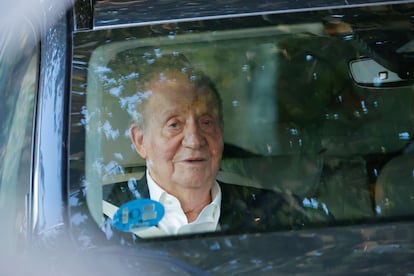

Juan Carlos de Borbón, who reigned as King of Spain for nearly 39 years, is back in the public eye just weeks before the 50th anniversary of the Spanish monarchy. It may seem unusual, but the former monarch has decided to give a few interviews to the French press to promote his new memoir, Juan Carlos I d’Espagne. Réconciliation, which will be released first in France.
The 512-page book, written with author Laurence Debray, will be published in France on November 5 — moved up from the originally planned date of November 12 to avoid coinciding with the anniversary of the Bataclan tragedy — and in Spain on December 3 by Editorial Planeta. According to Le Monde, which has had an advance look at the book, it was conceived “to explain and defend” the former king’s decisions and to prevent others from “stealing” his story.
After his interview with Le Figaro, many questions remained about key moments of his long reign — some of which begin to be addressed in the article published by the French daily on Wednesday morning. Juan Carlos sees himself as a monarch who was “never truly master of his own destiny.” He admits to being “aware of having disappointed” others, to being the victim of many “weaknesses” and “errors of judgment in matters of love and friendship,” to having kept “bad company,” and to having accepted “gifts that some may consider inappropriate.”
The emeritus king is also aware, according to the excerpts cited by Le Monde, that these confessions “will no doubt rekindle criticism” and controversy around a royal institution that the Zarzuela Palace, the seat of the Spanish royal household, has been trying to quiet since his abdication in 2014 and the subsequent proclamation of King Felipe VI.
One of the topics he addresses in the book is the money he received from the late King Abdullah of Saudi Arabia, whom he calls “a brother.” He describes it as “an act of generosity from one monarchy to another.” During the early years of his reign, Juan Carlos I strengthened ties mainly with Morocco and Jordan, but also with other Gulf monarchies that were beginning to emerge as economic powers.
The former king admits in the book, according to Le Monde, that “$100 million is a considerable sum.” “A gift I did not know how to refuse. A grave mistake,” he confesses — claiming that the funds were meant to provide for his family and to “secure my retirement, far from official life in Spain.”
When this news became public in March 2020, King Felipe renounced his father’s inheritance and said that Corinna Larsen — a Monaco-based business consultant known for her relationship with Spain’s former monarch — had sent a letter to Zarzuela Palace informing him that he and his two sisters had been named as beneficiaries of the Lucum foundation, which received the $100 million deposit from the Saudi royal house. The Spanish royal household decided to notify the government and consult a notary to refuse any funds from these accounts.
A Swiss investigation revealed that on August 8, 2008, Arturo Fasana deposited $100 million into an account at the private bank Mirabaud. This money came from the finance minister of Saudi Arabia. Four years later, the funds were transferred by Juan Carlos, who was still Spain’s head of state (he did not abdicate until 2014), to a bank account in Nassau, in The Bahamas. The account in the bank Gonet & Cue was held by the company Solare, which is owned by Corinna Larsen. The Swiss prosecutor Bertossa froze the suspicious accounts and opened a secret money laundering investigation into those involved.
Larsen — a German businesswoman of Danish origin, who was the former king’s longtime companion during the most turbulent period of his reign — came to public attention after Juan Carlos I suffered an accident on an elephant hunting trip in Botswana, while Spain was still grappling with the effects of the economic crisis and the Great Recession. “A distant and costly trip that may seem completely out of place given the country’s situation,” he admits in the book, according to Le Monde, where he also describes his relationship with Larsen as a “mistake” he “bitterly regrets.”
In the spring of 2019, Juan Carlos I withdrew from public life. In March 2020, following revelations about the Saudi donation, Felipe VI renounced any future inheritance “to preserve the exemplary nature of the Crown” and revoked his father’s annual allocation as former head of state (just over $187,600). Juan Carlos I, however, remains a member of the Spanish royal family (alongside Queen Sofía, King Felipe VI and Queen Letizia, Princess Leonor, and Infanta Sofía), although he does not have an official schedule. “I am the only Spaniard who does not receive a pension after nearly 40 years of service,” the emeritus king complains.
Juan Carlos’s self-imposed exile in Abu Dhabi occupies a space in the book, as does his strained relationship with his heir, Felipe VI, whom he praises as king but criticizes as a son. “My son turned his back on me out of duty,” Juan Carlos writes. “I understand that, as King, he must maintain a firm public stance, but I suffered […] seeing him so insensitive.” Le Monde highlights a conversation between them recalled by the emeritus king, which took place at Christmas 2020, “locked in the silence of misunderstanding and pain.”
As he had already indicated in his interview with Le Figaro, Juan Carlos lavishly praises Spanish dictator Francisco Franco in his book. Franco, he argues, was undoubtedly the man responsible for his coronation, having designated him as his successor. “If I was able to be king, it was thanks to him,” he writes. Juan Carlos I, alongside other figures such as Adolfo Suárez — who came from the Francoist movement — planned the transition to a parliamentary monarchy, beginning with reform from within the old regime via the Political Reform Law, and culminating in free elections and the approval of the Constitution by referendum.
The former monarch recounts having “frequent and personal” interactions with Franco and admits a certain fondness for the dictator, something that has concerned some sectors of the political class. “I respected him enormously, appreciated his intelligence and political sense. […] I never allowed anyone to criticize him in my presence,” he writes. On the dictator’s longevity, he adds: “No one could dethrone him or even destabilize him, which, for so long, is an achievement.”
According to Le Monde, the book suggests that the scandals surrounding the emeritus king began to take shape during years when he enjoyed total impunity, especially in the 1990s, amid the rise of a circle of businessmen and bankers, some of whom ended up in prison. In the book, Juan Carlos admits having been “blind to a malicious environment” and having “the weakness to trust businessmen presented to me and to yield to what I now perceive as pressures,” eventually finding himself “in the middle of a financial mess that exceeded me.” He acknowledges that during his reign he allowed himself to be advised by “certain unscrupulous businessmen who acted in my name, but above all for their own benefit.”
Juan Carlos also recalls his wife, Queen Sofía, whom he refers to as “Sofi.” Yet he “bitterly regrets” that she did not visit him in Abu Dhabi, as his daughters Elena and Cristina and most of his grandchildren have done, with the exception of Princess Leonor and Infanta Sofía.
Regarding his daughter-in-law, Queen Letizia, whose arrival “did not favor cohesion in our family relationships,” he acknowledges the existence of a “personal disagreement.”
Sign up for our weekly newsletter to get more English-language news coverage from EL PAÍS USA Edition









































