
At the epicenter of the mysterious health alert in Siberia: ‘Plague? There’s no panic, people are calm’
The Russian authorities’ lack of transparency is fueling rumors among the public. Health officials are inspecting veterinary clinics in response to a possible animal infection
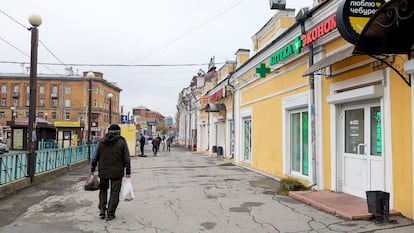

“What plague?” an Irkutsk resident exclaims when the epidemiological crisis that has put this small Siberian city near Mongolia on the front pages over the past week is mentioned. “Do you see me wearing a mask?” the annoyed clerk at a pharmacy retorts when asked whether she has noticed any concern over reports of quarantines and the death of a laboratory worker. “Whatever the authorities say, we’ll obey. We all obey the authorities,” say two elderly women, carefree as they sit on swings in a park in Shelekhov, the suburb that their own governor advised people not to visit due to “a particularly dangerous infection.”
Residents of Irkutsk are today disconnected from statements by the World Health Organization (WHO) and Donald Trump about an alleged plague outbreak in the region. A week and a half has passed. No one is wearing masks and there are no ambulances on the streets, as was the case six years earlier during the Covid pandemic.
Authorities point to their press releases. The official version of events from Russia’s consumer protection and public health agency, Rospotrebnadzor, says that Daria Shipilova, a 28-year-old researcher at the Irkutsk Research Institute for Plague Control, died on October 2 of “pneumonia of undetermined etiology.”
The regional governor, Igor Kobzev, declared the crisis over on October 8. “The quarantine is lifted,” the politician said, adding that “the patient” died “of pneumonia acquired outside the hospital,” and that more than 5,000 tests performed “did not identify health problems related to infectious pathologies.”
However, the WHO has requested more information from Russian authorities. It demands clarification, among other things, on what caused the researcher’s death. The Russian explanations leave several questions unanswered: basically, why some officials mentioned a plague case; why an emergency meeting at all levels was necessary; and why hundreds of people were placed under observation.
Elena Trifonova, editor-in-chief of the local paper, Liudi Baikala (People of Baikal in Russian), tells EL PAÍS that, because of the lack of transparency, another plausible hypothesis behind the government inspections is an animal-origin infection. An employee of a veterinary clinic in neighboring Angarsk told Liudi Baikala there had been “a plague inspection” last Thursday. “Authorities are monitoring these centers to prevent risks. One can conclude that the danger has been contained and the situation is under control, but the authorities have not declared the alert over. They suspect an infection transmitted by animals,” the journalist says.
Russia witnessed a similar crisis earlier this year. Authorities culled livestock en masse in several regions, including Irkutsk, without giving farmers any details other than that it was “a particularly dangerous infection.” Suspicions pointed to outbreaks of foot-and-mouth disease.
“Authorities refused to admit it because that would have meant closing borders and banning the sale of meat and milk. That would have caused economic and reputational damage,” Trifonova explains. “Generally, the first reaction of Russian authorities is to hide information. It is the nature of any authoritarian or totalitarian system.”
Indifference and conspiracy theories
Although the quarantine has been lifted, some hospitals still impose certain restrictions.
“Attention: Restricted Access,” warns a sign at the entrance to Irkutsk Hospital No. 3. “Visits to hospitalized patients are temporarily restricted. Access permitted only with authorization!” the sign emphasizes. Another sign refers to a decree dated October 2 that prohibits visits to patients due to “the flu season, acute respiratory infections, and the new Covid-19 strain of 2026–2027.”
In any case, normal life goes on in the surrounding neighborhood, where no one wears masks. “They are treating people — what is there to be afraid of?” asks Ksenia, a clerk at a pharmacy near the hospital.
“No one is buying antibiotics. Now more masks are sold, but because of the flu season. Since Covid there’s more of a habit,” she adds. Nevertheless, an investigation by Liudi Baikala of 15 pharmacies at the start of the crisis showed that “some ran out of antibiotics.”
At another nearby pharmacy, a clerk and her customer laugh at the idea of a contagious outbreak. “Nothing has been confirmed, there is no problem,” the clerk cuts in.
The deceased researcher lived on Voronezhskaya Street, local press say. A quiet, half-paved street where workshops and offices in an industrial park mix with small houses.
“The plague case occurred outside the city. Shelekhov is 20 miles away,” says Denis, one of her neighbors. “My wife is a doctor. She told me that those in the building [of the deceased] were put in quarantine in a — pff!” he adds with a whistle. “Everything is fine here,” he asserts.
Denis is one of the few residents who seems interested in this epidemiological crisis. “Plague? Fine, plague,” says a young man with a laugh after asserting that “everything is fine, everything is normal.” “There is no panic, people are calm,” his partner adds.
“Everything is fine, everything is normal” is the mantra repeated by all Irkutsk residents, surprised by the attention given to this case. “We don’t know what the girl died of — many girls die,” replies the man. “Do you see restrictions? I don’t. I don’t think about it,” says Ivan, an employee at a truck repair shop, before speculating about alleged conspiracies. “It’s the Overton window. Someone creates an absurd concept and then wraps it in rumors. Hence this opera,” he claims, showing a completely mistaken idea about what the Overton window is.
The lack of transparency from authorities and the relentless propaganda about a Russia that is always under threat feed conspiracies and disinformation in Irkutsk. “The plague thing is not true — the news says everything is fine. It’s just that two women were diagnosed with Covid,” says Lidia, a pensioner from Shelekhov, the village where the researcher was hospitalized and which the governor recommended people not visit in a post he deleted shortly afterward.

“At first we were scared because that day my husband and I had gone to get vaccinated at the same place,” Lidia admits. “There is only disinformation,” says Elena, another elderly Shelekhov resident. “The girl broke a vial in the lab. It wasn’t plague — the girl simply died of cardiac arrest,” she states.
Elena is accompanied by a friend, Yuri, who exclaims, “It’s all a provocation!” “They can’t defeat us. We have friends like China, Japan, and the United States, and they’re spreading rumors all over Europe,” he proclaims, without ever specifying who might be behind this alleged disinformation.
Yuri has lost two sons in what people here call the “special military operation,” the invasion of Ukraine. Although there is no trace of a supposed pandemic, another plague — the plague of war — strikes Irkutsk, a “provincial” city, as Muscovites put it, that serves as a recruiting ground. Its streets are plastered with recruitment posters promising huge salaries, and dozens of funeral homes have sprung up across the city. There is no neighborhood where these establishments do not display their headstones to the public in a fierce competition.
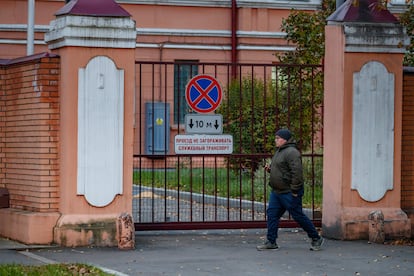
At least 6,859 residents of Irkutsk have died in the invasion of Ukraine, according to a count by the newspaper Mediazona using open sources, although the real figure is probably higher, and its Belaya air base was one target of Ukrainian drones in the 2024 Spider’s Web operation.
Nearby, in another park, two friends rest and say they are “neutral” about this epidemiological crisis. “The media talk too much,” one of them exclaims, adding that “the administration will tell us when and how to act.”
Irkutsk, 35% larger than Spain but inhabited by 5% of its population, is closely linked to Mongolia. That country reported a fatal case of bubonic plague in 2023 from the consumption of infected marmot meat. Earlier, during the height of Covid, Ulaanbaatar also reported other cases.
According to the WHO, around 10 countries, including the United States and China, recorded 423 deaths and nearly 4,000 plague cases between 2019 and 2025, figures that pale in comparison with those of Covid.
“The coronavirus was terrible — so many people sick, so many died,” recalls Elena, a Shelekhov resident. Six years ago Russian authorities were lax in their Covid restrictions to avoid the political cost. The lockdown lasted barely a few weeks and the government turned a blind eye to masks. According to the U.S. National Institutes of Health, Russian excess mortality exceeded one million people between 2020 and 2021, one of the highest rates in the world.
Meanwhile, one of the jokes circulating in Irkutsk is that plague is not the only scourge afflicting the city. “Attention! Bears may appear in settlements in the region. Stay alert!” read the SMS sent by Irkutsk authorities to all cellphones this weekend.
Sign up for our weekly newsletter to get more English-language news coverage from EL PAÍS USA Edition









































