Surviving in the Muslim quarter: A hundred skeletons shed new light on a medieval minority in Spain
Chemical compounds preserved in the bones of an Islamic cemetery have allowed researchers to reconstruct the diet of Tudela’s Mudéjar community over five centuries
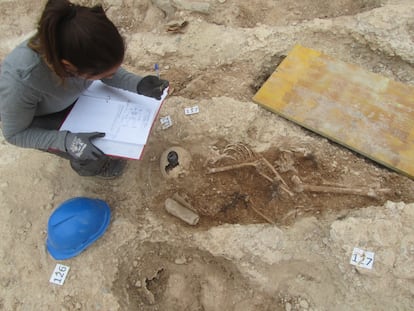

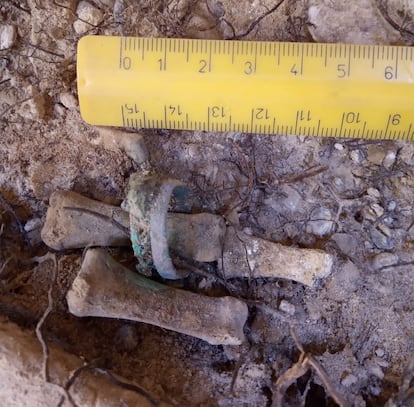
In 2019, work to expand a school in Tudela, a town in the northern Spanish region of Navarra, led to the discovery of a medieval cemetery. Because construction was halted and archaeologists were called in, researchers were able to document more than 400 graves. The position of the bodies and the direction of the faces revealed that the site was one of the largest Muslim burial grounds found in Christian-ruled Spain, dating from the 11th to the 14th centuries.
Now, an analysis of the chemical compounds preserved in the bones has enabled the largest study of its kind on a minority community in medieval Spain: the Muslims of Tudela, who made up the largest morería (Muslim quarter) in Navarre and one of the largest in northern Spain.
When Christians reconquered Tudela in 1119, the terms of surrender required the city’s Muslim population to leave within a year. Those who wished to remain had to relocate outside the city walls. Leaving the city was far more difficult for poorer Muslims, and many stayed. In later centuries, these Muslims living under Christian rule came to be known as Mudéjars, a term used in medieval Spain for Muslims who retained their religion and customs after the Christian conquests.
The new study, published in the journal Antiquity, recovers part of that history through the chemical traces preserved in the remains of people who, for the most part, remain anonymous in the written record. By analyzing different forms of chemical compounds, known as isotopes, researchers were able to reconstruct the diets of 120 individuals buried in the Islamic cemetery of Torre Monreal.
The findings make it possible to trace the life of a community that remained in Tudela until 1516, when its members were forced either to convert to Christianity or leave the Kingdom of Navarra. Because of both the number of individuals studied and the centuries it covers, the research is the largest isotopic study ever conducted in Spain on a historical minority population and one of the most extensive of its kind in Europe, according to the team behind the study.
“More than a study of what people ate in the Middle Ages, it is a story about how a minority negotiated its identity and adapted to profound political, economic and environmental changes through something as basic as food,” explains archaeologist Patxi Pérez-Ramallo, the study’s lead author.
“At a time when Europe is once again intensely debating integration, cultural diversity and the place of religious minorities, Tudela offers us an almost 400-year historical perspective on how these large processes end up materializing in everyday life and, literally, in people’s bodies,” adds Pérez-Ramallo, who is a researcher from the Max Planck Institute for Geoanthropology in Germany.
According to Pérez-Ramallo, the Muslim cemetery in Tudela is the largest and best studied from this period anywhere in Spain. Unlike Christian and Jewish burial grounds, Muslim necropolises have not been preserved, often because of urban development pressures. That was the case with the cemetery beneath Plaza del Castillo square in Pamplona, which was destroyed in 2001 to make way for an underground parking garage despite local opposition. And with the cemetery of San Nicolás in Ávila, once the largest Islamic burial ground in Spain.
“There are preservation and research agreements in place for Christian and Jewish cemeteries, and representatives of both communities have influence over decisions affecting them. But in the case of Muslim cemeteries, that is absent,” explains Pérez-Ramallo, who also works at the Free University of Brussels.
In Tudela’s maqbara, or Muslim cemetery, the regional government of Navarra and the city council opted to excavate and preserve the site. The work was entrusted to regional archaeologist Jesús Sesma Sesma, a co-author of the study, who assembled an interdisciplinary team to analyze the remains. The project was carried out with the support of representatives of Navarra’s and Spain’s Muslim communities, as well as members of Tudela’s present-day Muslim community.
Facing Mecca
The way to distinguish a Muslim burial from a Christian one in this period is by the position of the face. Christians were buried on their backs, facing upward, whereas Muslims were laid so that their faces were turned toward Mecca, a practice that was also reflected in the overall orientation of the grave.
One of the study’s findings is that, over the centuries, Tudela’s Mudéjar community became increasingly observant of its religious traditions. Initially, the dead were buried lying on their backs, but later they were placed on their right side. In time, bodies were laid in narrower side-access burial niches designed to maintain that position.
For the researchers, this evolution suggests that these communities grew more attached to their religious practices as pressure from the Christian authorities increased.
Chemical isotope analysis of the remains, which include children, adults and the elderly, reveals a decline in river fish consumption following the Christian conquest. Fish was permitted under Islamic dietary rules, but in 1127 King Alfonso I reserved sturgeon and other fish species for the Crown. Prices, taxes and Christian control over resources may have limited the Muslim minority’s access to these foods, particularly among artisan households.
Over time, sheep, goats and rabbits became more important in the diet, as did, surprisingly, cattle. Although cattle were generally less prized than sheep and goats at the time, their estimated contribution to the diet eventually surpassed that of both. The isotopic signal may reflect the consumption of dairy products such as milk and cheese as well as beef. If dairy products were subject to lower taxes under Christian rule, they may have provided a more affordable source of nutrition.
This diet differed both from that of earlier Andalusi communities in the region and from that of nearby rural Christian populations. The researchers see it as evidence of how Tudela’s Muslim minority, which at one point accounted for about a quarter of the local population, adapted, perhaps under constraint, to its circumstances.
The analysis shows a shift in this pattern in the aftermath of the Black Death and subsequent famines, which may have killed as much as half the population. River fish and poultry regained prominence in the Muslim diet during this period. The study suggests that labor shortages may have given the community — which continued to occupy a subordinate position — greater bargaining power.
The study found little difference in the diets of Muslim men and women, with one notable exception. Women over the age of 50 appear to have poorer and more limited diets. The authors suggest that many of these women may have been widows whose livelihood depended heavily on relatives or on charity.
There is one final indicator of religious observance. The remains of children under the age of three show clear signs that they were breastfed for at least two years, in line with recommendations in the Qur’an.
Sylvia Jiménez Brobeil, an anthropologist at the University of Granada who was not involved in the research, describes the study as “an important contribution to our knowledge of medieval populations in the Iberian Peninsula, especially those for which written records are scarce.”
She cautions, however, that the findings should be interpreted carefully, as the authors themselves acknowledge. Even so, she points out that the pattern observed among older women is consistent with evidence from other Muslim cemeteries and has been linked to gender roles within these societies. “Young women of childbearing age consume good-quality food, while the oldest women face limitations,” she says.
Jiménez Brobeil also highlights what she sees as a gradual impoverishment of the Islamic community over time, reflected in lower protein consumption and a greater reliance on plant-based foods. “The authors themselves acknowledge that not only legislation but also ecological changes are at play,” she says. “The Middle Ages are a very interesting period to study because of various climatic changes. Populations adapted to those changes by altering their settlements, ways of life and livelihoods, and, of course, their diets.”
Alejandro García Sanjuán, a historian at the University of Huelva, highlights the importance of DNA and isotope analysis for studying aspects of daily life in medieval communities for which no written records survive. “In the case of the Mudéjars, this is an analytical pathway with great potential, especially in kingdoms where few documentary records remain; here funerary archaeology can become an almost unique avenue for studying these communities,” he says.
The research team is now preparing a genetic analysis of the remains, which may shed light on the geographical origins of Tudela’s Mudéjar population. They also plan to publish findings on the small number of valuable objects recovered from some of the graves.
Sign up for our weekly newsletter to get more English-language news coverage from EL PAÍS USA Edition