The Amazon at a crossroads: Brazilians’ vote also decides the rainforest’s future
Deforestation has fallen 71% during Lula da Silva’s term. But the far-right candidate Flávio Bolsonaro denies climate change and promises to loosen environmental laws if he wins on Sunday
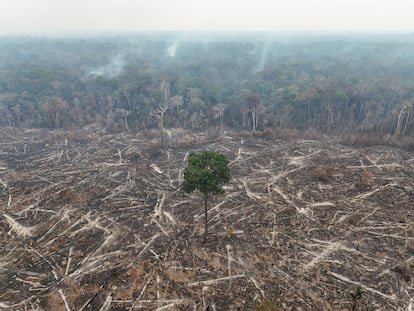
When nearly 159 million Brazilians go to the polls to elect a president on Sunday, they will also be deciding the fate of the world’s largest rainforest. The Amazon, a climate regulator and a key bulwark against global warming, with the largest freshwater reserves on Earth and natural riches still unknown in many cases, faces two completely opposite models for its future in this election. Yet the issue has been almost absent from the campaign.
During Luiz Inácio Lula da Silva’s four years in government, deforestation in the Amazon fell by 71%, reaching the lowest levels since 1988. Under Bolsonaro senior it rose by 60%. Now his son Flávio Bolsonaro promises a return to those policies: loosening laws so the environment is not an “obstacle” to landowners and economic development.
Marcio Astrini, coordinator of the Climate Observatory, which brings together more than 170 environmental and scientific organizations in Brazil, sums it up in one sentence: “Brazil will decide whether we continue on the path to end deforestation or to end the forest,” he tells this newspaper. Scientists have long warned that the Amazon is dangerously close to a tipping point. Degradation has reached such a level that much of it could permanently turn into a savanna with no capacity to regenerate.
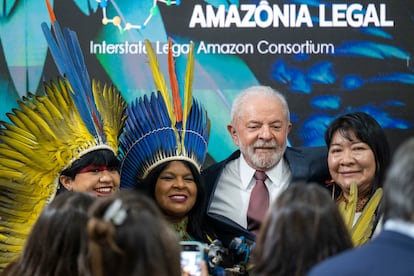
When Lula returned to government in 2023 he made environmental policy one of his flagship priorities. He appointed Marina Silva as minister of the Environment and Climate Change — Silva had already succeeded in reducing deforestation during her first term in the early 2000s. Serious plans to combat crime in the forest returned, as did fines and operations to expel illegal invaders from natural reserves and Indigenous territories, and incentives designed to make preserving the forest more profitable than cutting it down. Lula turned the defense of the forest and the climate into state policy and a diplomatic showcase, culminating with the COP30 summit on climate, held in Belém in the heart of the Amazon.
Bolsonaro junior, by contrast, promises to revive his father’s formula: dismantling environmental policies from within, allowing mining inside Indigenous lands, ending the requirement that landowners preserve part of native vegetation, and generally relaxing controls.
Astrini, like most environmental specialists and activists, warns that this time the far right’s attacks on environmental legislation could be more successful than during the patriarch’s years in office. Jair Bolsonaro’s eldest son Flávio, “a climate denier,” would, if elected, have an unprecedented majority in Congress, with enough strength even to secure a majority of sympathetic judges on the Supreme Court and amend the Constitution.
Although there are some very remote regions, the Amazon is far from the untouched sanctuary that still persists in the popular imagination outside Brazil. The Brazilian portion alone is larger than the entire EU, and more than 27 million people live there. For many, extensive ranching and farming — the two main drivers of deforestation — are the only means of subsistence.
At a recent campaign rally in the city of Marabá, in the state of Pará, Flávio Bolsonaro told residents what they wanted to hear: “You will be able to plant, raise cattle, do whatever you want on your land; what you exploit from the land is yours. We are going to end those environmental obstacles that exist, especially for ideological reasons,” he said. The crowd erupted in applause.
What for some is a reason to rejoice sends chills through others. Alessandra Korap, better known as Alessandra Munduruku for her ethnic group, is one of the Indigenous leaders on the front lines. She has received prestigious international awards, but that has not stopped her from facing threats on a daily basis.
She says the atmosphere has grown tenser with the possibility of a change of government: “The pressure increases when [Bolsonaro junior] says he will not demarcate any indigenous land. The aggressors feel emboldened. That rhetoric, which is the same as his father’s, empowers them. Between 2018 and 2022 we experienced terror here. My house was attacked twice; a relative’s house was burned down. We are very afraid under this political scenario, because of the power he could amass, since he would control the presidency and Congress,” she says.

Munduruku answers a phone call in the middle of a meeting about threats from mining companies. In the last legislative elections she ran for federal deputy with Lula’s Workers’ Party (PT), but did not get enough votes to take her fight to Brasília.
In any case, Brazil’s Indigenous people obtained an unprecedented share of power in the last legislature despite the fact that, unlike in some Andean countries, the native population in the giant South American nation is very small: less than 1% of the census.
Lula created a Ministry of Indigenous Peoples and appointed one of the movement’s leading activists, Sônia Guajajara, to lead it. For the first time, Indigenous people began to lead public policies for Indigenous communities. The country’s first Indigenous university is even being prepared to give due value to traditional knowledge.
For Brazil’s native peoples the main demand is, as Munduruku said, land demarcation; when the state recognizes a people as the owners of a territory, it means the land is fully protected. Lula has regularized around 20 territories, processes that are always delicate and surrounded by compensation, lawsuits and the expulsion of invaders. Bolsonaro has already warned he would halt all ongoing processes (there are 286), and as his father said in one of his most famous threats, he would not dedicate “one more centimeter” of land to Indigenous people.
Everything points to the next battlefield in these territories being the exploitation of rare earths, now in the sights of the United States because of the enormous reserves Brazil holds. But the risk of a potential Flávio Bolsonaro government is not limited to the Amazon or the Indigenous issue. All policies for emission mitigation or incentives for biofuels and renewable energy could be halted. As a senator, Bolsonaro was the only one to vote against the law on climate change adaptation. He also looks favorably on fracking, currently suspended in Brazil, and even backed a controversial proposal that could open the door to privatizing beaches. Until now, many of these ideas failed for lack of a majority in Congress, but that will cease to be a problem from 2027.
Sign up for our weekly newsletter to get more English-language news coverage from EL PAÍS USA Edition