The Amazon in flames: Brazil’s rainforest burns amid El Niño and election tensions
The rise in wildfires comes despite deforestation falling to its lowest level in nearly 40 years
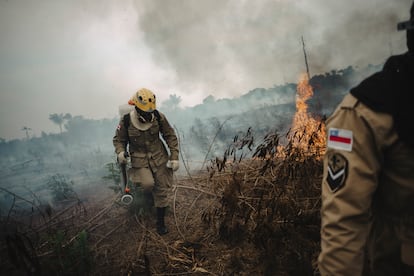
Concern for the future of the Brazilian Amazon is conspicuously absent from the frenzy of Brazil’s election campaign. But for the more than two million residents of Manaus, the large city embedded in the heart of the rainforest, it is impossible to ignore. The city has been shrouded in smoke for weeks.
During the first half of October, satellite imagery detected 9,045 fire hotspots across the Amazon, a 62% increase compared with the same period last year. The situation is particularly severe around Manaus, the capital of Amazonas state, where authorities have been forced to suspend classes and issue public health warnings.
“The air quality is completely unhealthy. You open the windows and can’t see the horizon. From my apartment I can normally see the Rio Negro, but now I can’t see the bridge and sometimes not even the river,” Carlos Barbosa, an audiovisual producer, tells EL PAÍS by phone.
Despite the Amazon’s legendary humidity, his apartment is filled with buckets of water to add moisture to air that has been dramatically dried out by the smoke. Meeting friends at a neighborhood bar or going for a run in the park is out of the question. Conditions worsen at night and only improve when it rains, which is rare at this time of the year.
Manaus has endured the world’s worst air quality for several weeks, but for residents the situation is not entirely new. It recurs every year around this time, although this October has been especially severe. On Saturday, Civil Defense sent a “severe alert” to residents’ cell phones urging them to stay indoors and, if they had to go out, to wear masks. Air quality was rated “very poor” at 14 of the city’s 15 monitoring stations. In nearby towns such as Autazes, hospitals and health centers have already reported a surge in patients with respiratory illnesses.
The government has deployed more than 300 wildfire brigades and 11 aircraft to assist firefighters and local authorities in containing the blazes. Biodiversity, Indigenous communities and, more broadly, those who live in the rainforest are obviously bearing the brunt of the fires, but the fire season has also produced some unexpected consequences.
At Barbosa’s production company, for example, staff have had to adjust their work schedule. Traditionally, they avoided filming during the rainy season because of the weather. Now, shooting during the dry season is often just as difficult because capturing a blue sky or the orange glow of a sunset has become nearly impossible.
Human activity is responsible for the gray-white haze that now seems to permanently blanket the sky. Ane Alencar, science director at the Amazon Environmental Research Institute (IPAM), says most of the fires are deliberately set. In many cases, forest is burned to clear land for cattle ranching. The situation is made even worse because the rainforest has become a tinderbox, exceptionally dry as a result of this year’s super El Niño.
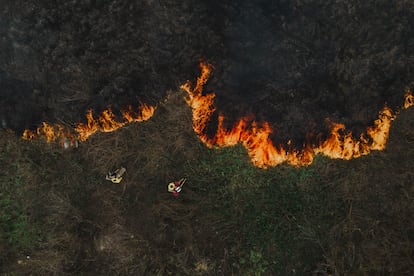
Alencar also warns that the surge in recent weeks may be linked to the electoral climate. September was the second month with the fewest fires on record, but everything changed after the first round of the presidential elections on October 4, when Brazilian President Luiz Inácio Lula da Silva lost to Flávio Bolsonaro, the son of former far-right president Jair Bolsonaro.
Alencar explains: “After the first round was won by a candidate who does not have a track record of supporting environmental causes, people may have felt that he is likely to win and that he tends to repeat what his father did, which was to dismantle the environmental governance framework. I think the prevailing mindset is that ‘we won’t be punished.’ That may have played a role.”
The government is also exploring that possibility and has tasked police forces and Brazil’s intelligence agency with investigating whether there is “something organized and coordinated” behind the fires, as Jair Schmitt, president of the Brazilian Institute of the Environment (Ibama), told the newspaper Folha de S.Paulo. It would not be the first time.
Electoral prospects and political disputes have long reverberated through the rainforest, though sometimes for different reasons. Four years ago, deforestation rates rose as landowners and speculators sensed that the permissive climate of the Bolsonaro years might be coming to an end and that Lula, who had promised a tougher crackdown on environmental crimes, could return to power. In 2019, rural landowners in the state of Pará even organized the so-called “Day of Fire” in support of the far-right president’s land-clearing policies.
That policy shift did arrive, was firmly implemented and has produced results. Deforestation rates have fallen year after year, and the most recent reporting period recorded the lowest level since 1988. Between August 2025 and July of this year, 1,295 square miles of the Amazon were deforested, a 42% decline from the previous period.
It is still an enormous figure, an area more than five times the size of Madrid, but it is far below the 4,478 square miles lost in 2022, the final year of the Bolsonaro administration. Over Lula’s current term, deforestation has fallen by nearly 72%, and his government has set a goal of achieving zero deforestation by 2030.
Although the Amazon has barely featured in the campaign, and environmental protection has never been a priority for the far right, Flávio Bolsonaro and his allies have used the thick smoke blanketing the region to criticize the federal government’s handling of the crisis. However, many Bolsonaro supporters in northern Brazil are among those eager to see environmental regulations loosened so that more rainforest can be converted into pastureland.
Sign up for our weekly newsletter to get more English-language news coverage from EL PAÍS USA Edition