Milan, a city torn apart by luxury and inequality
The riots in the Italian metropolis did not come from nowhere. After years of gentrification, the city is now home to one of the largest concentrations of millionaires even as it expels its longtime residents to the periphery

Milan is the city where singer Dua Lipa is considering moving to but also where many of the local residents are being forced to leave. It is among the places that host the most millionaires in the world, who move into new skyscrapers designed by prominent architects. They are drawn by the flat tax offered in Italy since 2017, a single payment of €300,000 (it convinced Cristiano Ronaldo to leave Real Madrid for Juventus in 2018). It is the so‑called Milan Model — a city of luxury, culture, fashion and investment banks, ideal for living, except that soaring housing prices have made living impossible: buying a home costs 57% more than a decade ago, and renting is 70% more expensive than in 2018, according to online real estate data.
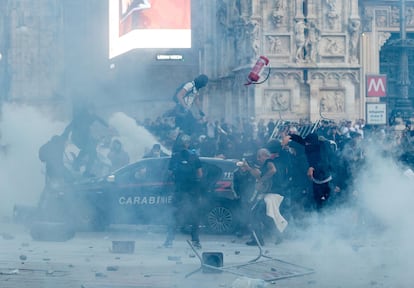
The ratio between wages and housing costs is now worse than London’s, according to the Financial Times. In Italy, wages have not moved in 25 years while they have risen 35% in the rest of the OECD; there is no statutory minimum wage, and inflation has been 27.1% over five years. This is the breeding ground for social unrest across Italy, but in the city of Milan life is even worse. It is an extreme example of the ills affecting other major European capitals and, moreover, it is not very large — 1.3 million inhabitants — so it has pushed its citizens out faster, expelled to the much uglier metropolitan area where 1.8 million people now live. The Devil Wears Prada 2 was filmed in Milan, but behind the set it is a city torn apart by inequality. The 2,000 youths who stormed the city center over the weekend did not come from nowhere. Or rather, they came exactly from nowhere — from that periphery that seems not to exist, excluded from the world of luxury. Over the weekend they smashed shop windows and stole branded sneakers. The youngest arrested was 11 years old.
“How do you pay €1,200 for sneakers if you earn €1,400 a month? I think stealing from multinationals is fine, not from individuals,” says Lello, 20, one of the individuals arrested in the riots. It is Monday and he has just been released, along with his brother and two other boys they met in the cell at the Fatebenefratelli street police station. Dressed in black, they refuse to speak to journalists until one of them says he works for Fabrizio Corona’s YouTube channel — a famous paparazzo who has ended up in prison and become a widely known figure. His channel is called Falsissimo. Then they agree to talk; to them he is a “big shot.”
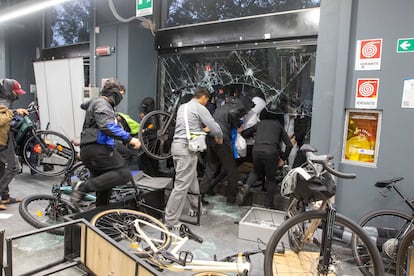
Like almost all the young people who descended on Milan that weekend, they came from the outskirts. They came from Rho, San Donato, and even Lecco, an hour away by train. The four, aged between 18 and 21, describe hard lives. They neither work nor study, they come from troubled families, they are unemployed or have precarious jobs. One has already been in juvenile detention. The two brothers say they recently spent two months without a home. Nobody has called their parents yet, who do not know what happened. They insist they did nothing wrong during the chaos on Sunday; they claim they were just there until they were taken away. At the station there were 27 youths in one cell: the four Italians, and 23 people of foreign origin. They know nothing about politics.
“We did it to make ourselves heard”
Why did they go to the Duomo on Sunday? They all saw on TikTok that something was happening, and they signed up for it: “Like in France, because here no one has had the guts to make themselves heard, we have to turn the situation around. For education, for jobs, for fuel, for taxes. We did it to make ourselves heard; if nothing changes it will get worse and worse, everyone onto the streets to riot! The new generation has guts, not like the previous ones,” says Alessandro. Two say they will do it again, one says he won’t because a night in a cell was too intense, and the fourth does not know.
Mario Calabresi, a journalist and writer who has just announced his candidacy for mayor of Milan, had expected something to happen, although not in such violent form. “In September I already said we had two cities. One bright like a shop window, and another that feels unseen, with less light. I said we had to heal that fracture, because otherwise someone would break that shop window. These kids feel that the city center is a store they cannot enter. We have to rebuild the community and the citizenship,” he says.
Another issue is also emerging: the assimilation of immigrant populations. When did politics start to forget about them? “It never really began to take care of them in the first place,” he says. He points out that this is the first time in Italy that a social explosion similar to France’s has occurred: “Immigration began arriving in the mid‑1990s. This is our first second generation — a new problem for us.”
For Calabresi, part of the explanation is Brexit in 2016: many entrepreneurs and executives who left London moved to Milan. Students too: he cites a figure — 10 years ago there were 150,000 in the city, and today there are 230,000 — another impact on the housing market, with many private universities and students with higher purchasing power. Then the tourists and short‑term rentals arrived.
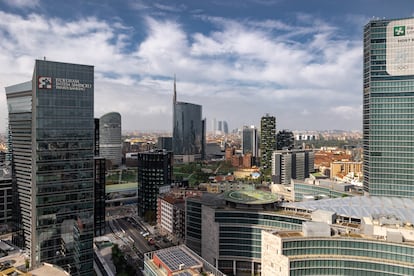
It is curious for a city that had always been considered gray and unattractive compared with Rome, Venice or Florence. But it is all the result of a large image operation that Lucia Tozzi, a researcher of urban policy, dismantled mercilessly in her 2023 essay The Invention of Milan. It was a book that broke the taboo of denying how wonderful the city was, “immersed in the self‑praise of its image success,” she says as she drinks coffee in her Isola neighborhood. The city has also gentrified because it sits at the foot of one of the symbols of the new Milan: the two Bosco Verticale towers, designed by the Boeri studio, in the new Porta Nuova area. But each of these symbols has driven up prices in the surrounding area and demolished old buildings. “A huge number of people have been pushed out of the city. First the poorest, then the middle class. In my son’s class I saw all his classmates leave, neighbors of a lifetime from the neighborhood. They have moved out of Milan,” she says.
The Milan courthouse announced 94 vacancies for judicial clerks and just said it filled only five, due to rent levels that cannot be covered on salaries of €1,500 to €1,600. The region also lacks between 2,500 and 3,000 nurses, and in the most recent recruitment drive for 600 general practice doctors, only 20 applied. The same is happening in other sectors, from teaching staff to drivers for Milan’s public transit system: 400 workers are needed.

For Tozzi it all began with the 2015 Expo. The exposition itself was not much, but it provided the excuse to attract a large flow of public investment. “Money that was taken from other cities and regions, and with the ideal arrangement for an Italian officeholder — special laws that meant you could bypass ordinary procedures. Milan became almost a tax haven. Many foreign investors arrived, starting with Qatar.” These lax rules led in 2025 to a major investigation, still ongoing, into urban planning irregularities concerning 14 large real estate operations. Projects have been halted and, together with the lack of new developable land, the model is starting to be under threat.
“They first replaced the buildings and then replaced the population; the touristification of Milan began,” Tozzi explains. The city has multiplied the number of tourists fivefold over the last six years. For her, the whole Milan model has been a big cultural con, using events, greenwashing, inclusivity and entertainment, all of which concealed “a concentration of wealth in few hands and a savage privatization of goods and services.” And it all took place under a center‑left administration. Beppe Sala, the mayor since 2016, was the Expo commissioner.
The social explosion, says Tozzi, was to be expected, although she thinks it is still too early to figure out what happened. Apart from the riots, she believes many Milanese have finally become aware that these years “have been a scam.” “The lack of a future affects everyone, not just the young. This is not a generational revolt, it is a class revolt. They have understood that if they are doing badly it is not due to a personal failure, but a situation that politics could resolve, although here there are not yet candidates like Berlin’s mayor, and I do not think we will see them,” she reasons. What saddens her most is that, systematically and in a few years, a city that was exemplary in the 1960s and 1970s for its public services and social housing has been destroyed.
The journalist and writer Michele Serra, one of the leading columnists at La Repubblica, recalls that as a child he lived next to Santa Maria delle Grazie, the basilica of Leonardo’s The Last Supper. “My father was a simple bank clerk and we rented our apartment. But today living there for a family is unthinkable. To live in Milan you have to earn at least €5,000 a month, otherwise you have to leave,” he says. He remembers that all those new skyscraper areas were vacant lots until the 1990s. He thinks everything then happened very fast. What interests him now is understanding what is in the minds of those kids who stormed the shops — whether they only wanted expensive sneakers or whether there is a real critique of the social model behind it.
“We were poor, but we dressed well”
The psychologist Roberta Milanese, a leading figure in Italy in brief strategic psychotherapy, believes that, contrary to popular belief, the attitude of these youths has little to do with anger: “To me it seemed they experienced it almost as a spectacle. These kids were, so to speak, invited by social networks to participate in an event, all dressed the same; in some interviews they said it felt like a flash mob or a video game. Then a group phenomenon was activated, a mechanism of belonging — a fundamental aspect for adolescents.” She thinks many of these youths are searching for an identity: “It means we have failed to create in them a sense of belonging to the community.” She believes these kids “felt like heroes for a day.”
Baby Gang, a 25‑year‑old Italian rapper of Moroccan descent from Lecco near Milan, was the most streamed Italian artist on Spotify in 2025, with 6.5 million streams. One of his famous lines goes: “Alcott, Zara, Bershka, we stole the clothes / With the anti‑theft devices left in the fitting rooms / It was a titkitaka of Africans and Maghrebis / We were all poor, but we dressed well.” The song is from 2021.
Sign up for our weekly newsletter to get more English-language news coverage from EL PAÍS USA Edition