
The founders of On, the phenomenon attracting Kylian Mbappé and Zendaya: ‘Cost is not a limiting factor; our followers are willing to pay’
The running shoe segment seemed completely saturated — until On arrived and upended certainties. EL PAÍS traveled to the brand’s headquarters in Zurich and spoke with its founders to analyze and explain the interest

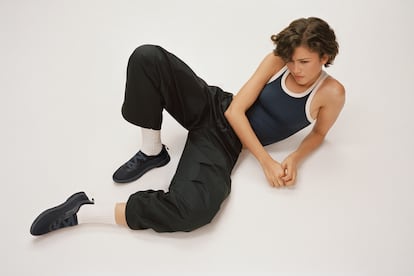
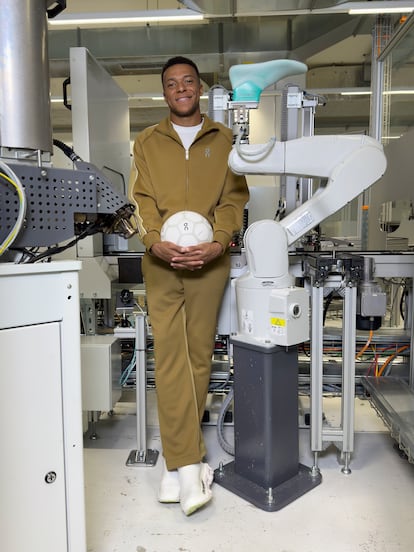
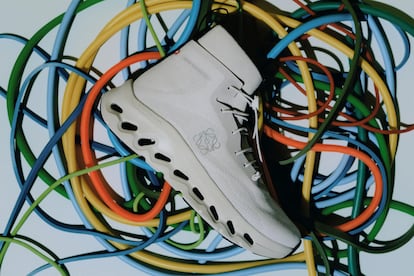
You may have recently come across some of these athletic shoes with unsettling holes in the sole. If you noticed them, you might already have seen a lot of them. It’s not just your imagination: in a few short years, designs from the brand On have spread across the globe. Outside the sports world the label was little known before the pandemic, but it has since become a cultural phenomenon that goes beyond the world of running. The company’s latest headline-making move came last week, when it announced a deal with Real Madrid forward Kylian Mbappé, who left Nike after 20 years of collaboration. On already works regularly with luxury house Loewe, superstar Zendaya, and former tennis world number one Roger Federer. The brand so appealed to Federer that he became one of its shareholders.
The income statements put numbers to this rapid growth: while the company had revenue of 267 million Swiss francs (about $325 million) in 2019, in just six years it had increased that figure 11-fold, generating 3,014 billion Swiss francs (about $3.67 billion) in 2025. In Spain, the craze is a recent phenomenon, according to the JD Sports retail chain: “In 2023, we began to notice an increase in interest among our customers, and it was in 2024 that sales growth became truly remarkable.”
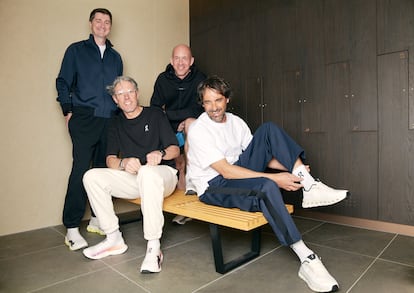
It all began with an offbeat idea, when Swiss athlete Olivier Bernhard came up with a prototype for a new sole by gluing pieces of hose together. He teamed up with two colleagues, Caspar Coppetti and David Allemann, and those experiments produced the first trainers, with their famous holes. On was founded in 2010: “At first the users were us,” Coppetti recalls; he and Allemann are also CEOs. “We started this company because we wanted a product we could use to run better.”
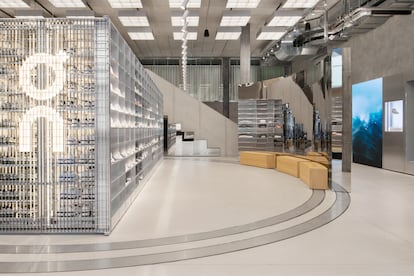
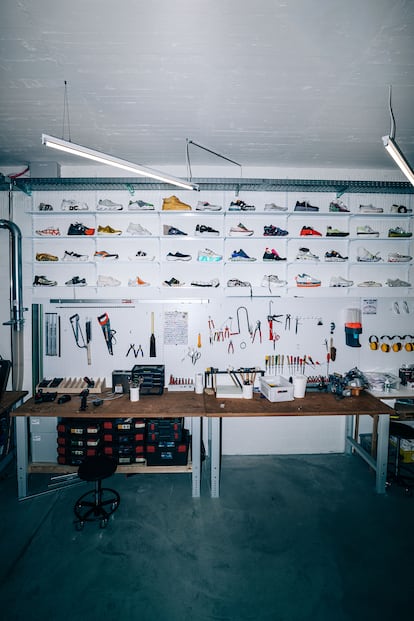
Some of those early models are displayed at the brand’s headquarters in Zurich, which this summer opened its doors to the press for the first time (El PAÍS was the only Spanish outlet invited). The main office building, 17 storeys high, is a visual metaphor for its evolution: the company moved into it only four years ago, occupying the lower floors, but have already expanded up to the 15th. They expect it will soon be too small. Like a university campus, nearby workshops house prototypes and testing zones where even the noise produced by the shoes is evaluated.
Partnerships with professionals go beyond traditional sponsorship with funding, Olivier Bernhard points out: “We also support them with a program that handles issues such as nutrition or sleep, and we help with matters like insurance or taxes. That removes a lot of daily stress. When I was a triathlete I didn’t have these things.” They develop a kind of symbiosis with athletes, because many of their technical advances have come from athletes’ requests. “When people think of innovation they tend to think of the final product,” says Jaime García Romo, head of product innovation for athletes, “but when runners come here they don’t ask for a shoe. They ask for a faster run, for legs that don’t get tired… so the process starts further back.” As he speaks, one of those athletes runs on a monitored treadmill hooked up to electrodes and devices that analyze everything from his speed to the oxygen he consumes, the rebound of his stride, and energy return.
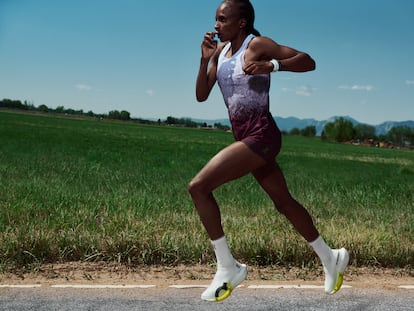
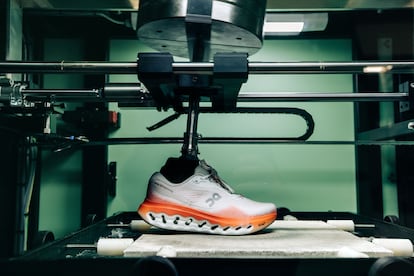
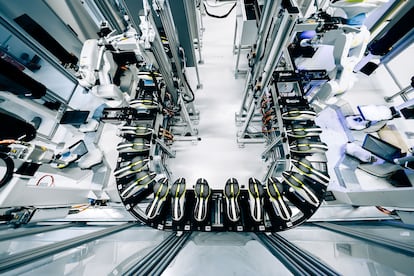
This is how they calculate how cushioned a sole should be (one that is too hard wouldn’t be comfortable; too soft and it would absorb too much energy), testing until they find the combination that best propels each stride. When they find something to improve, they commission the changes. If it’s the LightSpray model, they can manufacture a new variation on the floor below. This design, introduced at the Paris Olympic Games, is made from a single 1,500-meter strand that a robotic arm sprays directly onto the sole. It’s mesmerizing. In three minutes a new shoe is ready. Production of this model is currently split between a factory in South Korea and this Swiss laboratory. “It’s a lightweight structure, seamless and without superfluous material. It’s winning marathons and gold medals,” says Allemann. “We’re also reinventing production: we can install factories here or elsewhere; wherever demand arises we can meet it quickly and flexibly.”
LightSpray technology is only one of their assets; On holds countless patents (they registered 200 last year), but those advances alone do not explain the recent exponential growth. Their leap came alongside deep cultural shifts in society. “In recent years a new type of consumer has emerged: the generation of movement. We’ve moved from wanting to own goods to investing in experiences. That’s why sport now occupies a central place. Health and longevity are the new wealth,” Allemann analyzes. “It’s one of the last experiences we share as a community, whether in a group that goes for a run, plays tennis, or trains daily. Sports gear has shifted from functionality to identity; for many it’s not occasional, it has even become the way they dress. I think this offers an incredible opportunity to sports brands, especially young ones that understand the dynamic.”
While established competitors such as Nike or Adidas struggle to keep the general public’s interest without losing legitimacy among more technical consumers, On has managed to balance that equation. “For us it’s not about choosing between performance or fashion, but combining both while remembering we are an innovation company. Unlike our competitors we don’t have an archive to resurrect; we create everything from scratch and our inspiration is that active profile we were talking about,” explains Coppetti.
On products are not cheap, but that’s not a problem, Coppetti says: “Cost is not a limiting factor; our followers are willing to pay high prices for high-performance footwear, so we can invest in technology.” If in the 2010s aspirational consumption revolved around streetwear (Supreme, Off-White or Yeezy), another, subtler ideal prevailed after the pandemic that favored On’s rise, whose wavy soles are a recognizable trademark, though not universally. Because beyond the customer seeking maximum athletic performance, “On shoes began to gain popularity in Spain mainly among women in their 30s or 40s who were looking for shoes to go walking with friends or enjoy their free time. Gradually male customers also became interested, especially younger ones,” JD Sports reveals. “We have an obsession,” says Bernhard, “that every product be exceptional.” A mantra that translates into a corporate philosophy favoring a flat hierarchy in which any idea is taken into account. It remains to be seen whether they can keep that spirit with each new leap.
Sign up for our weekly newsletter to get more English-language news coverage from EL PAÍS USA Edition









































