
Which brand won the World Cup? Adidas moves ahead of Nike, but a coffee brand with Latin roots pulled off the big shock
With an estimated $5.2 billion at stake, Adidas reached the final on the shirts of Spain and Argentina and outpaced Nike on several commercial measures. Nevertheless, sales, public attention and purchase consideration pointed to other winners: a brewer and a coffee brand
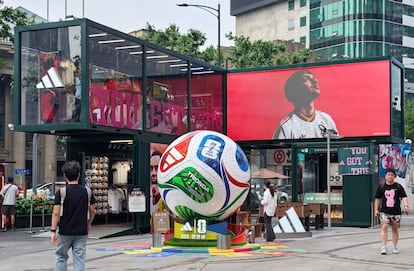
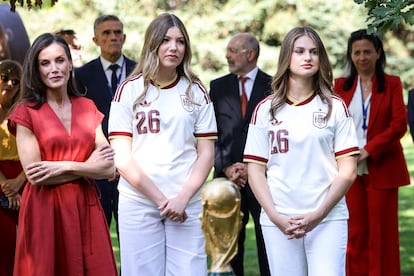
By the time Ferrán Torres scored the extra-time goal that gave Spain its second World Cup in New Jersey, Adidas had already won the final. The German brand, one of FIFA’s commercial partners, supplied La Roja (its white second kit has become ubiquitous this summer) and also Argentina (it outfitted 14 of the 48 participating teams), and created the tournament’s official ball. Its main rival, the U.S. company Nike, technical provider for 12 teams, launched a campaign that featured Kylian Mbappé, Cristiano Ronaldo, Erling Haaland, LeBron James and Kim Kardashian, but it was left without a team in the final match. On the pitch, then, Adidas prevailed last Sunday. Deciding which brand emerged victorious from the World Cup in sales, advertising, and awareness, however, requires looking at other measures.
The problem is that brands are contesting several “world cups” at once: the one for shirts sold, the one for conversation driven, and the one for purchase intent. There is also a tournament that is hard to quantify: memory — getting a logo linked to the image of the champion lifting the trophy. The commercial scale of the men’s World Cup gives an idea of how intense that rivalry is. Brand Finance, the U.K. consultancy that specializes in brand valuation, estimates that the name, reputation, and commercial power of the FIFA World Cup 2026 have had an economic value of $5.2 billion. That is not the governing body’s revenue nor a hypothetical sale price for the tournament, but the estimated present value of future economic benefits attributable to its brand.
Within that calculation it assigns $1.9 billion to sponsorship and $1.8 billion to broadcasting rights. WARC Media, which analyzes advertising investment, projected that the World Cup would lead companies to spend an additional $10.5 billion on advertising during the second quarter of 2026, 1.1% more than would have been spent without the tournament, after adjusting for inflation.
Nike takes the lead, Adidas stages comeback
Those figures help explain why brands invest so much in the World Cup, but not which company benefited most. To find an answer, LSEG (the group that owns the London Stock Exchange and provides global financial information and infrastructure) compared commercial demand, business prospects, and the public presence of Adidas and Nike, which embody the most visible rivalry in sportswear and sell comparable product categories. Its report The Retail World Cup: Adidas vs. Nike, dated June 22, offered an initial, awkward snapshot for Adidas. During the first two weeks of the tournament 28% of Nike’s World Cup Stock Keeping Units (SKUs) had sold out in the United States, versus 7% of its rival’s. The American firm also set an average price of $125 per garment, compared with Adidas’s $95, and accounted for around 80% of the mentions about both companies recorded since early June in the news and social media analyzed by LSEG MarketPsych Analytics.
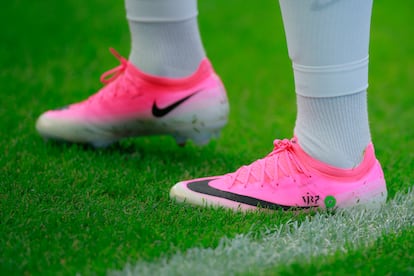
A product selling out can have two readings: strong demand, or inventories that were too tight and possible lost sales. “Without data on restocking it is not possible to determine how much each factor weighed,” Jharonne Martis, head of consumer research at LSEG, told EL PAÍS. Her later update, based on Centric Market Intelligence data (a platform that tracks prices, promotions and product availability in U.S. retailers), reversed the result: as of July 17, 32% of Adidas’s World Cup SKUs had sold out since June 1, versus 17% of Nike’s. At that time 15% of Adidas’s assortment was on discount, versus 25% of Nike’s. Among promoted items, the average discount was 35% at Adidas and 23% at Nike.
Financial forecasts also favored Adidas. For the quarters ending in June and September, the consensus of analysts compiled by LSEG expected Adidas to register an average revenue growth of 6.8% and an estimated earnings rise of 22.2%. For Nike they anticipated a 1.7% decline in revenue and a 6.1% drop in earnings in the quarter ending in August (both companies have different fiscal calendars). According to Martis, the World Cup did not create that gap but amplified an existing trend: Adidas entered the tournament with improving accounts and greater investor confidence; Nike faced weaker sales outlooks and was trying to win back lost market share.
More winners than trophies
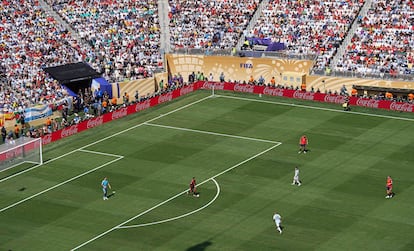
If the comparison is widened to all official sponsors, the podium shifts. Meltwater, a company that monitors media and social platforms, analyzed posts about those companies on TikTok, Instagram, and X between June 11 and the final. Adidas accounted for about 17% of mentions and ranked second in interactions (likes, comments, shares, and reposts), with 21.8%. In this metric AB InBev, the brewer that owns Budweiser and the light beer Michelob Ultra, led with 31.2%. That exposure was helped by FIFA’s recurring posts about the man-of-the-match award for each game, sponsored by Michelob Ultra.
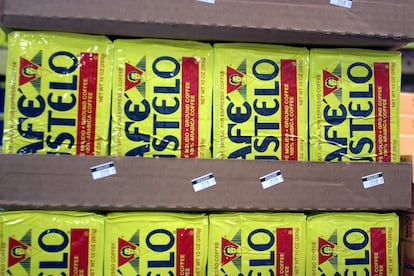
YouGov, the international market research firm, produces a more unexpected winner. Its BrandIndex tool compared — among U.S. adults interested in the World Cup — the 18 days before the tournament with the period from June 11 to June 28. The analysis tracked the evolution of three measures within an initial universe of more than 2,000 brands: ad recall, the balance of positive versus negative things respondents had heard about them, and purchase consideration. When calculating the result, it gave purchase consideration double the weight of each of the other two. Topping the list was Café Bustelo, a coffee brand with Latin roots. Its campaign consisted of limited-edition cans inspired by Argentina, Brazil, Colombia, and Mexico, each including a set of temporary face tattoos. Pepsi, despite not being the tournament’s official soft drink, was second; Gap Kids was fourth, and Coca-Cola fifth. Adidas finished 48th in the published selection. That is not contradictory: the ranking does not measure sales, size, or total notoriety, but how much those three variables improved during the tournament. A lesser-known brand, in principle, has more room to grow, although YouGov does not explicitly ascribe Adidas’s result to that effect.
Beyond the logo
Sponsorship status does not work miracles either. In February the market-research platform Cint found that 52% of U.S. respondents were unlikely or very unlikely to consider buying products or services advertised during World Cup broadcasts. Only 26% said a company’s sponsorship of the tournament would increase their likelihood of choosing it over a competitor. The attention these associations attract is not uniform across Europe either. Before the tournament YouGov asked people who intended to follow it whether they noticed companies linked to the World Cup. The percentage ranged from 29% in Great Britain to 58% in Switzerland. Spain was at 39%; Italy at 44%; and Germany and France at 45%.
How that presence is commercially leveraged also matters. A consumer study in France on Sony’s sponsorship of the 2010 World Cup in South Africa, published four years later in the International Journal of Research in Marketing, found that over the period analyzed both the perceived fit between the firm and the event and brand evaluation increased. Paying to place a logo buys visibility, but turning it into meaning requires more.
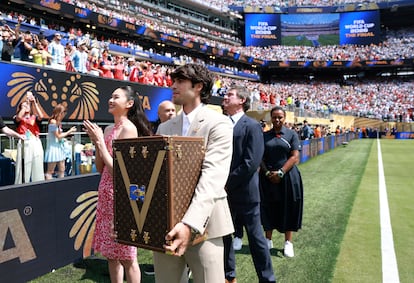
Luxury also tried to capitalize on the World Cup, although available sources do not offer a comparable ranking that would allow naming a winner. Loewe designed the Spanish team’s travel wardrobe; Burberry recreated the atmosphere of match day in A Good Sport, a campaign starring actors, models, and footballers; and Louis Vuitton produced, for the fifth consecutive edition, the official trunk used to transport and present the trophy. These incursions were visible, though scattered. Bia Bezamat, a cultural analysis specialist at Kantar (a market-research company), told Vogue Business that fashion’s role had seemed relatively muted for such a globally significant event.
So if the question forces you to pick a single brand, Adidas won. But it did not dominate every metric. AB InBev captured the largest share of interactions among official sponsors; Café Bustelo was the biggest mover in YouGov’s measures; and FIFA turned the tournament into a stage where sponsors and non-sponsor firms ran their own World Cup. The Cup, of course, was won by Spain. But everyone already knows that.
Sign up for our weekly newsletter to get more English-language news coverage from EL PAÍS USA Edition









































