
From a taqueria to a café: The California businesses linked to relatives of ‘El Mencho’
The brother and youngest daughter of the man who led the Jalisco New Generational Cartel opened business ventures in the cities of Hemet and Perris

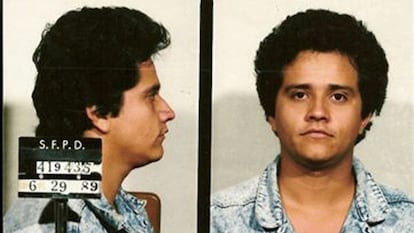
Luck turned against Marín Oseguera Cervantes in June 2013. Filing for bankruptcy in a California court, he said he had $117,000 in debt and only $38 in his pocket. Court records show that with his income as a granite countertop installer and the modest earnings of his wife, Azucena, who worked as a nanny, he could not keep up with the rent on their home, payments on 13 credit cards, installments on two vehicles, or three outstanding medical bills.
But three years later, in the summer of 2016, the picture had changed completely. He and his wife opened a taqueria on a busy avenue, a short distance from their new home, valued at more than $500,000. Life appeared to be smiling on the brother of Nemesio Oseguera Cervantes, known as “El Mencho,” founder of the Jalisco New Generation Cartel (CJNG), who by then, following the downfall of Joaquín “El Chapo” Guzmán, had become one of Mexico’s most dangerous and wealthy drug traffickers.
In neighboring Perris, years later, El Mencho’s youngest daughter, Laisha Michelle Oseguera González, also ventured into business. She opened a coffee shop with an unusual name, El Rincón La Chulis (La Chulis’ Corner), which ultimately became a front for her lavish lifestyle in the Inland Empire. She was often seen there with her partner, a CJNG leader, driving luxury vehicles and displaying expensive watches, designer clothing and handbags. The couple was supposed to keep a low profile, but they lived in a mansion. The U.S. Drug Enforcement Administration (DEA) was not supposed to discover that, virtually under its nose, the young woman was living with a top fugitive: Cristian Fernando Gutiérrez Ochoa, known as “El Guacho.”
Another relative of El Mencho, his stepson Juan Carlos Valencia González, also entered the region’s real estate market. In 2011, he purchased a ranch in Hemet for $250,000, unaware that California’s real estate boom would nearly triple its value over the following 15 years. Now, however, the government has begun proceedings to seize the property belonging to the cartel leader, known as both “El Pelón” and “El R-3,” who took over the criminal organization after the death of his stepfather in February during a military operation in Mexico.
Money linked to Nemesio Oseguera’s family continues to circulate through Riverside County, a desert region located about 53 miles east of Los Angeles, through businesses, properties and a lavish way of life that, in some cases, appears to outstrip any known source of income.
The cartel leader’s older brother, Marín Oseguera, and his daughter Laisha Michelle have never been criminally charged. Other relatives of El Mencho, however, have faced charges, and some are serving sentences in U.S. prisons for drug trafficking and money laundering. They include his brother Antonio Oseguera Cervantes, known as “Tony Montana”; his son Rubén Oseguera González, “El Menchito”; his brothers-in-law Abigail, Gerardo and José González Valencia, known collectively as “Los Cuinis”; and his son-in-law, “El Guacho.” His eldest daughter, Jessica Johanna, nicknamed “La Negra,” was released after serving a two-and-a-half-year prison sentence for managing a tequila company and restaurants in Mexico that had been sanctioned by the Treasury Department for allegedly moving illicit CJNG funds.
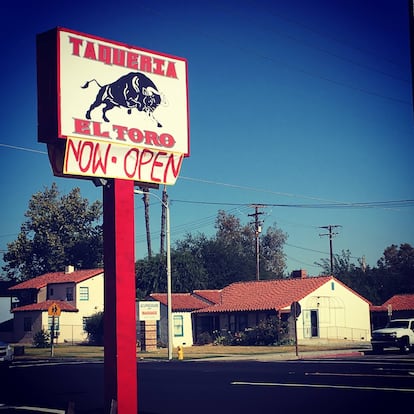
Taquería El Toro
A charging bull poised to lunge was the image Marín Oseguera Cervantes and his wife, Azucena, chose for their Mexican restaurant. The sign could be seen from blocks away along Florida Avenue, Hemet’s main thoroughfare. The couple registered the business as Taquería El Toro with Riverside County authorities in March 2016. The menu featured a long list of traditional dishes, including grilled chicken, quesadillas, tortas, menudo, birria, burritos and mulitas. Its specialty was steak and carnitas tacos prepared in the style of Michoacán, the owners’ home state.
For several years, the taqueria kept a low profile on Facebook. Most of the photos circulating on social media were posted by customers. The first image in which the restaurant was tagged did not appear until June 2017, after it had been operating for a year. A diner enthusiastically showed off three tacos covered in green salsa with the caption “Taco Tuesday.” There are only a handful of comments on the restaurant’s Facebook page. In one, a customer complained that after ordering a tripe burrito, he was served mostly rice and beans. In July 2019, the business marked its third anniversary. “Thank you to our customers for making this possible,” the restaurant posted.
Marín Oseguera and his wife were listed as the restaurant owners in 2016, although since 2022 the business has been registered under an entity called Jacoba Inc. The restaurant continues to operate under the same name, branding and bull logo. According to public records, its current permit is valid through December 2027.
The location of Taquería El Toro was convenient for Marín Oseguera and his family, who have lived for years in neighboring San Jacinto. Their two-story home has five bedrooms, four bathrooms and 3,100 square feet of living space. Built in 2005, it is equipped with multiple security cameras strategically placed around the property. Zillow valued the house at more than $547,000. The home of El Mencho’s brother sits in the heart of a quiet community surrounded by ranches and vacant lots, facing rugged, rocky hills.
Hemet lies off the region’s main transportation corridors. Reaching it requires leaving Interstate 10 or Interstate 215 and driving several more miles into the valley. The city attracted new residents after the 2009 housing crisis drove home prices sharply lower. But its isolation comes at a cost. For commuters working in the major employment centers of Los Angeles and Orange counties, the daily journey can become a long and grueling trek that, with traffic, may consume more than four hours a day on Southern California freeways.
Marín has spent much of his life in the Inland Empire, far from the bloodshed unleashed by his brother in Mexico. A few months ago, Azucena Oseguera told EL PAÍS that her husband had no ties to El Mencho and stressed that he made an honest living in California. “He is completely separate from what his brother does,” she said.
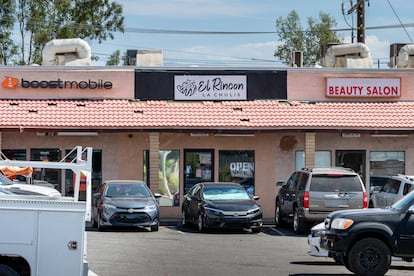
El Rincón La Chulis
Laisha Michelle Oseguera González was last seen in public six months ago, during her father’s funeral in Jalisco. The woman, about 24 years old, was photographed by news media outside a funeral home. By then, she had stepped back briefly from her role as the owner of El Rincón La Chulis, a café that gained unusual attention on social media after it was revealed that she was the true owner. But she has become almost a ghost at the business. “She never comes here, to be honest,” an employee told EL PAÍS during a recent visit.
The café is located in a little-frequented shopping plaza in Perris, flanked by a seafood restaurant, a taqueria and a barbershop called Mi Familia. Inside, there is room for only two small tables. Most of the space is taken up by an open kitchen, a service counter and a display refrigerator. Laisha Michelle registered the business in early 2023, and its operating permit is valid through February 2028. In addition to a variety of coffees and teas, the café serves tortas, sandwiches, crepes, croissants, and yogurt with fruit and granola. Motivational messages, handwritten in marker, are often scrawled on customers’ cups. “It’s not what you lack that hurts you, but the belief that you need it,” read one. “A goal without a plan is just a wish,” said another.
Years before becoming a business owner, when she was 19 and in her third semester studying business administration at a university, Laisha Michelle wrote a letter asking for leniency from the federal judge preparing to sentence her older sister, Jessica Johanna, for violating the so-called Kingpin Act, which targets individuals and businesses linked to drug trafficking leaders. “Jessica is like my second mother because she has always been there for me and supported me unconditionally,” she wrote in the letter, dated April 22, 2021. Two months later, her sister was sentenced to 30 months in prison.
The opening of the café in Perris coincided with the arrival in California of her partner, Cristian Fernando Gutiérrez Ochoa, who settled there with her under a false identity: Luis Miguel Martínez. El Guacho was pretending to be dead in an effort to stop the DEA from searching for him. According to the indictment, his future father-in-law had spread the false rumor that he had ordered him killed for lying to him. The couple moved into a luxury home in Riverside purchased by Pasión Azul Tequila, a company that U.S. authorities say is linked to the CJNG. Prosecutors say the arrangement was part of a strategy to hide who really lived in the house.
In November 2024, federal agents arrested Gutiérrez Ochoa and searched the residence. Inside, they found $2.2 million in cash and extensive evidence of the lavish lifestyle enjoyed by El Mencho’s daughter and son-in-law. The property contained a late-model BMW M4, a 2022 GMC Yukon Denali and a 2019 Mini Countryman. Rooms and common areas were decorated with valuable artwork and sculptures. In the bedrooms, investigators found two firearms, jewelry, luxury watches, designer shoes and handbags, as well as an expensive blanket from Hermès. Authorities seized the items. El Guacho later pleaded guilty to one count of international money laundering and was sentenced in December to more than 11 years in prison.
Sign up for our weekly newsletter to get more English-language news coverage from EL PAÍS USA Edition









































