
US Treasury and Mexican authorities deliver their biggest blow yet to the Jalisco cartel, including El Mencho’s stepson
Juan Carlos González heads a list of more than 50 members of the criminal organization and companies accused of financing it who have been sanctioned
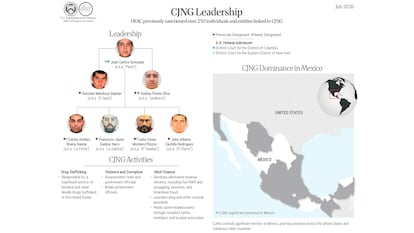

The U.S. Treasury Department, in coordination with Mexico’s Finance Ministry, announced on Thursday what it described as the biggest blow ever dealt to the Jalisco New Generation Cartel (CJNG). Financial authorities in both countries unveiled a package of sanctions targeting 55 entities and individuals linked to Mexico’s largest criminal organization, including 39 individuals and 16 companies. Among those sanctioned is Juan Carlos González (also identified as Juan Carlos Valencia González), the stepson of the cartel’s late leader, Nemesio Oseguera Cervantes, better known as “El Mencho.”
Mexico’s Financial Intelligence Unit (UIF) has filed a criminal complaint with the Attorney General’s Office (FGR) for alleged money laundering and placed those identified on its Blocked Persons List, while the U.S. Treasury has frozen the assets and property of those included in the sanctions package.
The individuals named by both authorities are part of a money-laundering network headed by Audias Flores Silva, known as “El Jardinero,” together with Gonzalo Mendoza Gaytán, alias “El Sapo,” and Julio Alberto Castillo Rodríguez, alias “El Tarjetas.” According to the Treasury Department, although Flores Silva was arrested last April, his network of “gardeners” continues to operate, laundering cartel proceeds in the states of Jalisco, Nayarit, Michoacán, Guerrero and Zacatecas.
“He has amassed a vast network of subordinates including complicit family members, plaza bosses, and financial and logistical associates in various territories,” the Treasury said in a statement.
With part of the CJNG leadership weakened following the death of El Mencho in a police operation and the arrests of key lieutenants such as El Jardinero, the criminal organization has reorganized and installed new figures in positions of command. Among them is César Alejandro Villaseñor Olivares, known as “El Güero Contra,” who is in charge of concealing “Jardinero’s interest in assets initially obtained with illicit proceeds” through a laundering network made up of companies, business associates and family members. Although El Güero Contra was also arrested last April, the cartel’s corporate machinery that he allegedly oversaw remains operational.
Among the companies sanctioned for their alleged role in the network is Petrocoda S.A., a gas station operator run by El Jardinero’s cousin, Areli Isis Medina Flores, together with Gabriel Serrano Magaña. Other relatives of Flores Silva who allegedly managed businesses used for money laundering include his wife, Karely Lizbeth Ramírez Banales, owner of a liquor store called El Almacén Licorería. She and her husband’s cousin also co-own the clothing wholesaler Stella Servicios Comerciales y Empresariales.
Other companies allegedly used by the cartel include the agave and spirits producer Casa Tequilera El Origen del Tequila; the construction firm Hurrari Kash S.A. Promotora de Inversión de C.V.; the agricultural producer Agropecuaria Amateq del Valle S.A. de C.V.; and even a furniture manufacturer, Productores Vagu S.A. de C.V. The first three were headed by Roberto Jiménez Arias, whom the Treasury Department identifies as a CJNG member. His wife, Martha Alicia Alvarado Rodríguez, allegedly assisted him in running the agricultural business.
Another alleged cartel operative, José Jesús Gutiérrez Valdez, divided his time between overseeing several methamphetamine laboratories in Zacatecas and managing the furniture company. Other individuals named by authorities include Joana Domínguez Aguilera, Efraín Corona Pimentel, Ángel Gabriel López Larios and Fidel Damián Moreno López.
The Treasury Department also identifies José Octaviano García Martínez as the CJNG’s regional boss in Florencia, Zacatecas. According to U.S. authorities, García Martínez, assisted by Cuauhtémoc Rivera Zepeda and Uriel Hernández Morales, produces “large quantities of fentanyl, cocaine, and methamphetamine in clandestine laboratories in Jalisco and Zacatecas” and operates extensive distribution networks that transport narcotics to cities across the United States.
Another figure allegedly overseeing a network of businesses serving the CJNG is Gerardo Botello Rodríguez, alias “El Cachas,” described by authorities as a high-ranking member of the organization. He was arrested in 2018 while serving as a bodyguard to El Mencho’s wife. Despite being imprisoned twice, authorities say he continued to direct a conglomerate of companies alongside his nephews, Gustavo Botello Rodríguez and William Geovanni Botello Rodríguez, as part of a scheme to launder drug-trafficking proceeds.
Among those businesses is Bubux Baby Shoes S.A., a children’s footwear company managed by his cousin, Miguel Ángel Ayala Botello, who also served as public security director for Tepalcatepec, Michoacán. Botello’s two nephews later became municipal police officers in the same municipality, with his backing.
Cachas’s most recent wife, Liliana Cisneros Tapia, and his sons — Jesús David Botello Ortiz, Edgar Gerardo Botello Ortiz and Ricardo Botello Ortiz — were also sanctioned by the Treasury Department. Investigators place them in management roles at several other companies allegedly linked to the laundering scheme, including Green Agropacific S.P.R. de R.L. de C.V., an agricultural producer in Nayarit; Corporativo de Seguridad Privada Alfa y Gama S.A. de C.V., a private security company authorized to carry firearms and operating in Michoacán and Jalisco; and the tequila and agave producer Rancho San Miguel Los Tres Hermanos S.P.R. de R.L. de C.V.
Sign up for our weekly newsletter to get more English-language news coverage from EL PAÍS USA Edition









































