
Argentine court orders return of Nazi-looted painting to victim’s family
The artwork was stolen from a Jewish collector in the Netherlands and was discovered last year in Mar del Plata, hanging in the home of Friedrich Kadgien’s daughter
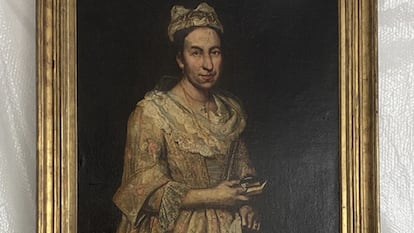

After almost 90 years, a painting stolen by the Nazis in the Netherlands will be returned to the heirs of the victims. Argentine courts ordered the restitution of the Portrait of a Lady to the family of Jewish gallery owner Jacques Goudstikker (1897–1940). The work, painted in the 18th century by Italian artist Giacomo Ceruti (1698–1767), had been missing since World War II and was found last year in the city of Mar del Plata, about 250 miles from Buenos Aires. It hung in the home of one of the daughters of Friedrich Kadgien, who was known as the Nazi regime’s “finance wizard.” Kadgien, a prominent associate of war criminal Hermann Göring, later moved to South America, where he lived out his life without ever facing justice.
In the case heard by the federal courts in Mar del Plata, Patricia Kadgien and her husband, Juan Carlos Cortegoso, were charged with possessing and concealing artwork stolen in the context of a genocide. After initially claiming to be the lawful owners of an inherited painting, the couple ultimately accepted an agreement reached between prosecutors and their defense attorneys to avoid a trial. As part of the deal, they irrevocably waived any rights or claims to the artwork.
The painting will now be returned to Marei von Saher, Goudstikker’s daughter-in-law, who, together with her daughters Charlene and Chantal von Saher, has devoted years to tracking down and recovering works looted by the Nazis. Through her lawyers, Von Saher, the heir of the art dealer who died in 1940 while fleeing the Nazis, said she would not accept “86 years of plunder,” but added that she was seeking neither revenge nor compensation, only the return of the painting that once belonged to her father-in-law.
According to her legal representatives, the family’s intention is for Portrait of a Lady to be exhibited on loan at a museum in Buenos Aires before it is returned, in order to raise awareness of the Nazi regime’s systematic looting of artwork. For now, the painting remains in the custody of Argentina’s Supreme Court in Buenos Aires.
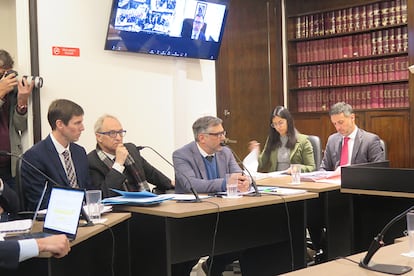
The painting’s return was finalized on Friday during a hearing presided over by Federal Judge Santiago Inchausti, with representatives of the Attorney General’s Office, Von Saher’s legal team, the defendants and their attorneys in attendance. During the proceedings, prosecutor Carlos Martínez said the resolution amounted to “a form of historical reparation for the victims.” As part of the agreement, the defendants must donate 4.8 million pesos (about $3,200), which will go to a charitable foundation supporting a maternal and children’s hospital in the district.
The discovery of the painting
Portrait of a Lady is an oil-on-canvas measuring 119.5 centimeters high by 89 centimeters wide. Its trail had gone cold in Amsterdam after Adolf Hitler’s regime looted the art gallery of Jacques Goudstikker, whose collection contained more than 1,100 works. In Goudstikker’s records, the painting was attributed to Giuseppe Ghislandi (1655-1743), but an expert examination carried out by Argentina’s National Academy of Fine Arts confirmed what several specialists had suspected over the years: the work was actually painted by Giacomo Ceruti, known as Il Pitocchetto. The painting is now estimated to be worth around €250,000 ($290,000).
The artwork’s rediscovery was the result of a chance development during a journalistic investigation into Nazi official Friedrich Gustav Kadgien (1907-1978). In August 2025, as part of coverage marking the 80th anniversary of the end of World War II, the Dutch newspaper Algemeen Dagblad sent correspondent Peter Schouten to Mar del Plata to try to contact Kadgien’s daughters.
Schouten was unable to reach anyone at the house, but he noticed a for-sale sign outside the property. Later, while browsing the real estate firm’s website, he found the listing. Among the photographs showing the interior of the home, he spotted the long-lost painting hanging prominently in the living room. Kadgien’s daughter and her husband were detained for 72 hours before surrendering the artwork to authorities.
“He is a snake of the lowest sort,” a U.S. intelligence report from 1945 said of Kadgien. A member of the SS, Kadgien had served as a financial expert for the Nazi regime since 1938. He played a key role in foreign-currency operations and in the plunder of territories occupied by Germany during the war. One of his responsibilities was extorting Jewish merchants in Amsterdam to help finance the Nazi war machine. After the Allied victory, he fled first to Switzerland, then to Brazil and ultimately, like many other war criminals, to Argentina, where he reinvented himself as a businessman.
Contemporary intelligence reports indicate that Kadgien escaped with diamonds and numerous works of art. For at least one of those works — the portrait of an Italian countess named Colleoni — something resembling justice has finally been served.
Sign up for our weekly newsletter to get more English-language news coverage from EL PAÍS USA Edition









































