
Science, pigs and money: the race between the US and China to make animal-to-human transplants viable
Techniques such as the gene-editing tool CRISPR already make survivals approaching a year possible, something unheard of until recently

A year ago, an open microphone during a conversation between Xi Jinping and Vladimir Putin illustrated modern humans’ faith in science and technology and the idea that we are machines made of flesh. “Biotechnology is continuously developing. Human organs can be transplanted continuously. The longer you live, the younger you become, and you can even achieve immortality,” the Russian president said. Xi was more cautious, but did not spare optimism: “Today you are a child at 70. Predictions indicate that this century it may be possible to live to 150 years.”
Transplants are among the most fascinating achievements of modern medicine, the result of a mix of scientific talent, boldness and generosity that reflect the best of humanity. In Spain, more than 6,000 people get a new chance at life each year thanks to organs donated by 2,500 people at death. But that medical intervention has little to do with replacing a dishwasher part.
Organs come from donors. You cannot mass-produce thousands of identical livers and kidneys on an assembly line, and fewer than 1% of people who die each year do so in conditions that allow them to donate organs. And when someone receives another person’s organ, their immune system tries to destroy it. A transplant recipient needs lifelong drugs that keep them immunosuppressed, making them more vulnerable to infections or cancer. With a new liver, Putin would not function exactly the same, but he would be better than before the operation—more like a car that’s had its oil filter changed.
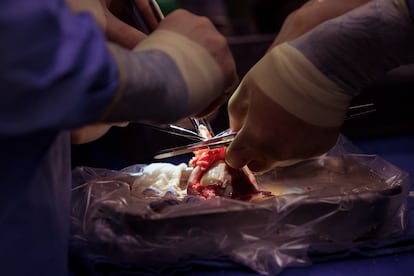
For decades, animals have been considered a solution to donor shortages, but the reaction when inserting an organ from another species into a human is even worse than with human-to-human transplants. These xenotransplants began to be attempted in 1906, when French surgeon Mathieu Jaboulay unsuccessfully implanted a pig kidney into the elbow of a 48-year-old woman; attempts with various organs and animals—from primates to pigs—followed, and in most cases survival was short-lived.
The immunological differences between animals and humans, forged over the millions of years since our evolutionary paths split, seemed an insurmountable barrier even after the arrival of immunosuppressive drugs that revolutionized human-to-human transplantation in the 1980s. Until 2012, that is. That year, the gene-editing technique CRISPR opened up a new era. Since then it has been much easier to tweak DNA to eliminate the rejection caused when a pig organ contacts human blood or to modulate the immune response. In 2022, David Bennett became the first person to receive a genetically modified pig heart and survive for two months.
The race to create genetically modified pigs as an almost unlimited source of organs has two main competitors: the U.S. and China. If they manage to overcome current obstacles, the technology’s impact would be enormous. According to the WHO, just over 150,000 transplants are performed worldwide each year, but that covers only 10% of global need. It would also become a multimillion-dollar business.
Last Thursday the medical journal The Lancet published details about the case of Tim Andrews, the current record holder for survival after a xenotransplant. His kidneys had failed because of diabetes and he survived for two years thanks to dialysis sessions that cleaned his blood several times a week. For cases like his, transplant is the best solution, but Andrews was a complicated patient: his blood type was O, the hardest to match, and he had less than a 10% chance of receiving a human kidney within five years.
As part of a trial approved by the FDA, a team led by Leonardo Riella of Massachusetts General Hospital in Boston implanted a kidney from a genetically modified pig designed to limit rejection and the risk of porcine virus transmission. Although an initial rejection was managed with drugs, Andrews was able to live without dialysis until nine months later, when another rejection rendered the kidney useless. Fortunately, soon after that the patient received a compatible human organ that has kept him alive to date.
Two U.S. companies stand out as leaders in the field: eGenesis and Revivicor (part of United Therapeutics). eGenesis provided Andrews’ kidney and kidneys for three other patients who kept renal function for eight months. The FDA has already authorized a trial involving 33 patients that would start early next year. Revivicor has begun a trial with six patients with the potential to expand it to 50 for its kidneys, and it has approval for another trial for the first pig-to-human heart transplant.
A competition between countries
In China, ClonOrgan has also managed to surpass 200 days of survival with one of its kidneys, and a hospital at Anhui Medical University performed the first pig liver transplant into a living person, who died four months later, among other achievements by the Asian country.
Beatriz Domínguez-Gil, director of Spain’s National Transplant Organization, warns that all these “are individual cases authorized for compassionate use or in the context of clinical trials with very few cases and many questions about what durability will be.” “There is much to refine in terms of how the organ is genetically manipulated or the type of immunosuppression that should be used, but cases like Tim Andrews’ confirm that, even though we remain in experimental territory, there really is a future for xenotransplantation,” she adds.
In a recent review of the field’s current status, Alan Kirk, director of the Department of Surgery at Duke Health in the U.S., says that “what was once considered science fiction is gradually becoming a clinical reality.” In his view, with the months-long survivals achieved so far, animals can be organ sources for cases with few options, like Andrews’, serving as a bridge until a human donor appears. He specifically cites acute liver failure, where an organ that buys a few extra days can be lifesaving.
On cases like these, Pablo Ramírez, head of General and Transplant Surgery at the Virgen de la Arrixaca University Clinical Hospital in Murcia, Spain explains that his team has achieved “periods of survival longer than a week in non-human primates, which could be enough to cover the critical time until a human donor organ becomes available.” “This life-saving window could be the most realistic and immediate clinical application of xenotransplantation, serving as a bridge to a human transplant,” adds Ramírez, a member of the Council of Europe’s Expert Committee on Xenotransplantation.
For now, the race to make xenotransplant outcomes more like those with human donors is centered in the U.S. and China. In Europe, a team led by Eckhard Wolf at Ludwig Maximilian University of Munich has launched XTrasplant, a company already developing genetically modified pigs and planning to start human studies in 2027. However, the volume of venture capital flowing to biotech companies in the U.S., or the backing of Chinese state platforms, makes it difficult for academic consortia in Europe to compete.
Moreover, Domínguez-Gil explains, “there has been some delay in defining the regulatory aspects of xenotransplant development in the European Union.” “The EMA’s Committee for Advanced Therapies in 2025 classified xenotransplantation—specifically hearts—as an advanced therapy medicinal product. But advanced therapy medicines regulation definitely does not cover all the aspects needed for xenotransplant development,” she explains. “A greater regulatory effort and coordination in Europe will probably be required to move forward,” she concludes.
While efforts continue to make pig organs viable for more patients and not only the most desperate, concerns exist about how this field is developing. Ramírez worries that, if it follows the U.S. model, “only the wealthy will have access to those organs, even in wealthier countries.” In his view, “the future of xenotransplant research should not be dominated solely by profit-driven pharmaceutical corporations.” “Research on xenotransplanting genetically modified pigs to humans should be carried out in university hospitals using pigs raised in academic settings,” he adds.
Ramírez also advocates for a public model for xenotransplants similar to the one that has made Spain a global benchmark in this field. “In the future, the production of transgenic pigs for human transplants should be managed on government-regulated farms under a consortium with health ministries, to prevent unchecked commercial exploitation,” he asserts.
The development of clinical trials will begin to provide more precise information on which genes are most useful to manipulate or how to modulate the immune response so the patient remains more or less healthy without harming the organ. After many years of unfulfilled promises, it appears pigs may become an organ source that starts to offer options to those who lack them. But those who work in transplantation know we are not on the verge of a world where old organs can simply be swapped for new ones to achieve eternal life. Humans are not machines.
Sign up for our weekly newsletter to get more English-language news coverage from EL PAÍS USA Edition









































