
From the Treasure of Villena to the French Crown Jewels: The lucrative business of stealing pieces of history
The spectacular rise in the price of gold over the past nine years has triggered a wave of increasingly violent heists at European museums, which are struggling to protect themselves
Museum robberies are an old business. And, since 2023, the rise in the price of gold has revitalized it.
Over the past nine years, the value of an ounce of gold has increased fivefold. As a result, the European museums with gold artifacts are trembling, and currently reinforcing all their security measures. The European Union Agency for Law Enforcement Cooperation (Europol) has warned these institutions about the violent gangs that carry out these robberies; these groups don’t hesitate to use explosives.
The museums in the cities of Villena, Badajoz and Albacete have been the three Spanish victims over the last four months. All of them have lost priceless and irreplaceable collections made with gold from antiquity.
On April 4, 1921, a votive crown that once belonged to King Suintila, of the Visigoths – was stolen from the Royal Palace of Madrid. The police never found the culprits. The crown was part of the so-called Treasure of Guarrazar. This collection of crowns and crosses, all made of gold and precious stones, had belonged to the Visigothic kings, who ruled the Iberian Peninsula from the 5th to the 8th centuries. Many of these pieces were later sold to silversmiths in the city of Toledo and melted down. Those that were recovered are now on display at the National Archaeological Museum of Spain and the Cluny Museum in Paris.
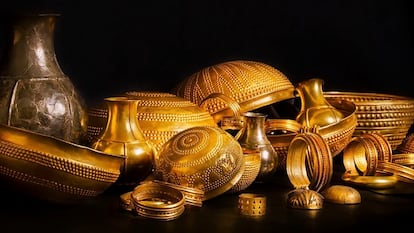
A century later, these events are being repeated, but in different settings. Thieves have stolen gold pieces of immense heritage value — which are practically unsellable, even on the black market — from the aforementioned museums in Badajoz, Villena and Albacete. According to several police sources, as well as experts from museums and the archaeological sector, the extremely high value of an ounce of gold is what’s motivating the criminals. The Villena Treasure, a trove of 3,000-year old burial artifacts, weighs 22 pounds, worth approximately $1.4 million once melted down.
The Villena theft occurred in the same week that Europol warned in a report of the gangs’ new tactics – employing more violent methods – as well as new targets: gold artifacts. Jean-Yves Goriou, head of the EU Organised Crime Unit, part of Europol’s European Organised and Serious Crime Center (ESOCC), explains to EL PAÍS that there’s been “a clear and pronounced increase in the number of museum heists reported by national authorities to Europol.”
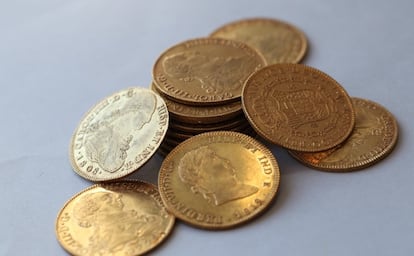
On July 27, the Albacete Provincial Museum was burglarized, with thieves making off with 220 gold coins from the 19th century. Police stated that the perpetrators were four masked individuals who, at midnight, entered through a window and raided the Archaeology Room, where two coin collections belonging to Spain’s Ministry of Culture were being kept. These collections consisted of 42 pieces from the reigns of Charles III, Charles IV and Isabella II. The getaway car was found, torched, just a few hours later.
In the case of the Provincial Archaeological Museum of Badajoz, a criminal gang stole 149 coins that comprised the so-called Villanueva Treasure, a collection of coins discovered in the city of Villanueva de la Serena back in 1987. The robbery occurred on April 25, also in the early hours of the morning. The thieves entered through a back door, forced open a security grille and smashed the display case. Police arrived as soon as the alarm was triggered. As in the cases of Villena and Badajoz, nothing remained.
The incident in Villena “is another example of this trend,” Goriou notes. He understands the difficulties faced by art galleries and exhibition centers. “Museums are probably doing everything they can, given budget constraints and the fact that, by definition, they’re open to the public. For some, simply existing is a victory. Finding the right balance between protecting cultural heritage and providing public access is quite a challenge,” the police officer acknowledges.
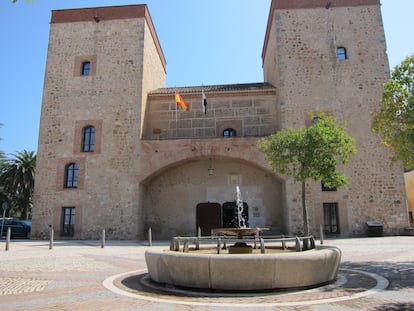
And what measures had the Villena Museum taken to secure one of the jewels of Spanish archaeology? The treasure, consisting of 59 gold objects, including 27 bracelets and 11 bowls from the Bronze Age (between 2200 and 750 BC), was displayed behind a 10-foot-high glass case. Both the front and sides were constructed with high-security glass. Specifically, two-layer laminated tempered glass, 10mm thick per layer, bonded by a polyvinyl butyral (PVB) interlayer, that’s “certified against manual attacks.” This is according to the security report that was commissioned by the Villena City Council before deciding to display the treasure in the new local museum, which opened in 2024. Before that, the collection was kept in a secure vault owned by the Spanish security forces. Access to it was only granted on rare occasions.
The back wall of the display case was lined with armored metal sheeting, but the thieves attacked from the front. The ceiling was lined with two-centimeter-thick double metal sheeting. Access to the room is through a reinforced door, with five locking points.
Furthermore, the treasure was protected by an extensive alarm system, with five distinct systems or layered rings of protection, both outside and inside the building, as well as in the vicinity of the precious pieces. The museum also has night-vision cameras. Shortly before it opened two years ago, the City Council undertook two security audits, which established new measures and improvements in certain areas. All of these were adopted and implemented by the municipality. On August 3 of this year, the systems were reviewed and tested again.
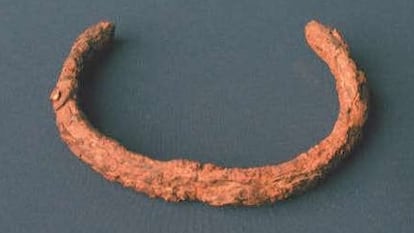
However, just 24 days later — and in under four minutes — the thieves entered through a side window of the building. It was 5:20 a.m. At 5:24 a.m., the local police and the Civil Guard arrived on the scene, but nothing remained. Only five or six pieces lay scattered on the ground, discarded by the thieves due to their low monetary value, as they were made of silver or iron. However, one of them — a simple iron bracelet — is considered to be the most valuable piece of the collection: it was forged from meteorite ore, at a time when the inhabitants of the Iberian Peninsula were unfamiliar with this material.
But for the gangs, it’s “relatively easy” to conduct reconnaissance before a robbery: “Simply by buying a ticket for a few euros, they can access the museum and observe the windows, exit doors, cameras, display cases and the security measures that are in place,” the Europol expert sighs.
Colonel Francisco Poyato, head of the Spanish Civil Guard Command in the province of Alicante, adds that, regarding the robbery, “there are still no conclusions” and “several hypotheses have been considered.” Including, as Europol states, the possibility it was planned by a specialized gang. In fact, the Villena Museum’s security system reached level three out of the four possible levels, according to European standards (EN 50131-1). Level four, the highest, is reserved for military, nuclear, explosives, or critical infrastructure installations.
And the transfer of the Villena Treasure from the vault where it was stored to the museum was carried out with the express authorization of the Directorate General for Cultural Heritage and Fine Arts, within Spain’s Ministry of Culture.
This past July, faced with an increase in museum thefts, the Ministry of Culture conveyed its concern to the National Police’s Historical Heritage Brigade and requested “their collaboration in trying to prevent cases similar to those that occurred in the spring and early summer,” according to an official spokesperson for the ministry.
The National Police subsequently asked all national, regional and local museums to provide them with “the number of objects [on display] made of gold, silver, or other metals, [as well as] precious stones likely to attract the interest” of thieves. The information arrived within a few days. The Ministry of Culture, meanwhile, decided to reinforce security at all its museums and establish “constant contact with the [regional governments] and their directorates general for cultural heritage and museums, especially those that had experienced thefts.”
Concern is at an all-time high. On August 29, as EL PAÍS reported, a meeting was held between the Ministry of Culture’s Directorate General for Cultural Heritage and Fine Arts and the directorates responsible for museums in Spain’s regional governments, in order to address this issue and strengthen security and collaboration. The federal department also shared the information received from Europol.
The Louvre heist
One of the most striking examples of the new trends complicating the lives of museums across Europe is the spectacular heist of the French Crown Jewels at the Louvre, which took place in October of 2025. But perhaps the closest parallel is another robbery also reported by Europol: the theft, in January of 2025, of the Cotofenesti gold helmet and three bracelets. These belonged to the treasure of the ancient Kingdom of Dacia; they were on loan from Romania to the Drents Museum in Assen, in the Netherlands. During that heist, the robbers forced their way in the main door by detonating explosives.
Jean-Yves Goriou explains that these are often objects that, generally speaking, aren’t “famous.” They’re also relatively small and “easy to move.” This is especially the case in an art market that, he points out, “is poorly regulated when it comes to the provenance of works,” given that agents — art dealers, auction houses and others — “have no legal obligation to verify the provenance of a work or to carry out checks such as consulting databases of stolen artworks before making a purchase.” Furthermore, it’s a “broad and [very] international” market, often conducted online, which facilitates the sale of works of dubious origin.
The Villena Treasure was insured (although the policy amount hasn’t been disclosed). But no matter how much money will be paid out, nothing will ease the loss of such a “spectacular collection,” as described by Ignacio Montero Ruiz, head of the Spanish National Research Council’s Archaeometallurgy Project, which has carried out more than 25,000 analyses of pieces from antiquity.
Translated by Avik Jain Chatlani.
Sign up for our weekly newsletter to get more English-language news coverage from EL PAÍS USA Edition









































