
Two dozen children vs Pablo Escobar’s hippo: The legal battle to get to a Colombian school
The three-ton mammal threatens the children on their way to school in Puerto Nare. A court issued a ruling in favor of the minors and has given the state 60 days to act
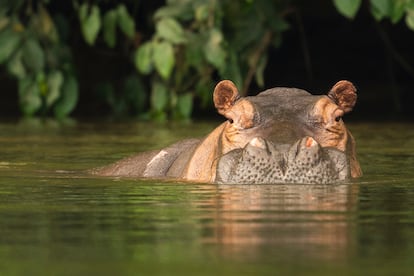

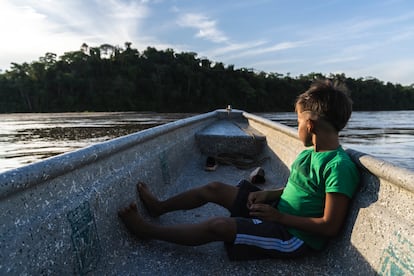
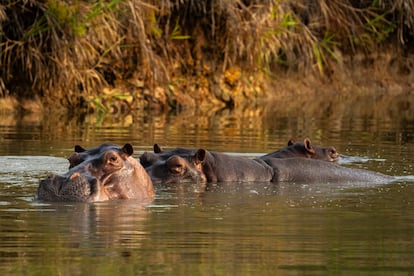
Twenty-three children make their way to school with their eyes glued to the murky water of the Nare River to see if they can see the hippopotamus. The school route has become a kind of safari with the kids scanning the horizon. Everyone in the municipality has a story to tell about the hippopotamus; that his feces scare away the fish, that he eats the banana crops, that his footprints are the size of three palms, that he will capsize a canoe... The Puerto Nare hippopotamus is all that’s talked about here. For Luis and his brother Diego, he is not a stranger. They call him Selmo. Their mother shakes her head and asks them not to get too attached because the judge has allowed just 60 days for the hippo to be removed from the vicinity.
The boys saw Selmo for the first time on July 27. When Luis got home from school, he told his mother. “A what?” she said. “A hippopotamus, mom. Tell Diego he has to take care in case he runs into him.”
When she was just five, Nancy Tabares Arbelaez felt her legs go weak. She had just come face to face with a hippo in Doradal, 35 miles from Puerto Nare and next to the Hacienda Nápoles, the estate featuring an illegal zoo created by drug lord Pablo Escobar over 40 years ago that housed more than 80 species brought in from abroad. At the time, Nancy was riding her bike when she saw the hippo yawning a few meters from her. She managed a quick escape. To think that one of those animals is now marauding near her children is her worst nightmare. Along with her neighbors, she has demanded the state take action against the three-ton Selmo.
Puerto Nare is located between the departments of Antioquia and Boyacá, in central Colombia, where the river of the same name crosses the municipality and flows into the Magdalena River, the country’s main waterway. Here, life is completely bound up with the river. The fishermen fish from childhood and drink directly from the tributaries, the women wash the family’s clothes on the shore, and the river also serves as the children’s park; they throw themselves in and let the current carry them a short way downstream. The river also takes them to the local doctor, to school, and to bury their dead. It is, as they say, their treasure.
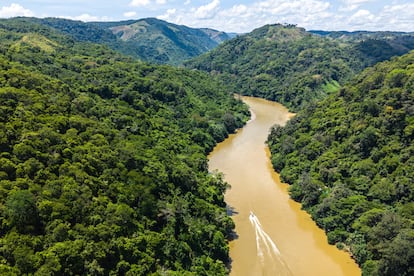
Juber Martínez, a lawyer and former representative of this rural municipality, was the one who suggested the neighbors resort to this rapid constitutional mechanism that seeks to ensure the safety of minors. The judge ruled in their favor at the beginning of September and ordered Corantioquia, the environmental authority in charge, to take measures to remove the hippo within 60 days. Martínez took issue with the time frame: “Two months seems to us a very long time for the execution of the measure when the children are at real risk as they cross onto the hippopotamus’ side [of the river] twice a day,” he says. “There is already proof that the best option is a lethal one. It is useless to reconsider options that have already been ruled out by scientists.”
The debate about what to do with Escobar’s hippos has been going on for almost half a century. After Escobar’s killing by the police in 1993, these mammals became the responsibility of the state, which kept them in the Hacienda Nápoles. Other smaller species collected by Escobar were transferred to other zoos across the country, but the hippos got out of control.
An invasive species in Colombia, these hippos are now part of a population of 200 that continues to reproduce unchecked. Furthermore, they do so very easily, as they have no natural predators and no dry seasons like those in Africa. Consequently, they have colonized a large part of the Magdalena River basin. Currently, they reproduce 4% more than in the countries where they are endemic and inhabit 770 square miles — an area larger than the size of the Colombian capital of Bogotá. Recently, a hippopotamus was found in Barrancabermeja, over 185 miles from Hacienda Nápoles.
“A hot potato”
Hippos move in clans. Generally, two males will confront each other with one forcing the other to look for alternative territory. The hippo that lives by the Nare River has wounds on the right side of its back and left ear, possible evidence of aggression. Experts suspect that this means a group of hippos may soon invade the space. The estimates are overwhelming. Colombia’s Environment Ministry has warned that the country’s hippo population will exceed 500 by 2030 without intervention. By 2050, there could be 1,000 hippos spread across 5,000 square miles — about seven Bogotás. “The management of these specimens has been a hot potato for one government after another,” says Germán Jiménez, biologist, professor at the Javeriana University, and an expert on invasive species. “While no one acts, the problem grows,” he says.
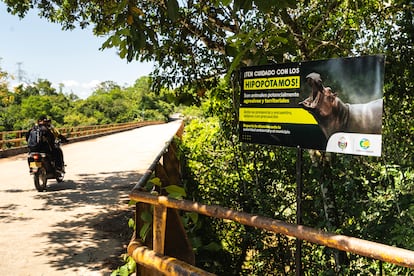
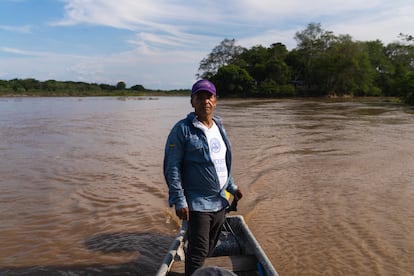
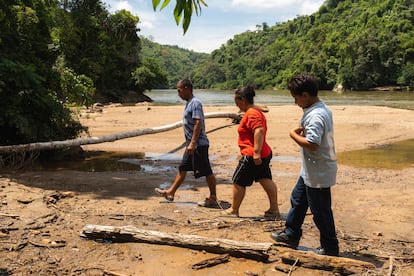
So why will no government tackle the issue? The answer has to do with the economic and political cost. On the one hand, being the government that sacrifices dozens of these cuddly-looking animals has its downside. The country’s animal rights activists have spent years supporting their conservation, despite the impact they are having on the environment and locals. There are also currently about 8,000 people in Antioquia who benefit directly or indirectly from the tourism associated with the hippopotamus, according to Jiménez’s estimates. Then there are those who profit from the illegal sale of the offspring and the tusks. “The approval of euthanasia is very necessary to conserve our ecosystems,” says Nataly Castelblanco, a biologist and member of the Biodiversos Colombia team.
For decades, all possible options have been assessed such as creating a reserve, castrating the hippos, culling, and euthanasia. Each proposal has caused friction between ecologists, animal rights activists, and different political groups. In April, toward the end of Gustavo Petro’s term in office, the former minister of the environment, Irene Vélez, approved a management plan that included sacrificing those hippos that represent a danger to communities and castrating the remainder of the population. The government of Abelardo de la Espriella and the new environment minister, Fabio Arjona, has abandoned the plan.
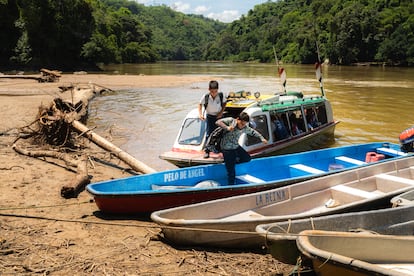
In an interview with EL PAÍS in July, Arjona not only rejected the possibility of killing the hippos but also indicated he was thinking of setting up a Jurassic Park-style sanctuary that would be financed by the Indian billionaire Anant Ambani, who had committed to the transfer of 80 specimens to India. Two months on, Arjona is less decisive, promising instead spaces for dialogue and a monitoring app. Neither the environmental authorities consulted nor the locals interviewed have details on the sanctuary, much less the budget for it.
“What else do you want us to talk about?” asks local Juan Aguirre with a sigh. “We need them to solve it, not to mull it over more. It’s a tricky problem.” A few meters from his house there is a giant slide created by hippos every time they climb out of the water in search of food. It is one of many negative impacts on the ecosystem. Each hippo feeds on about 70 kilos of grass daily and expels about 50 kilos of feces into the river. Hunger sometimes forces them to approach the ranchers’ farms to eat the banana crops.
The daily meanderings of hippos weighing three or more tons have disastrous environmental consequences such as displacing native species like the West Indian manatee, the capybara, and the otter. “How are we going to create a sanctuary for a species that is not only not endemic, but is affecting our flora and fauna? We would be the first country to do something this crazy for an invasive species when that money could be invested in protecting our diversity,” Castelblanco says.
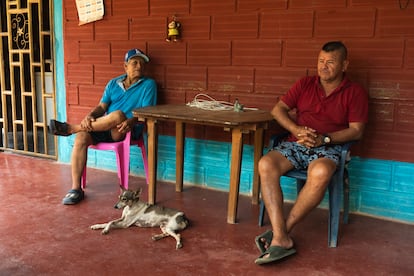
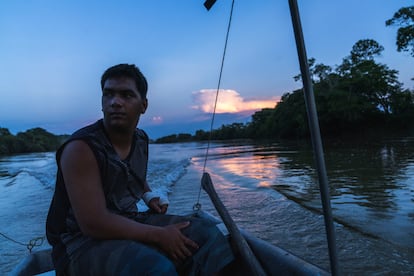
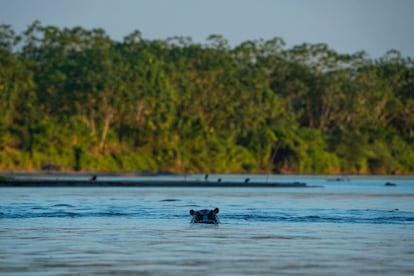
The impact is also economic. In this region there are many fishermen, like Marcelino Salazar, who stopped fishing for fear of encountering a hippo and is now in search of an alternative way to put food on the table. For others, like Álvaro Sacra Molina Pérez, a fisherman from Las Angelitas located 40 minutes by boat from Puerto Nare, they continue to fish despite there being around 15 hippos in the vicinity. “We fishermen are like thieves. We know that if they catch us they will kill us, but we keep at it. Being illiterate, what else am I going to do?” he says as he embarks on the eight-day job of mending his fishing net, which a hippopotamus tore apart in seconds.
“They are waiting for someone to die”
On the Nare River, Selmo is all anyone thinks about. Every day, since Selmo turned up, locals try to catch the hippo on camera. Videos are uploaded to Facebook. Vanessa Arango, secretary of the community action board, criticizes animal rights activists and those who consider it a tourist attraction. “This might seem very nice from a distance,” she says. “They come and go in their car... But I go in a canoe. And I assure you that the hippos don’t look so beautiful up close.”
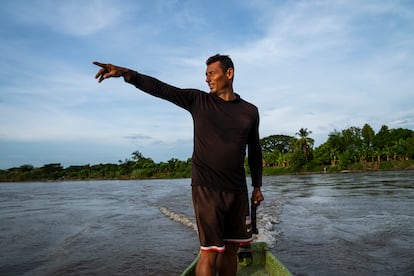
Hippos are highly feared in Africa, where they cause some 500 deaths a year. In Colombia, there are at least four people who have suffered direct injuries from an encounter; one of the victims now has mobility problems. “They are waiting for someone to die. Then they are going to say that something must be done fast,” says Arango. The aggressiveness of hippos of both genders is due to their high levels of testosterone, a hormone that increases as the population grows. This explains why Colombian specimens are apparently more docile than African ones. However, if the population reaches 1,000 animals by 2050, as estimated, this could change.
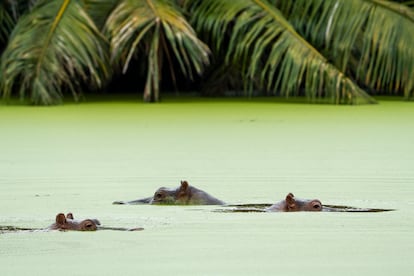
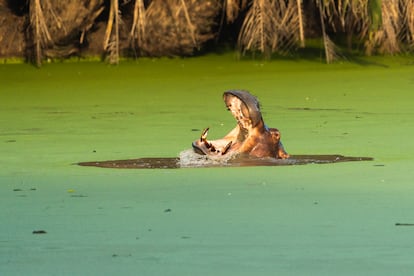
When dusk falls in El Doradal, Leonardo waits by his motorbike for his girlfriend to leave the prison where she works, a stone’s throw from the Hacienda Nápoles zoo. He goes early so he can sit by one of the lakes where there are an estimated 20 hippos. The idea of euthanasia makes him laugh. “Impossible,” he says. “Nobody here is going to allow that. Neither the locals nor the armed groups.” When his partner leaves work, he points out four hippos peeping above the surface, one of them yawning. “Let’s stay a little longer,” he says to his partner, adding, “It’s been a while since so many have come out.” Leonardo is not afraid. He says they won’t do anything. “It’s hard to explain but they are calm around us. They are one of us.” When it comes to Selmo, Luis and Diego agree.
Sign up for our weekly newsletter to get more English-language news coverage from EL PAÍS USA Edition









































