
Colombia bids farewell to the government that promised four years of left‑wing change
Gustavo Petro is spending his last day as president after a term filled with promises, noise and controversy
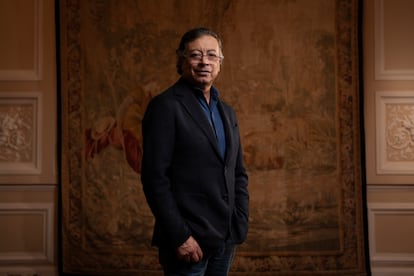

“The government of change” was the term used until this Thursday by Gustavo Petro, a former guerrilla fighter, former mayor of Bogotá, successful opposition politician and winner of the 2022 presidential election on the back of a tumultuous social mobilization during the right‑wing government of Iván Duque. Petro arrived with a huge promise: to build a new country. Behind that promise was the question of how he would manage to make progress while respecting the institutional checks and balances that have shaped Colombia for decades, or whether he would end up colliding head‑on with them.
Four years later, Colombia has experienced significant changes, but it remains an extremely unequal nation, with serious problems of illegality, drug trafficking and violence. It has, however, achieved measurable improvements in unemployment and poverty and, above all, an expansion of the political spectrum that can access the presidency — a change that had been taking shape for decades and crystallized with the 2022 vote.
Petro took office in a country with explosive emotions. On one side was the hope of a large sector of Colombian society that voted for him, or of those who said they voted for his iconic vice presidential running mate, Afro‑activist Francia Márquez; on the other were those who feared a left‑wing government, citing the example of the Chavista regime next door in Venezuela. In between, many felt uncertainty and curiosity. Francia, as she is popularly known, marked the other deep change achieved by the outgoing government: greater representativeness in the executive. If in the 1980s and 1990s it became common to see women in the traditional photos of white men in suits and ties, under Petro it became normal to see Indigenous people and Afro‑descendants in senior executive posts.
That is perhaps the government’s deepest legacy: a broader, more diverse democracy, one more step in a process that spans nearly half a century. If, from the mid‑19th century to the end of the 20th century, Colombia lived under a strict two‑party regime, that system gradually loosened. In 1988 Colombians elected their mayors by popular vote for the first time — until then mayors had been appointed by the president — opening the doors to power for people outside the Liberal and Conservative parties. That first step paled beside the 1991 Constitution, the first not born out of the end of a civil war and drafted by agreement among a wide range of political forces, including former guerrillas. Three decades later, Petro brought representatives of other social sectors into the country’s most important offices. That new widening of democracy has been one of the strongest links to those who feel like the “nobodies” Márquez said she represented and whom the president sought to vindicate throughout his term. In fact, in February 2025 he held a special event to present a renewed cabinet that he presented as a display of diversity.

Those major shifts in representational prospects do not have an exact mirror in concrete outcomes. Some promises made progress, others ended in failure. Petro faced an opposition less organized but stronger than it appeared, the complexity of the economic, legal and social system, and a leadership that focused more on rhetoric than on the ability to organize and follow a strategy with goals, deadlines and priorities.
The president began his government the way he ran his campaign: open to other political sectors, with a broad legislative coalition and several moderate ministers — José Antonio Ocampo at Finance, Cecilia López at Agriculture and Alejandro Gaviria at Education. He built bridges with the more progressive wings — and with more clientelist figures — of the traditional parties. In that way he pushed through an ambitious tax reform that seemed to signal an order of doing things: first, secure the funds to implement reforms, then carry them out. That logic, however, quickly unraveled. In the first half of 2023 he announced a trio of social reforms — labor, health and pensions — that had to pass Congress and constituted the core of a program that concentrated change in building a more generous social security and labor system and a stronger role for the state.
The most controversial element was the health reform, which was not a major concern in a country with pressing problems of employment, poverty and security, yet Petro chose to make it his flagship. He presented it before labor and pension reform, despite criticism from his moderate ministers led by Health Minister Carolina Corcho. The clash led him to break the coalition, remove the moderates and adopt a confrontational approach with what he generally saw as “the establishment,” which he believed was blocking his impulses for change.
Four years on, the record of that trio of reforms is mixed. The labor reform, which brought improvements for formal workers, was approved by Congress. The pensions reform, more contested, remains unresolved: the Constitutional Court is reviewing it and suspended its application. But the health reform was rejected twice by Congress, and Petro chose to advance some targeted changes administratively, meaning they can be easily reversed.
While pushing that legislative program, Petro lashed out at the courts when they made decisions adverse to his interests, whether justified or not — and even when they were, as occurred with the Constitutional Court on parts of the tax reform, due to legal weaknesses noted from the start by experts. Petro spoke of a “soft coup” against him, threatened to put together a constituent assembly in a country that highly values the 1991 Constitution — the same constitution he repeatedly said he sought to deepen — and said he felt trapped in the presidential palace.
At bottom, that interpretation reflected less a real conspiracy than a difficulty in accepting that those checks and balances — the courts, the Bank of the Republic, the media, the opposition — are a structural part of Colombia’s political system, not obstacles invented against him. He said he had understood that the president’s power is limited compared with established forces, such as business or political sectors. He lost the October 2023 regional elections and entered a dynamic that filled the government with unease.
In those months the president moved toward trying to build a more direct relationship between himself and the people. He repeatedly urged his base to take to the streets, with mixed results that heightened tensions but did not produce a major rupture. He used his X account and institutional channels to make and announce state decisions, and sought enemies on various fronts: former right‑wing president Álvaro Uribe, the reelected U.S. president Donald Trump, and even the leader of FARC dissidents known as Iván Mordisco.
Meanwhile, his grand promises of achieving peace quickly — based on the idea that former president Iván Duque had failed to reach agreements or demobilizations out of lack of will and that, because Petro came from the guerrilla, he would be an easy interlocutor for groups such as the various FARC dissident factions or the ELN guerrilla — were failing. His policy of “total peace” gradually disintegrated. In fact, another of the enemies Petro ended up confronting was Iván Mordisco himself, leader of one dissident FARC group, against whom he unleashed air strikes and artillery attacks, using weapons whose use he had questioned when Duque ordered them, due to their damaging collateral effects. He even appointed a military officer as defense minister for the first time in 35 years, hardening against those he had once extended a hand to and with whom he did not achieve the easy agreement he had expected.
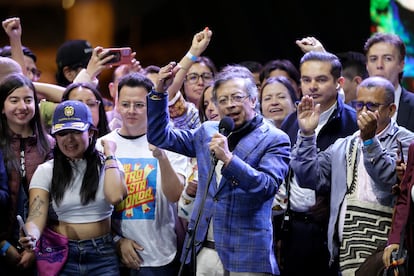
Another major foreign policy promise was the restoration of diplomatic relations with Venezuela, broken during Iván Duque’s government. Petro was banking on on reopening the border and rebuilding ties with Caracas, promising to reactivate bilateral trade and contribute to regional stability. But the gamble failed to deliver the major economic or social gains it had promised. In contrast, Petro had a year of clashes with Trump, which led to the loss of his U.S. visa and his inclusion on the OFAC list. He managed to calm tensions after visiting the White House in early 2026, shortly after Trump intervened in Venezuela, kidnapped Maduro in Caracas and put him before a jury in the U.S.
While all this unfolded in a country where politics was part of everyday debate and the atmosphere was permanently tense, the economic front followed its own pace, separate from the political instability. By way of public spending, Petro managed to reduce unemployment and poverty — two of his major goals and an indisputable accomplishment of his term. He did so, however, at the cost of a high fiscal deficit, which leaves one of the most complex legacies for the incoming government, amid sustained criticism from those who said the spending increase had an electoral purpose.
To that criticism were added scandals of corruption that struck his administration, from the case against his eldest son Nicolás Petro for appropriating money intended for the presidential campaign, to the misuse of public funds from the National Unit for Disaster Risk Management (UNGRD) to secure votes in favor of his legislative initiatives, a scandal that has two former ministers in jail.
But perhaps his greatest frustration is that his successor is Abelardo de la Espriella, whose major pledge is to undo much of what Petro accomplished, and who could lead Colombia to join the wave of far‑right governments currently ascendant on the continent.
In his final weeks, Petro has not only sought to complicate De la Espriella’s accession to power — for example, by denying the possibility of a traditional transition — but has also tried to delegitimize him on various fronts. He and his party have questioned the incoming president’s U.S. citizenship and, above all, have claimed electoral fraud they have not been able to prove. Despite this, he has devoted lengthy posts, television appearances and an amount of energy exceeded only by what he has spent trying to secure his own future: Petro is seeking removal from the OFAC list and has even attempted to travel to the United States on his last day as president to do so.
If Petro is wondering about his immediate future, Colombia is asking the same as it gets a president who has never done politics or been a public administrator and who, like his predecessor, brings huge promises of change and big questions about how to deliver them. But the country is no longer the one of 2022. Colombia has already experienced a markedly left‑wing, anti‑establishment government that came to power despite accusations rooted in decades of armed conflict and that, despite the tensions he himself fomented, avoided both the siren song of concentrated power and the formation of a regime that denies elections. Democracy remains, at once, broader and more weakened.
Sign up for our weekly newsletter to get more English-language news coverage from EL PAÍS USA Edition









































