
Venezuela negotiates, Washington arbitrates, Trump decides
The success or failure of the dialogue between the chavista government and the democratic opposition will depend on the concrete changes that give Venezuelans control over their own destiny
If Venezuelans have learned anything over the past few decades, it is that the best intentions of the parties involved do not guarantee political progress. More than a dozen negotiation processes between the chavista government and the democratic opposition — most of them ending in farce, frustration, or fraud — bear witness to that. Will the new dialogue taking place this week be different from previous ones?
The recent joint statement by María Corina Machado and Edmundo González Urrutia made it clear that the main opposition leaders will not take part in the negotiation aimed at renewing the National Electoral Council and part of the Supreme Court of Justice with the ultimate goal of paving the way for free, fair, and transparent elections. That does not mean the talks led by Dinorah Figuera have collapsed before they have begun. But it does highlight the tension running through the opposition camp. After years of hopes and disappointments, those who see this as another chavista maneuver to cling to power are again at odds with those who believe it is worth trying because — this time — the pressure is coming directly from Washington.
Chavismo will not go into any discussion united either, as it once did under the leadership of Hugo Chávez and Nicolás Maduro. In recent days, figures such as Mario Silva and Iris Varela have publicly criticized the leaders of the transitional government for cooperating with U.S. demands and negotiating with opposition sectors they deem illegitimate. They were joined by a group led by former vice president Elías Jaua, who called for a dialogue “among Venezuelans, for Venezuelans, and by Venezuelans,” a cautious way of rejecting U.S. tutelage. None of these figures occupy the center of power today, but they express the unease of factions sidelined by the troika made up of the Rodríguez siblings and Diosdado Cabello.
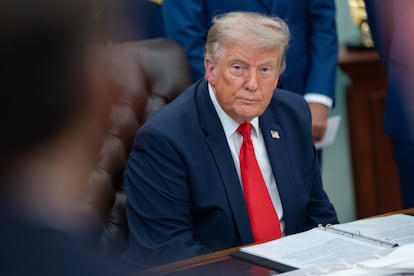
The biggest novelty in this process, however, is not the fragmentation of the opposition or of chavismo. It is the role of the United States. Unlike earlier negotiations, Washington will not act as a facilitator or observer but as an arbiter with huge vested interests. The opposition and the government will negotiate, but Donald Trump will decide. That raises an unavoidable question: can there be a democratic transition when the true center of decision-making lies outside Venezuela?
The answer depends largely on what the Trump administration’s real priorities are. These do not always align with those of Venezuelans, nor even with those of the opposition leadership, as the de facto veto against Machado appears to show. While Trump has stressed the need to ensure Venezuela’s economic stability, Marco Rubio has reiterated that the ultimate goal should be holding democratic elections. Between those positions sits Undersecretary Michael Kozak, who has spoken of finding a middle ground that would create conditions for an election before the current U.S. presidential term ends. In other words, neither too soon nor too late: likely in 2028.
The coming months will test Dinorah Figuera’s ability to give legitimacy to a negotiation that today lacks the backing of much of the opposition. That legitimacy will not come from statements or photographs of meetings, but from results. For many Venezuelans, the dialogue will only make sense if it produces concrete changes: the renewal of electoral authorities, the restoration of political and civil rights, the recovery of space for freedom of expression and the press, and a reform of the judicial system that rebuilds institutional checks and balances.
María Corina Machado and Edmundo González Urrutia, for their part, have reiterated that they will return to Venezuela. But whereas a few months ago that possibility seemed to fit naturally into a strategy of a rapid transition via presidential elections, it is now unclear how their return would contribute to a negotiating process that seeks, precisely, to open institutional space in stages with an electoral calendar that starts out by renewing the legislature before presidential contests. Among the most skeptical opposition sectors, suspicion prevails that Washington’s real aim is not to democratize the country but to stabilize it to facilitate oil and mining deals.
Recent statements by Trump did little to ease that perception. A few days ago he said that Chris Wright, his energy secretary, was the one running Venezuela. At the same time, the Treasury Department decided to relax controls on the Venezuelan government to favor financial stability, economic recovery, and reconstruction after the earthquakes of June 24. For many opposition figures, these signals reflect the stark asymmetry of power between the two countries.
A person close to González Urrutia and Machado, who agreed to speak on condition of anonymity, summed up that view bluntly: “The United States does not care about the outcome of the dialogue. It wants stability to exploit resources. That is why it eases sanctions and keeps Delcy Rodríguez in power. The tutelage is absolute. It is about colonizing a failed state to extract its resources.”
The same source notes an increasing distance between Machado and sectors of the Trump administration, including Rubio. Other observers agree that the decision to stay out of the negotiation has not been well received in Washington. Nevertheless, for influential figures in both the Republican and Democratic parties — from María Elvira Salazar and Bernie Moreno to Tim Kaine — Machado remains the most legitimate option to compete in a potential presidential election.
Despite these tensions, some believe that Washington’s influence actually increases the chances that the process will yield results. With the advantage of controlling the institutions — and also having the endorsement of the United States — the chavista government has not even revealed the names of its negotiating team.
Can there, therefore, be a democratic transition when the true center of decision-making is outside Venezuela? Yes, but only if the dialogue produces verifiable progress and does not become a mere operation to politically stabilize the country in order to do business over Venezuela’s strategic resources, even if that involves lifting sanctions, which is the regime’s primary demand. Ultimately, the legitimacy of the process will depend less on who sponsors it than on Figuera and her team’s ability to offer a credible electoral calendar, restore the political rights of parties and candidates, and guarantee basic conditions of transparency and democratic competition.
None of that will be possible without freedom of expression and the press, nor without an active citizenry. After years of broken promises, the principal guarantee that the popular will — stymied by force on July 28, 2024 — will not be mocked again will be a mobilized society capable of simultaneously pressuring the government and the opposition to turn agreements into deeds. The new dialogue remains a journey into the unknown. The difference is that this time success or failure will depend on concrete changes that return to Venezuelans control over their own destiny. That will be the measure by which Figuera and her team are judged.
Sign up for our weekly newsletter to get more English-language news coverage from EL PAÍS USA Edition









































