
Pablo Escobar’s hippos: A serious environmental problem, 40 years on
A drug trafficker’s megalomaniac dream continues to be an unsolved problem for Colombia
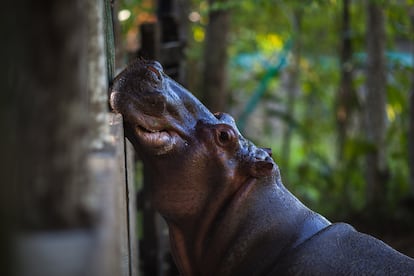

In the 1980s, four hippopotamuses landed in Colombia, part of an exotic whim of the feared drug trafficker Pablo Escobar. Later on, Pepe — a wayward descendant — became the herd’s most famous member when he was captured. Since then, the country has changed its Constitution, its presidents, and its wars, but four decades — and various reporters — later, the headline remains the same: Colombia doesn’t know what to do with Pablo Escobar’s hippos. It doesn’t matter when you read this, it will probably still be the case.
The story began at Hacienda Nápoles, located some 93 miles from Medellín, where Escobar — possessed by the spirit of a megalomaniac Noah — built a private zoo with rhinoceros, elephants, and other animals that had been purchased on the international black market. The hippos found an unexpected paradise in the Magdalena River basin: abundant water, no natural predators, and a perfect climate for breeding. After Escobar’s downfall and the abandonment of the estate, some escaped from their ponds and made their way into the river. Over time, the four became dozens. Today there are 169. There will be 1,000 by 2035. And if nothing is done, there will be 1,300 by 2060.
The hippos are back in the public conversation — if they ever really left. The government of Gustavo Petro, now in its final stretch, has also failed to solve the problem posed by the country’s most famous — and heaviest — invasive species. At the end of November, the Colombian newspaper El Espectador dedicated an extensive report to the animals that opened with the story of Luis Díaz, an illiterate farmer who was attacked by a hippopotamus as he drew water from the pond of a farm one morning in May 2020. He was nearly killed. “That entire first year, he couldn’t hear the name of the animal because he would start crying,” said his mother.
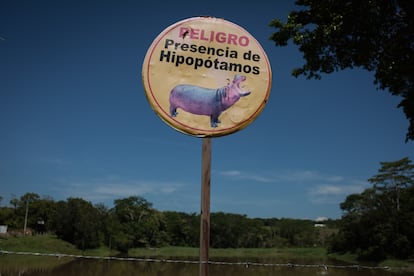
The report also mapped out the possible ways forward — options that are all well known and all problematic. Contraception using a drug that requires multiple doses — and costs a fortune — would achieve eradication in about 45 years. Capture and sterilization, which requires at least 12 people and six hours of nighttime surgery on a three-ton animal, is a titanic effort. Or euthanasia, defended by part of the scientific community as the most effective solution, but opposed by progressive and animal-rights sectors of Colombian society.
Petro’s government waded into this tangled web, promising a definitive, respectful strategy to address the dangerous hippos: relocating part of the population to foreign sanctuaries and controlling the rest with contraceptives. There were talks with Ecuador, Peru, the Philippines and India, but no country has closed an agreement — it would be a problem for them too. Scientists criticize the fact that beyond the intention, there is no plan, no timeline, and no funding. Meanwhile, the population keeps growing, endemic species are under threat, attacks continue, and the urgency to act increases.
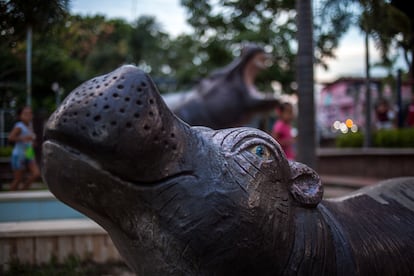
A one-ton sculpture of a hippo made from red wire greets visitors to Bogotá’s National Museum. It is a reminder of the environmental problem and proof that the animal is no longer seen only as an invasive species. Instead, it has become something more: a symbol that both unsettles and fascinates. In fact, just a few weeks ago, several Colombian artists, inspired by the hippos, opened an exhibition that plays with wall hangings, photographs, paintings, and even the animals’ own dung, which has turned out to be an ideal habitat for a certain hallucinogenic fungus. To cap off the symbolism, artist Camilo Restrepo displayed the excrement molded to resemble cocaine bales.
Colombia has always been adept at exploring its own contradictions. A country that turns a problem into metaphor, into an aesthetic object, into an uncomfortable reflection on its own history. Into memory. No matter when you read this piece: the hippos—and, in some way, everything that brought them here—will still be there.
Sign up for our weekly newsletter to get more English-language news coverage from EL PAÍS USA Edition









































