
Reality was worse than ‘Zoolander’: the parody that predicted the influencer world 25 years ago
In 2001, Ben Stiller’s outlandish comedy about the fashion world anticipated the Instagram poses and the culture of content creators where form has devoured substance
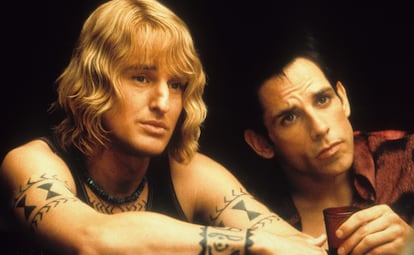

A few days ago, a crowd of young people gathered beside Barcelona’s Arc de Triomf to take part in an event as new as it was unsettling. It was the first event in the Catalan capital to do “aura farming.” Hundreds of teenagers assembled to strike a series of poses, project an “original” attitude and gauge the “social respect” they could scrape together under the gaze of all those strangers. The spectacle, halfway between an artistic performance and delirium, inevitably recalled a certain film directed by and starring Ben Stiller 25 years ago.
When Zoolander hit theaters in September 2001, critics were ruthless. The Washington Post, for example, dismissed it as a “one-joke comedy,” while the global edition of Time Out called it a “banal comedy that fails on every level.” Ángel Fernández Santos of El País described it as “utterly dull (...) a crazily constructed comedy (...) clumsy, indigestible.”
Box-office returns were weak too, likely because it opened barely two weeks after the September 11 attacks, a time when audiences were hardly in the mood for absurd humor. Yet, viewed a quarter of a century later, the film can be read not only as a broad caricature of fashion but also as a sociological prophecy. A hyperbolic absurdity that describes, with alarming accuracy, the tyranny of image, the selfie culture and the heightened bodily self-awareness that dominate 2026.
The birth of the “faces”
Beyond the laughs—which may be easier to understand today than in the immediate aftermath of the worst attack on U.S. soil in history—one of Zoolander’s chief insights, often overlooked, was to “focus its gaze on male models, blowing up the traditional gender roles of the time,” says Estel Vilaseca, director of the Fashion Design Area at LCI Barcelona.
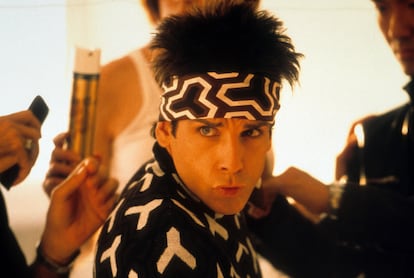
In fact, the film is all about looks. Looks that in Zoolander’s hands become almost works of art. The “Blue Steel look,” the “Magnum face”… The film’s characters treat them like Louvre paintings, even though they all look the same to the viewer. Today, we live surrounded by that kind of absurd grimace. We see them every day on social media. Some people only appear on their accounts making these kinds of faces, which have become so embedded in the collective imagination that they now seem as normal as a smile.
Stylist Rocco Marvin believes that “though structured as an absurd comedy, Zoolander contains a very sharp critique of the weight society gives to appearance, fame and the construction of a public image.” He says that “under a grotesque format, the film questions how far individual identity becomes subordinated to others’ perception.”
In this framework, Derek and his famous “Blue Steel Look” operate, the expert says, as a caricature of the contemporary need to find a perfect, iconic image. “Although the film takes this idea to extremes, it’s easy to relate it to the present, especially to social media, where many people carefully select the photos, gestures or appearance with which they want to present themselves to others,” she says.
As the project’s screenwriter, John Hamburg proudly suggested in an analysis published in Esquire on its twentieth anniversary that time has vindicated Zoolander’s intuitions. In his view, the film was ahead of its time for spotlighting the fashion industry’s dirty laundry (such as child labor exploitation and eating disorders) and, above all, for focusing on a culture already germinating before the advent of smartphones and social media. The film dissected and forecast the dynamics of visual overexposure that would later erupt into selfie culture and the rise of modern digital celebrities personified by figures like the Kardashians and the Hadid sisters.
The luxury of ugly
If Derek’s pose anticipated the Instagram era, the fictional Derelicte collection—designed in the film by the villain Mugatu and inspired by homeless people—prefigured one of the most controversial trends in contemporary fashion: the commodification of poverty. Estel Vilaseca points out that, in fact, fashion was already showing signs of going in that direction when the film was made. She recalls that Mugatu’s proposal seems to reflect John Galliano’s famous spring/summer 2000 collection for Dior.
Those outfits, noted for a newspaper-print pattern, became famous (and controversial) because they were inspired by the homeless who slept under Paris bridges and whom the designer encountered while out running. The expert adds that “although Galliano’s interpretation was not ironic but rather poetic, it still feeds fashion’s attraction to provocation and recontextualization, which Zoolander also reflects.” An obsession that has led current houses like Balenciaga to market trash bags or distressed garments at astronomical prices, further consolidating a strategy in which scandal and ugliness function as market drivers.
According to Rocco, the Derelicte line also illustrated “how arbitrary the fashion system is: what in one context might be regarded as ugly, strange or worthless can become a trend simply because certain figures or institutions confer prestige on it.” “The exaggeration is comical, but it also reveals a critique of the industry’s power to decide what we consider attractive or desirable,” she adds.
The assimilation of parody
Another important stroke on the fashion world supplied by Zoolander came through the relationship between the film and the industry it parodied, which underwent a very particular “metamorphosis.” During filming in 2000, much of the fashion industry turned its back on the project. Costume designer David C. Robinson recalled in Esquire how numerous fashion houses refused to lend clothes for the shoot after seeing a short aired during the VH1 Fashion Awards that introduced the character Zoolander.
However, after the film became a cult phenomenon, the industry ended up embracing the story to such an extent that top designers and models fought to make cameos in its sequel, Zoolander 2. Vilaseca says that this arc from initial rejection to later acceptance fits the sector’s behavior perfectly. “The same thing happened with The Devil Wears Prada. For the first film, Vogue barely covered it; by the second one it had actively collaborated.”
“Initially there’s fear of reputational damage, but then, once they see the phenomenon and the profits to be made, they jump on the bandwagon,” she continues. “Although in both cases the first installment is often regarded as far more genuine. And, without doubt, in the case of Zoolander, much more fun.”
Beyond newspaper-print dresses or the sophistication of poses for the camera, perhaps Zoolander’s most prophetic achievement was sketching the definitive contemporary influencer: a figure obsessed with projecting their own image but radically disengaged from reality. Their inability to understand the world around them is immortalized in a key scene when Derek violently destroys a model of the Derek Zoolander Center for Kids Who Can’t Read Good. Seeing the miniature, Stiller yells indignantly: “What is this? A center for ants? (...) How are they going to learn to read if they don’t even fit in the building?”
Beyond the joke, the scene now functions as an inadvertent allegory for the functional emptiness that dominates much of today’s content creators. In the era of dopamine aesthetics, rapid consumption on TikTok and the cult of aura farming, form has utterly devoured substance. Derek Zoolander anticipated that digital elite who can pose with sculptural precision but are sometimes unable to interpret the context that underlies their own content. Twenty-five years after its release, the joke has begun to flip: the reality of 2026 has come to imitate the delirium imagined by a comedy that increasingly resembles the world we live in.
Sign up for our weekly newsletter to get more English-language news coverage from EL PAÍS USA Edition









































