
Modern cults are replacing leaders with ‘life coaches’: ‘They mimic the capitalist logic of influencers’
Predatory groups have experienced exponential growth thanks to social media. Experts warn that it is now easier and cheaper than ever to reach a wider audience
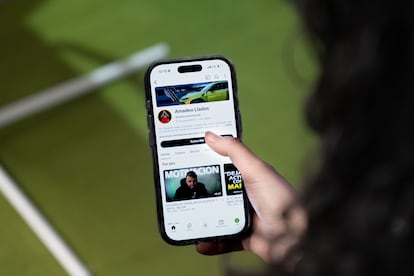

It all starts in front of a screen, in the most innocent way possible. Accepting a friend request on Facebook. Following an influencer. Signing up for a study skills course about investing in cryptocurrencies. Entering a Roblox minigame. These are all gateways into a labyrinth of psychological manipulation that, in just a matter of months, can end with the innocent internet user trapped in a cult-like community, isolated and ruined. This mental and physical kidnapping occurs — and this is the worst part — voluntarily.
The internet has transformed how cults operate. Street preachers are now influencers or life coaches. Messianic leaders — who once prophesied the end of the world — have moved on to talking about cryptocurrencies, luxury cars, burpees and personal growth. The methods have changed, but the substance remains just as murky.
“Cults have the ability to camouflage themselves, to adapt to the needs and cultural values of the moment,” explains Hortensia Valcárcel, a clinical psychologist specializing in groups that utilize coercive persuasion. Last month, the expert participated in the 11th National Meeting on Psychological Abuse and Cults, in Salamanca, Spain, where she warned about these new forms of online recruitment.
“There’s still a more spiritual aspect,” she clarifies. The classic cults — with their leaders, their end-of-the-world ravings and their esoteric trappings — still exist… but modern society is more skeptical. And that old story doesn’t fool everyone. “Young people are more easily recruited with this idea of financial success, this shark mentality, especially boys,” Valcárcel asserts.
Money is the new religion. Hence, a series of neoliberal dogmas are more appealing to certain sectors of society, rather than promises of redemption and eternal life. And there are other categories within this cult rebranding as well. “In the health sector, for example, alternative medicines and pseudotherapies are being used,” Valcárcel explains.
In the book Conspirituality: How New Age Conspiracy Theories Became a Health Threat (2023), the authors warn about how yoga, alternative medicine and the wellness world have become — at least, in some corners of the internet — a kind of cult-like digital religion. Through seemingly innocuous messages, they foster a rejection of vaccines, politics, and the education system. And they ask new followers for a certain degree of digital activism. “The faithful of this ‘conspirituality’ are invested as digital comrades-in-arms,” the authors point out.
The Ibero-American Association for Research on Psychological Abuse estimates that at least 400 sects or coercive groups operate in Spain. Around 400,000 people are believed to be under their influence, representing approximately 1% of the country’s population. Meanwhile, the International Cultic Studies Association (ICSA) — a global network of researchers studying groups that engage in coercive persuasion — currently tracks more than 4,000 of them worldwide, compared to approximately 2,000 in the 1980s. These figures are all approximate, as there’s some debate surrounding the very definition of a sect.
A recent report by Europol — the EU’s law enforcement agency — warns of the rise of this phenomenon. “On social media, perpetrators analyze social media behavior and deliberately target minors who already show some indication of vulnerability, [because they are] easier targets to groom and manipulate,” the report states.
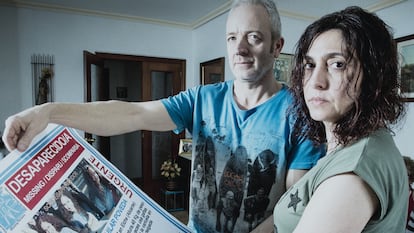
This is what happened to Patricia Aguilar in 2017. Her case received significant media attention, perhaps because of its extreme nature. Or perhaps because of her family’s determination: faced with the difficulty of legally prosecuting the girl’s captor (since she was legally an adult at the time), they went on television to tell her story. “Patricia was grieving; her uncle had died and the whole family was devastated,” explains Noelia Bru, Aguilar’s cousin and the spokesperson for AFISE, a support group for victims of cults. “She asked a question [online] about a dream she’d had… and she came across someone who gave her an answer and offered to guide her.” That person was Félix Steven Manrique, a Peruvian man who spread apocalyptic theories.
Manrique began talking to Aguilar on Facebook. He started recommending books and videos from his YouTube channel. Later, their conversation moved to WhatsApp. Message by message, the man drew her into a world of fantasy and paranoia. The conversations stretched into the early hours of the morning. Her parents noticed that she was drowsy and that her grades had dropped.
The man asked Aguilar for her date of birth and told her she was the “astrologically chosen one.” He claimed that she was a special being, predestined to join his cause, which involved having up to 10 wives and 300 children to create a new race. “And look, I know all this sounds very far-fetched, when it’s summarized like this. But it happened in such a subtle way and at such a delicate moment [in her life],” Bru clarifies. “It was a year-and-a-half of constant harassment.”
No one realized that anything was wrong, that is, until Patricia stole a large sum of money from her parents and left Spain. She had just turned 18: she took off without saying goodbye or leaving a farewell note. She was rescued a year later in a jungle region of Peru: she was living in deplorable conditions and had a baby who was just a few months old. Her captor was sentenced to 20 years in prison for human trafficking. “You think your home is a safe environment, but that’s not true,” Bru explains. “You see her in her room; you open the door and see her [sitting there]. You worry about strangers on the street and not so much about those who might appear on a screen.”
And this is a mistake. Because it’s not just the family environment that lowers our defenses: so does the internet. “When we’re in front of the computer, we let our guard down,” Valcárcel explains. It’s the so-called online disinhibition effect. “We lower the filter we use in face-to-face relationships. It’s easier for us to express feelings or existential doubts, to tell our life story to a stranger, something we wouldn’t do so easily in the physical world. We give them access to our most intimate thoughts. And to our bank account.”
Beyond the mantras, the philosophical trappings and the notion of transcendence, what interests almost all cults is, simply, money. “[Cult leaders have] started to imitate the capitalist logic of influencers: many no longer hold as many in-person meetings, opting instead for online gatherings,” explains Iñigo Rubio, a psychiatrist, writer and president of the Ibero-American Association for Research on Psychological Abuse. “Communities are created on Facebook or Instagram. There isn’t always a cult leader, so these communities are somewhat loosely defined.” The profits come from paying for individual consultations, retreats and workshops. “If you subscribe to their plan and pay a monthly fee, you have access to their group meetings,” Rubio adds. There’s no longer a need to create a temple or organize a spiritual retreat; a Facebook group is enough.
The internet hasn’t only increased the number of cults: it has also fragmented them. Nowadays, dogmas are blurred; there’s less coherence and unity. If someone is interested in outlandish theories — like those having to do with angel channelers — the algorithm will offer them similar content about, say, New Age spiritualism or Gnosticism. It’s like an all-you-can-eat buffet of paranoia; the user picks and chooses what to nibble on.
Rubio cites a typical case, describing a man who came to his office. “He was a patient who had suffered from depression, a man in his sixties. As a result, he had a psychotic episode. And, on social media, he began joining all kinds of groups, creating a kind of hodgepodge of esoteric content, sometimes with little internal coherence.”
This phenomenon occurs due to the flood of conspiracy theories and cult-like groups on the internet. “Now they can reach many more people, at virtually no cost and with little human intervention,” Rubio explains. You don’t need a large physical structure. You don’t need a bunch of people shouting on street corners or knocking on doors to spread their doctrine. All you need is a cell phone, a vulnerable person… and someone with the ability to manipulate them.
People often think of cults as large structures with hundreds of followers. However, a cult-like relationship can also exist on a small scale. Just a couple of people are enough. “One of the problems we encountered in Patricia’s case was explaining this,” Bru recalls. “Many people told us, ‘But there are only a few of them; that’s not a cult.’” At the time of the rescue, three women and five children were living with the captor. This situation is becoming increasingly common, as cults have become more fragmented. This makes them more manageable and easier to operate under the radar.
The case of 24-year-old Ismael Molina is another prime example of this phenomenon. The young man from the Catalonian city of Vilanova was manipulated for four years by an online friend into giving her thousands of euros. In a short period of time, he succumbed to a delusional story, mistaking everyone around him for mobsters. He ended up committing parricide, killing his father on the woman’s orders. She crafted a fantasy world and used coercive techniques to manipulate a man with low self-esteem and psychiatric problems.
Academic research shows that the internet not only facilitates the spread of radical ideologies, but also replicates many of the classic dynamics of cults: charismatic leaders, closed communities, group pressure and information isolation. The difference is that these processes can now unfold on a global scale and at great speed. The unique characteristics of social media create an environment that’s conducive to manipulation and harassment. Just as bullying has become more intense in recent years (because it no longer ends in the classroom), cult harassment is much more powerful, as it can be carried out at any time and from anywhere. The mobile phone becomes the end of a chain that the victim carries in their pocket, keeps on their nightstand and holds in their hand, 24 hours a day.
Several governments are working to prohibit access to social media for those under the age of 16, which could limit the reach of groups that engage in coercive persuasion. Some countries have already passed legislation that addresses this. However, experts believe that this isn’t enough.
In 2024, a group of victims of cults submitted 300,000 signatures to Spain’s Congress of Deputies, demanding a change to the Penal Code so that “coercive persuasion” or “abuse of vulnerability” would be considered crimes. This is already the case in France, Belgium and Luxembourg. In Spain, however, the terms are ambiguous. And it’s difficult to classify coercive persuasion under the crime of coercion, which would be the closest equivalent. Therefore, victims and specialists advocate for social education and legal reform. They point out — as feminist groups did with domestic violence years ago — that control isn’t only exercised physically. Mental chains are also binding.
Sign up for our weekly newsletter to get more English-language news coverage from EL PAÍS USA Edition









































