
‘I need +10K a month to live well’: How the ‘cryptobro’ mystique is taking over culture
The award-winning Gala Hernández’s new short film explores how the ideals of the financial manager have become the new mirage of the good life
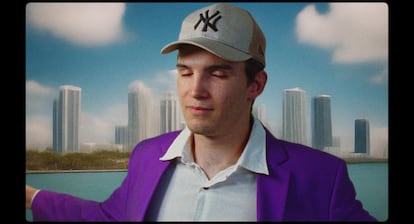

Pol Gascó is 21 years old and he dreams of driving a light blue Lamborghini, living in Miami, and earning more than $10,000 a month. To achieve this dream, he listens to podcasts about Bitcoin, has read Think and Grow Rich several times, and has posted a “dream map” next to his computer screen. “The more you visualize it, the more you attract it,” he says of his collage of postcards showing €50 bills, the Statue of Liberty, a glass-enclosed mansion with an infinity pool, and the model of car he dreams of driving around Segur de Calafell, a village in northeastern Spain where he lives with his grandmother and his Chihuahua dog until he can move to the United States.
As the friends he meets up with in parking lots to spend the afternoon say, Pol wants to break his family’s “chain of poverty.” He aspires to be the best version of himself, exercises diligently, and pays for a financial affairs academy even though several associations have accused it of being a “crypto-cult.” Pol only wants to attract wealth into his life so he can help his grandmother and stop the poor from being poor. That’s why he writes the same phrase dozens of times in a notebook every night: “I’m grateful to be a diamond and earn 10,000 a month.”

Pol is the protagonist of +10K, the new documentary short by Gala Hernández López, who won a Caesar Award in 2024 for her first documentary short, La mécanique des fluides, about an incel who wrote a suicide note and posted it on Reddit. It had its world premiere at the Cannes Film Festival, was considered the Best International Documentary Short at the Guanajuato Film Festival (GIFF), and will compete in the official short film section of the Valladolid International Film Week (Seminci), which starts this Friday.
If her first work explored the loneliness of incels, in +10K, the Spanish-born, French-based director delves, without prejudice, into the lives of youths who have surrendered to the gospel of financial bros. Unlike all the influencers she follows around, her main character is a tender and melancholic young man who is ignorant about the benefits of the welfare state, having grown up under the weight of the financial crisis. Hypnotized by the magic numbers on his Bitcoin apps in the solitude of his room, he aspires to hack the system to gain VIP access to his own bunker of prosperity, his lifeline against the uncertainties of the present. “We have more in common with Pol than we think,” this filmmaker and researcher assures over the phone.
Helping his grandma
Hernández conceived her short film after being profoundly affected by The Crypto-sect Has Kidnapped Our Children, an in-depth article by journalists Rebeca Carranco and Jesús García Bueno published in EL PAÍS in 2022, about the 40+ families who denounced IM Academy, a financial outfit that brought together 9,000 people from all over Europe in a pavilion in Badalona, Spain to learn how to invest in cryptocurrencies and get rich without working. “When I saw the photos of the event, I was fascinated. Almost all the attendees were young people. I needed to know why they were there and what had led them to that worldview,” explains the filmmaker.
The creator contacted associations, journalists, and families of those affected. After visiting several financial education academies, her casting director found the right person to feature in the documentary, Pol Gascó, at one of their events. “He’s a kid who exudes a lot of empathy and retains a certain innocence. He wants to help his grandmother and even other people generate wealth; he has a community vision. Pol could have turned out differently, or had other struggles, but his attention has been grabbed by that side of the scales,” the creator notes.
Hernández’s cameras accompany Gascó to one of the crypto-influencer mega-events at Madrid’s Movistar Arena. There, Pol shouts in unison with thousands of other attendees, launching a collective cry into the void as he imagines his 50-euro bills burning. It’s like witnessing the ecstasy of a gospel mass, but with believers in money. “You could look down on them and think they’re idiots, that they’re clearly being scammed. We have to move away from that disdain,” says Hernández. “The fact that these events are able to bring together thousands of people is a symptom of how badly the system is doing. These young people belong to a generation that feels like their future is lost and condemned to precariousness. And it is in this mystique of money that they have found faith, the answer to their ills,” she emphasizes about this new turbo-capitalist generation that has idealized money, just as the yuppies who became stockbrokers did in the 1980s. After all, these new cryptobros are the new iteration of Patrick Bateman in American Psycho (2000), Bud Fox in Wall Street (1987), or Sherman McCoy in The Bonfire of the Vanities (1990).
What is the good life?
The obsession with earning more than €10,000 a month doesn’t just torment the protagonist of Hernández’s short film. Between $80,000 and $100,000 a year is what Lucy’s (Dakota Johnson) clients demand from their future partners in the recent Materialists, Celine Song’s film about a matchmaker who makes a living finding partners for her clients. Beyond the math of couples, in 2025, how many thousands a year you should earn to feel happy is the viral question of the moment. This question generates thousands of comments on social media due to the dissociation of the answers based on the rich or poor neighborhood in which anonymous people respond. On social media it is a classic call to go viral regardless of the country in which it is asked.
Long gone are the days when economist Richard Easterlin’s paradox about how earning more money didn’t make us happier was often cited. Now, the trend is to repeat what two Nobel Prize winners in Economics, Daniel Kahneman and Angus Deaton, have quantified: that earning $100,000 a year, or about $8,300 a month, is the ideal amount to achieve happiness. And this fantasy has taken hold, especially among younger people. A 2024 survey by the financial firm Empower revealed that Gen Z respondents believe they should earn €500,000 a year to achieve “financial success,” while for Millennials the figure was €180,000 and for boomers it was €85,000.

What is the reason for this gap between older and younger people? Anthropologist Emilio Santiago Muiño lists four reasons: “A structural increase in inequalities, the victory of neoliberal culture, overcompensation for the chronic precariousness, and the defeat of the political project,” he replies in an email exchange. Muiño, who works at Spain’s National Research Council (CSIC), analyzed part of this problem in his essay Vida de ricos (The life of the rich), where he argues that the left must abandon its rhetoric of containment to recover and adapt to our times the idea of “communal luxury” championed by the 1968 revolution. “Neoliberal success is very much a pyramid scheme: many will be called, but few will be chosen. This is a perfect machine for generating mental health problems and large doses of frustration,” he diagnoses.
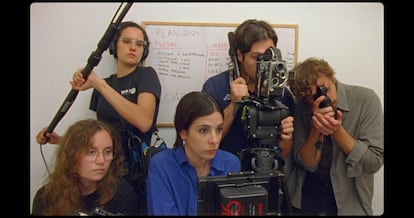
For the director of +10k, who breaks the fourth wall in her short with a conversation with Gascó about his ambitions in life, ideals can become problematic when we delve into the libidinal: “We all have a rather perverse and contradictory relationship with money. While I say I don’t want to get rich, I also want to live well. But what is living well? I want the viewer to ask their own questions, too.”
Sign up for our weekly newsletter to get more English-language news coverage from EL PAÍS USA Edition









































