
Discovering Chihuahua’s sotol, murals and the views from Copper Canyon
A journey that begins in the vibrant capital of the Mexican state and ends on the famous ‘Chepe Express’ train after stops in Cuauhtemoc’s Mennonite community, Creel and the Tarahumara Mountains

When Lenny Kravitz tried sotol for the first time, he had already experienced life, its powerful emotions, world tours and several number one hits. But his discovery of the distillate from the native Chihuahua desert plant lilacea dasylirion left such an impression on the singer that there was no turning back. He embarked on a journey that culminated in the launch of his own brand, Nocheluna, a sotol his marketing campaign dubs “Wild. Natural. Resilient.”
In the Ráramuri language, Chihuahua means “dry and sandy place,” a name one understands soon after landing in the Mexican state’s eponymous capital. From the Santa Rosa viewpoint, we got familiar with a capital city that departs from the stereotypical historic metropolis, located on a plain that stretches between the Cerro Coronel, Santa Rosa and Cerro Grande mountains (all of which appear on the state’s coat of arms).
Harvested in this desert landscape, sotol is one of the calling cards of Chihuahua, the country’s largest state and one of its least-known. To be instructed on the sotol universe, one is advised to pay a visit to the Oro de Coyame distillery, whose host Victor Ibarra is an encyclopedia of the liquor, which survived clandestinely until 2022, though it has been produced since the Spanish brought the still to Mexico. The dasylirion plant (which is more closely related to the onion than to the agave from which tequila and mezcal are made) is highly resistant and could not be more deeply rooted in the natural heritage of this northern region. Whether you try the brand’s Soto Mayor or its El Coyote, you’ll likely empathize with Julia Roberts, a big fan of sotol to whom the phrase “Like tequila? Love sotol!” is credited.
There is much to discover in this city, which is known for its Palacio de Gobierno state building and its murals by Aarón Piña Mora, and in whose courtyard Don Miguel Hidalgo, one of Mexico’s founding fathers, was executed in 1811. That historic event took place in the house that Pancho Villa bought to live in with his spouse Luz Corral, the only woman he wed in a church (his other 24 unions were civil ceremonies, and he made sure that documentation of them disappeared). The house is now home to the Historic Museum of the Revolution. Villa’s exaggerated lifestyle has rightly led to infinite books, films, legends and corridos. Despite the lack of curatorial intent (visits to the building are somewhat jumbled, with no context or chronology provided), the site serves as an entertaining history lesson that also reveals how George Lucas was inspired to create the character of Princess Leia by the Mexican Adelitas, guerrilla women who wore their hair in two characteristic buns by their ears and whose nickname comes from Adela Velarde Pérez, who participated in the armed struggle as a nurse with the rank of lieutenant. Originally from Ciudad Juárez, she inspired the renowned corrido Y si Adelita se fuera con otro (And if Adelita left with another man).
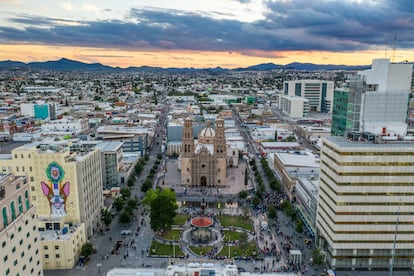
To come into contact with local gastronomy, there’s nothing like breakfast at Enrizos. Only when you’ve tried one of their montados (whose fillings are folded into generous tortillas, similar to a burrito) can one understand the lines that form starting when its doors open, and how deeply rooted the restaurant is in local culture. In the town’s center, in the Plaza de Armas located next to its Baroque cathedral (1725-1825) and the equestrian statue of the city’s founder, Antonio de Deza y Ulloa, to one side of the Eloy Vallina building inspired by Art Deco forms, there is a mural with an image of a colorful Chihuahua dog under a peyote plant, a graphic that brings to mind the construction of the railroad that would link Chihuahua with the Pacific (and which for various reasons was delayed from 1881 to 1961) as well as the Chinese workers who arrived from San Francisco to work on its section that passed through Chihuahua in 1914. Some of them came accompanied by their pets, tiny dogs that their boss, a U.S. engineer, began to call Chihuahuas — and the rest is history.
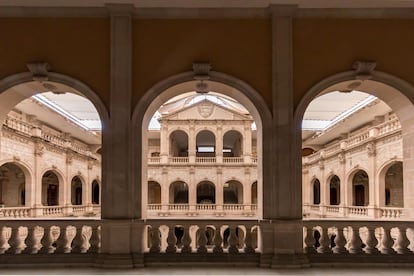
But if we’re talking murals, the central area’s most interesting examples are those of David Alfaro Siqueiros. The muralist born in Camargo, Chihuahua never tired of representing his roots, and was so visceral and combative he was thrown in jail seven times. His memory, which lives on in works like his vast mural La marcha de la humanidad (The march of humanity) is a return to a golden age of Mexican culture. Angel or demon, Siqueiros was quite a character, and adopted the name “David” out of his admiration for Michelangelo. Continuing Siqueiros’s artistic tradition is the sculptor Sebastián, known as Enrique Carbajal, a fellow son of Carmargo who is known for his yellow Cabeza de Caballo (Horse’s Head) on Paseo de la Reforma in Mexico City. He has three powerful works that can be seen in the city of Chihuahua: La Puerta de Chihuahua (The Gate of Chihuahua), La Guirnalda (The Garland), and La Puerta del Sol (The Gate of the Sun).
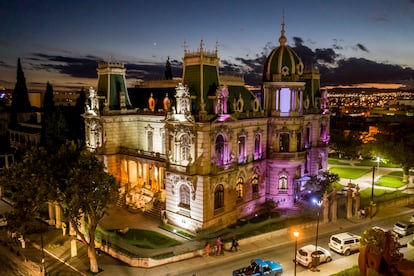
Quinta Gameros is a delirious Art Nouveau house designed by Colombian architect Julio Corredor Latorre for the Gameros family after living in Brussels, where Latorre became fascinated by Victor Horta. The furniture inside the house is equally organic, designed to harmonize with a space that has become a top attraction in a city where, truth be told, sotol is not the only thing quenching people’s thirst, as a local wine industry is on the rise. To get to know top-shelf Chihuahuan wine, it is worth booking a trip to Hacienda Las Ruelas, home to the Tres Ríos winery run by Consuelo Meléndez and sommelier Alejandro Rubio, a connoisseur and expert who talks about his wines (note the white chardonnay in particular) by alternating between technical explanations about balance and equilibrium and phrases like “wine is the only art form you can drink” and “a bottle of wine is a conversation waiting to be released.”
If you get hungry on your way back to the city, you’ve got two excellent options. La Casona is a restaurant located in the historic home of Luis Terrazas, a building that has seen it all, including Benito Juárez, who took refuge there in 1865 and 1866. It now houses a benchmark for haute cuisine. Nearby, there is the restaurant El Poeta, in the wonderful and affordable boutique hotel Central, located in Casa Trias, the northern capital’s oldest estate where history, art, gastronomy and of course poetry coexist, their presence even felt in the design of dishes and names of its rooms. This, due to the passion of owner Jaime Santiago Camino Creel, who can recite works of Octavio Paz and Rubén Dario from memory.
Beyond the city
Chihuahua is home to many tourist attractions beyond the capital, which makes the state a thriving destination for those looking to get away from the crowds to something that offers real authenticity. Let’s take a look at some of these sites.
On the road to the town of Creel, one can stop in Cuauhtémoc, the city of three cultures (Mennonite, Chabochi and Mestizo) where a vast Mennonite community really stands out. They are followers of a pacifist branch of the Anabaptist Christian movement that originated in the 16th century during what was called the Radical Reformation, and whose influence on the daily life and cuisine of the city is unusually prominent. The story of the Mennonites’ arrival in 1922 and their subsequent adaptation to the area is well illustrated at the Mennonite Museum, a truly fascinating stop on our tour. The order was founded in Switzerland five centuries ago and as a nomadic people, they passed through Germany, Russia and Canada before settling here. Their way of life and some of the dilemmas they face were beautifully portrayed by film director Carlos Reygadas in his movie Silent Light (2007).
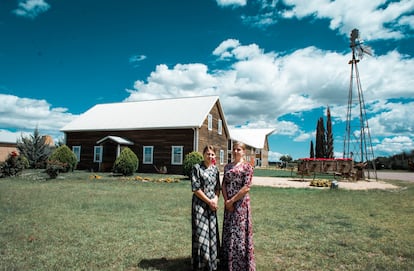
Creel is one of Mexico’s 177 pueblos mágicos, villages that have received the official designation due to the mythical character and preservation of traditional culture. Its charm is appreciated by European backpackers and enthusiastic Mexican tourists alike. Consider renting a quad bike (called a cuatrimoto here) to travel to the Indigenous community of San Ignacio de Arareko for a truly eye-opening visit.
“Tarahumara” is the word that was used by the Spanish when they proved incapable of pronouncing Rarámuri. Today, seeing Rarámuri women making crafts in the caves in which they live, or walking at a quick clip, it is impossible not to think of runner Lorena Ramírez, who appeared on the cover of the Mexican edition of Vogue and whose story was adapted to film by Gael García Bernal, who produced the Netflix documentary Lorena, la de pies ligeros (Lorena, the swift-footed one). Her tale represents her culture and its way of thinking, living, dressing, running, and inhabiting the world. The Tarahumara people’s swiftness was detailed in Christopher McDougall’s book Born to Run, which became a worldwide bestseller. Ramírez’s attitude towards the sport of running hinged on the concept of competing with no need to win and can serve as a lesson that principles should always be first to cross the finish line.
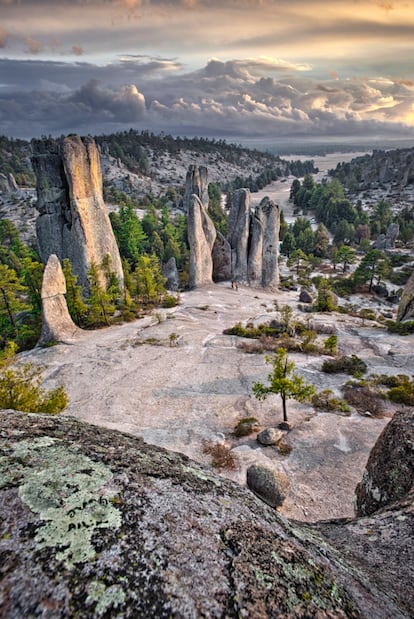
The impression left by the rocky formations of the Valley of the Mushrooms, Frogs and Monks is enough is worth pushing back one’s visit to Sebastián’s cave, Lake Arareco and even dinner. It’s a real pleasure to contemplate rocks that erosion has shaped so precisely. Below them is a stone church called La Misión that serves as reminder of the presence of Jesuits in the area, and in the film The Mission (1986).
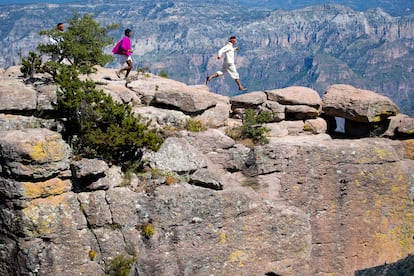
If you don’t see any buildings a few miles southeast of Creel, that’s because the area’s Ráramuri residents live scattered throughout the surrounding forest, We have to cross it to finally descend into the Valley of the Monks, also called the Valley of the Gods, where gigantic vertical rocks rise up to 200 feet tall. Some daredevils even climb these formations. The presence of the Ráramuri helps one to become acquainted with this highly spiritual site. Children who accompany tourists always have a secret to reveal, a viewpoint or a piece of advice for visitors. We are in the heart of the Tarahumara mountain range, feeling something similar to self-reflection, communing with the mystery of nature in its purest and most essential form.
In Creel, the Tarahumara Museum of Folk Art, located next to the old train station, teaches of the fundamentals of this pre-Hispanic culture through diverse elements related to ethnography, folk art and history. The best place to stay is The Lodge, a rustic hotel that is without a doubt the best the area has to offer, with wood cabins equipped with chimneys so characteristic to the area — and its integration with the natural landscape is impressive.
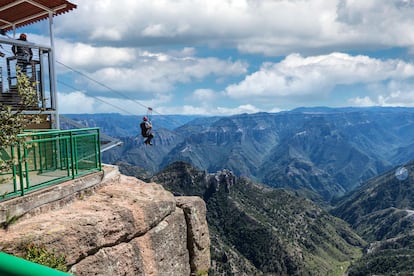
The Oteros River viewpoint imparts a 5,000-foot vista and the opportunity to be purified by Doña Catalina, a Ráramuri shaman who lives in a wooden cave in the foothills. She employs smoke, a potion and an egg, waving it over one’s head. Amid the folklore and catharsis, one is reminded of the legendary María Sabina and of Carlos Castaneda and his The Teachings of Don Juan, both teachers of the altered states of consciousness. Meanwhile, we approach the Divisadero, where the meeting of the three barrancas or canyons (the Cobre, Urique and Tararecua) makes for one of the most energizing landscapes one can witness. The 6,000-foot drop is unfathomable, and demands contemplation. If, instead of merely observing, you prefer to venture across the abyss, you can fly over it on a zipline that has put Barrancas Adventure Park on the map for adrenaline junkies. They say it is the longest in the world at 8,400 feet, it reaches speeds of 83 miles an hour and lasts three minutes, from sky to Earth.
It is also without a doubt the best introduction to Hotel Mirador, which is probably the most important site in Cobre Canyon, with serenely beautiful views that appear to have been painted by a Dutch master of the Golden Age. Its pure, transparent mysticism must be observed at all hours so as not to miss a single detail, whether in the soft morning light when shadows darken its nuances, or at night, when only twinkling stars are visible. It is a favorite of those who love waking up at 6 a.m. to see the sunrise arrive at its unhurried pace, with the crowing of roosters and birdsong and the echoes of distant dogs barking. The light gradually returns color to the landscape, allowing the mountains to wake up to the day. Clouds and a light mist, which sigh like smoke on the other side of the mountains, add to a spectacle that combines ceremony and purity. The moon still hangs high in the sky, watching over the appearance of the sun, whose warm rays break through the mist to crown and brighten a morning in which the colors of the peaks, both high and low, intensify.
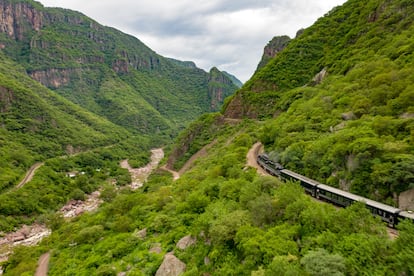
One might also see them reflected in a lake, as with the mountain down which the famous Chepe Express descends to connect Chihuahua with the Pacific as the state’s most profitable and well-known tourist attraction. From Divisadero to Los Mochis, seven hours without cell phone coverage await riders, something that these days, should be considered a luxury.
Sign up for our weekly newsletter to get more English-language news coverage from EL PAÍS USA Edition









































