
Trapped by the ‘incel’ algorithm in Mexico: ‘I thought I would always live miserably’
EL PAÍS spoke with young people immersed in a community that navigates a digital universe marked by hate speech and threats that operates unchecked

William believed his life was a failure when he was just 16. It was 2021, and he was going through a personal crisis, comparing himself to other people. “I’d never had a girlfriend, and my classmates made fun of me for being a virgin,” he confesses. He felt like everyone had failed him. He went online looking for answers, and the algorithm guided him into incel forums, a digital universe filled with hate speech and threats that operates unchecked. Something similar happened to Javier, who fell into these blogs during the pandemic. He wanted to take advantage of the lockdown to get in shape by looking for exercise routines, but other suggestions popped up instead. “Little by little, without realizing it, incel content appeared,” he confesses. This movement, which is growing globally, conceals radicalized followers like Lex Ashton, the 19-year-old student who murdered a classmate at his school in Mexico City last week. EL PAÍS spoke with three young incels who described the frustration and loneliness that led two of them to consider committing violent acts.
Hopelessness kept William, 20, hooked on forums where misogyny flourishes. For him, those places proved liberating. “Finally, I could listen to realities that had been worrying me and making me feel insecure without fear of retaliation,” he says. He saw how the Facebook groups he belonged to grew from 4,000 members to tens of thousands in just a couple of years. His thinking has changed today: “I’m pretty good. I have a girlfriend, I’m studying for a degree, I go to parties, something I never did before I was 17,” he says.
Javier identifies as a young man frustrated by his inability to make romantic connections. He describes entering that world as “a black hole” into which it’s easy to fall when someone feels rejected. He explains that behind the discipline and hegemonic masculinity there lies an extremist ideology. “It’s easy for misogynistic messages to appear there: ‘They’re all whores, all acting out of self-interest.’ No one gives you a ‘welcome to the club’ badge. You just log into channels and suddenly certain terms appear. When I see violent acts related to this issue, I think: ‘Wow, I’m into this.’ It’s hard for me to imagine having anything in common with someone who commits an atrocity,” he admits.
Fatalism in the ‘Black Pill’
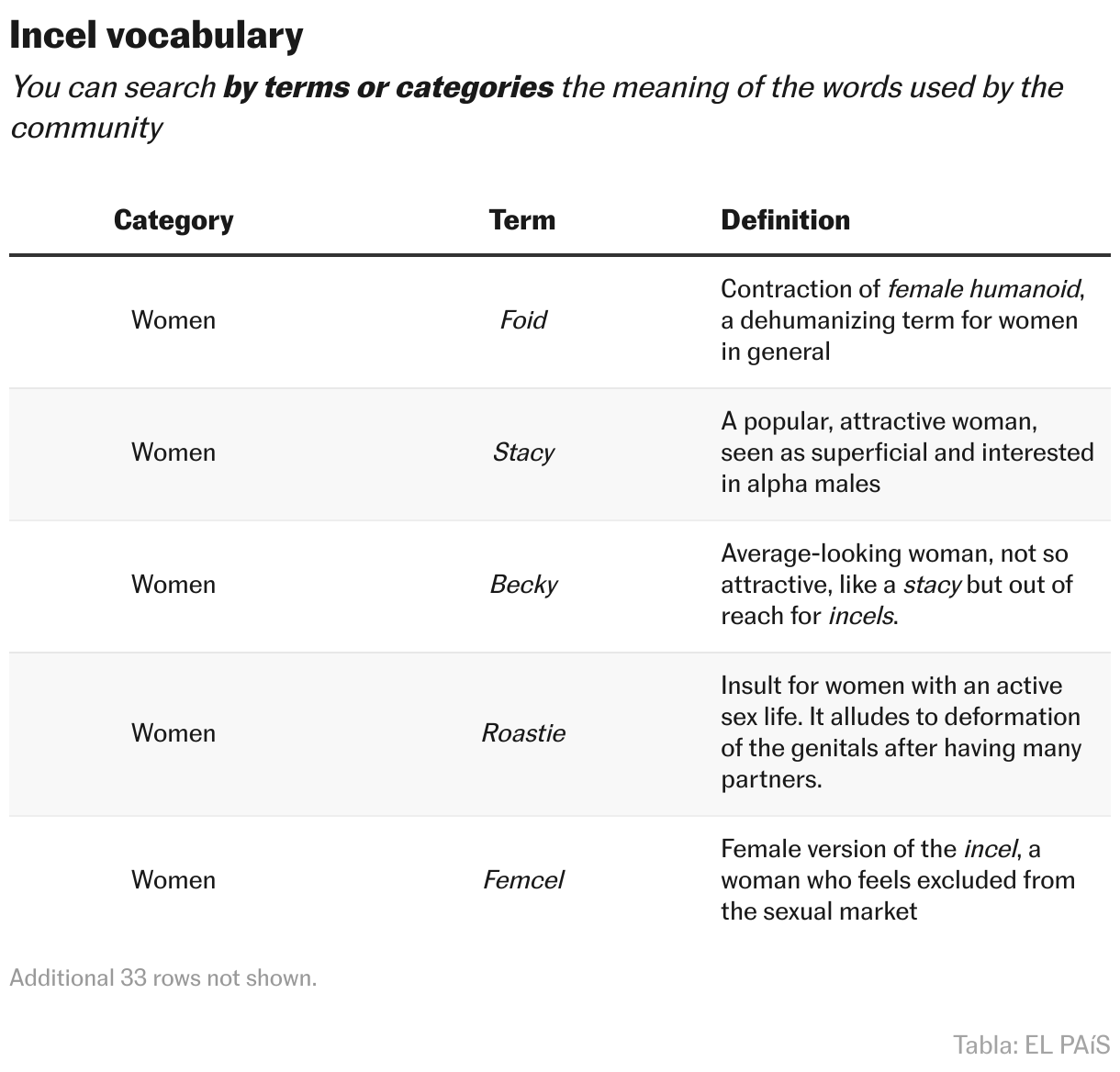
The director of the childhood advocacy group Tejiendo Redes Infancia, Juan Martín Pérez, groups this type of sexist rhetoric under the label of the manosphere, an online reaction that opposes feminism. “They label these groups stoicism, as in ‘work hard, stay away from those who don’t listen to you and don’t value you.’ They isolate them and then sell them [motivational] courses,” he says. Within this world, a particular language is used. Chads are attractive, popular men who represent masculine “success,” while foids is a contraction for “female humanoid,” a derogatory term used to dehumanize women. They have also given names to the ideologies and social dynamics in which they operate.
I have a hard time imagining that I could have anything in common with someone who commits an atrocityJavier, 30, 'incel'
William encountered one such label, the Black Pill, a movement that promotes the idea that sexual success depends solely on genetics. “They tell you that you’re not attractive and won’t be attractive even with surgery, because there are irremediable issues like height [...] I could say ‘it’s not all my fault,’ but that led to despair. It evolves in a very bad way. I thought I would always live a miserable life,” he confesses.
This was the stage in which he became more radicalized and considered attacking others and publicly taking his own life. He discussed these ideas on Facebook. He explains that violent attacks are not “openly” promoted in the groups on that social network to avoid being blocked or investigated, but the sanctions are easy to avoid. “You can create groups with a specific subject and control who enters and leaves. The rules are a facade: administrators discuss and even glorify those who have committed something [violent],” he points out.
Luis, like William, claims he was close to committing a fatal act. This 20-year-old from the State of Mexico reached that point because of the helplessness he felt. “The people who mistreated me weren’t going to pay if I didn’t do something. They stole my self-confidence, my self-esteem,” he says. The young man, who is also part of a Facebook group, looked up to one of the members. “His ideology, so to speak, was to give up and turn his back on the world,” he notes. However, he asserts that not all cases reach that extreme. “I’ve heard [that we were linked to] terrorism. But not all. We are sad men, whether due to bullying, harassment, or a negative environment. We don’t have the best self-esteem,” he explains.
The stories of the young people covered in this story all agree that the algorithm led them to the forums through searches for exercise routines or questions about their bodies and relationships with others. Pérez explains how relentless this algorithm is: “The platforms’ business is attention, keeping you trapped. An angry teenager who asks what false accusations are will automatically be directed to incel and far-right groups.” Bezanilla denounces the lack of greater oversight: “The platforms must assume some responsibility, without hiding behind the debate on freedom of speech.”
Ashton murdered his 16-year-old classmate Jesús Israel last week at the Colegio de Ciencias y Humanidades Sur in Mexico City. Before the attack, he posted his plans on an incel Facebook forum and shared explicit photographs of the weapons and clothing he used for the attack, a dynamic reminiscent of school shooters in the United States. EL PAÍS has contacted Meta, Facebook’s owner, to address its position on the issue. “We have taken action against content that represents and glorifies Lex Ashton on our platforms since the unfortunate incident was reported, for violating our policy against dangerous individuals and organizations,” the company states. Although they do not detail why groups posting threats continue to appear, Meta notes that they are “closely monitoring the case” and assure that they will “take action against content that poses a threat in the real world.”
The director of Tejiendo Redes believes that incels already have their own social representation: “[They appear in the collective imagination] as teenagers or young men glued to their screens, dirty, angry, mentally ill. And it’s not like that. Incels, for the most part, go to school, have economic activities [...]. There is no typical profile,” he explains.
In the United States and Europe, the movement’s echo has been heard more strongly, but it has already crossed more borders. Bezanilla explains why it’s becoming more visible in Mexico and points to several key factors: “The social and institutional order constantly violates us: a deficient education and healthcare system, lack of safety, job insecurity. All of this generates frustration, stress, and vulnerability.” He insists that institutions must assume their role. “Official statements never acknowledge structural responsibility. It’s easier to psychopathologize the aggressor than to admit that the context is also failing.”
A context marked by violence, a twisted algorithm, and a worsening mental health crisis following the pandemic all come together in a pressure cooker, ultimately revealing society’s structural shortcomings. “These generations have been almost entirely abandoned by the adult world, and it’s the responsibility of families, schools, and the country as a whole,” Pérez concludes. William has let go of the rope that tied him to that digital universe. But not entirely. “I haven’t distanced myself; I relapse and continue to visit these places frequently, whether out of curiosity or because I’m nostalgic,” he admits.
Sign up for our weekly newsletterto get more English-language news coverage from EL PAÍS USA Edition









































