
Amid protests and corsets, the Bezos’ takeover of the Met Gala hints at end of an era
Anna Wintour legitimizes Lauren Sanchez Bezos as a leading cultural figure at the Metropolitan Museum of Art’s pre-exhibition party in New York, alongside celebrities such as Beyoncé, Bad Bunny and the Kardashians

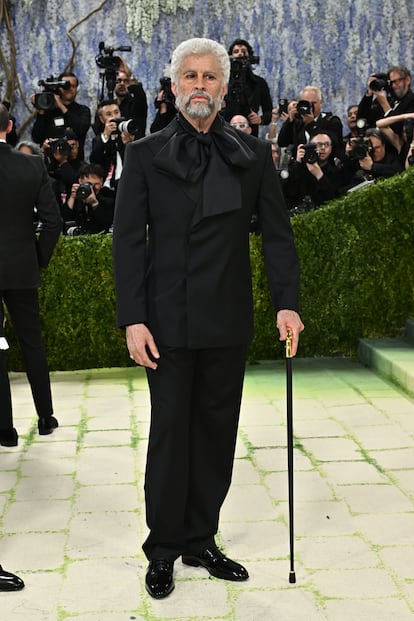
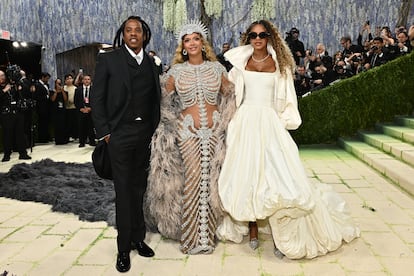
Beyoncé may have brought her family and worn a silver-and-crystal-jewelry dress made to look like a skeleton for her first appearance in 10 years at the Met Gala. Bad Bunny may have looked like a venerable old man dressed in a Zara suit. The Kardashians may have brought out the big guns—and big corsets—to wear on the most famous steps in the world. But this year, beyond the celebrities, the beautiful dresses, the much-needed inclusivity, and the messages about the conversation between art and fashion, the Metropolitan Museum of Art’s gala in New York will be remembered for another issue, one that seems even more important than highlighting body diversity, or how fashion itself is also art: how wealth, changing with each generation, can alter the narrative, take over culture, create a rarefied atmosphere and even usher in a new era.
On the first Monday in May, as has been the custom for eight decades, the Met was filled with celebrities, presided over by Anna Wintour, to celebrate the annual fashion exhibition, raise funds for the museum, and celebrate the undeniable link between art and fashion. But this time there was something more: Jeff and Lauren Bezos as the personal sponsors of the gala, with a contribution of between $6 million and $10 million, which changed everything. It’s not the first time that technology companies have financed this major event of global philanthropy and fashion. Nor is it the first time the couple has attended. But it is the first time they appeared to be paying for their presence, and under Wintour’s seal of approval.
The Bezos family has legitimized their access to high culture thanks to this event, which was preceded by features and even covers in Vogue, appearances at fashion shows, and meetings with social and cultural figures. Meanwhile, walls in New York have been plastered for days with protests against the world’s fourth richest man and his second wife, against Amazon’s labor policies, and against their support for the Trump administration. However, their millions seem to have been worth more to the ever-progressive Wintour and her beloved Met Fashion Institute, her great protégé.
It wasn’t just a minor tantrum. The opposition has been as discreet as the opulence of this event, but at times, it has been outspoken. There have been a few, but vocal, protesters outside the event. Even the mayor of New York, Zohran Mamdani, refused to attend. But Wintour has legitimized her protégés in every way possible. On Monday morning, at the press preview of the exhibition, the gala’s queen made an unprecedented gesture: after decades at the helm, she spoke to the press for the first time. And without sunglasses—a landmark moment.
The former editor-in-chief of Vogue said the exhibition was “about everybody, and it’s about every body,” and praised the co-hosts, Beyoncé, Nicole Kidman, and Venus Williams. But above all, she praised Lauren S. Bezos, who was present with her. She didn’t hesitate to explain at length how the donor “came to every important meeting full of enthusiasm and good ideas.” Of her and the three celebrities, she affirmed that “they have a desire to change things when we all agree that change is necessary.” Then she invited Bezos herself to speak, whom she described as “a great friend and a great supporter of the museum.” That afternoon, at the gala, they entered together, the first to arrive.
Even the museum director was being questioned about the matter. After the morning’s press conference, Max Hollein answered questions from several Spanish media outlets, including EL PAÍS, about the gala, the controversial presence of the Bezos family, and a possible boycott. The guest list is never officially confirmed, so it’s never known for sure who will be absent. But this year, some celebrities were missing, perhaps due to prior commitments or the awkward presence of the tech magnates. “We are celebrating the museum, celebrating fashion,” Hollein explained. “We are celebrating what we can offer to millions and millions of visitors. This is an institution that depends on the generosity and support of our donors and philanthropists. And that is precisely what this exhibition has represented for many years, and we will continue to do so,” he stated evasively.
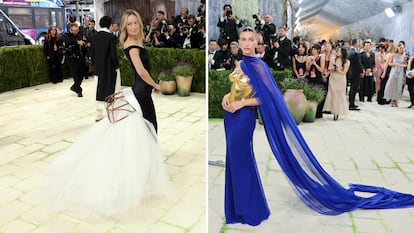
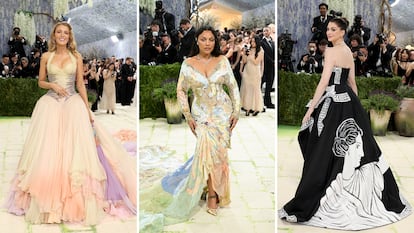
For now, media attention remains immense. Dozens of celebrities have passed through the famous staircase, and this year, they had to adhere to the theme “Fashion is art,” closely linked to the exhibition “Costume Art” (which can be seen from May 10). Hence, much purely artistic inspiration has been seen—from paintings, sculptures, and other works—in jackets and dresses, ranging from the “artsy” to the Greco-Roman: singer Sabrina Carpenter’s Dior dress was made of film reels; model Paloma Elsesser’s was covered in paint splatters and splashes; Blake Lively’s endless tulle Versace gown was multicolored; and actress Anne Hathaway’s Michael Kors dress featured Greco-Roman designs. Even Elizabeth Debicki and Suki Waterhouse wore wings on their heads, and Madonna sported a boat as a hat. Many garments revealed semi-naked torsos and buttocks, such as the dresses worn by Gigi Hadid, Kate Moss, and Simone Ashley.
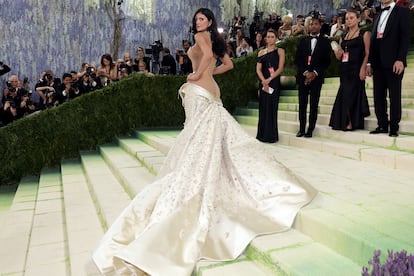
There were sculptural moments, including those featuring the Kardashians: Kim’s orange plastic body with pointed breasts; Kylie Jenner’s corset, with an unbuttoned Schiaparelli dress revealing what appeared to be her skin, with her nipples and navel falsely defined; Kendall’s draped dress, also featuring a trompe l’oeil of bare breasts. Other artistic inspirations included Hailey Bieber’s gold bustier with a blue skirt, Margot Robbie’s Chanel dress wrapped around her body, and Olivia Wilde’s Degas-esque ballerina bustle. There were covered faces, like those of Katy Perry, Rachel Zegler and Gwendoline Christie, wearing masks mimicking their own faces, but few have played with appearance as much as Bad Bunny, unrecognizable as an old man, in a nod more to the exhibition’s theme than to that of the gala.
The Puerto Rican singer wore Zara, with a look designed specifically for him by the Spanish brand and its team. In fact there was a good dose of Spanish fashion on display, as singer Stevie Nicks’ velvet dress with a top hat, at her first Met Gala at age 77, was also from Zara’s parent company Inditex, specifically created in anticipation of Zara’s upcoming collection by Galliano, which will arrive in September. Inditex chair Marta Ortega and her husband, Carlos Torretta, also walked the red carpet, officially attending their first Met Gala. And Luke Evans’ erotically tailored leather suit was created by Palomo Spain.
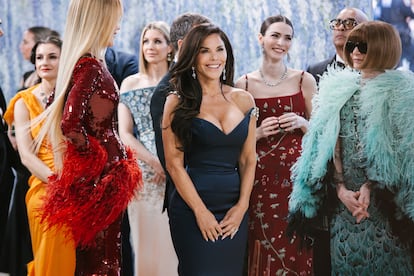
Lauren Sanchez Bezos, for her part, wore a midnight blue Schiaparelli corset dress, clearly inspired by John Singer Sargent’s painting “Madame X,” the portrait of a wealthy French banker’s wife from the late 19th century that hangs in the Met. The strapless look was also seen on actresses like Julianne Moore and Claire Foy. Interestingly, and despite the hefty check, Jeff Bezos was not present on the red carpet.
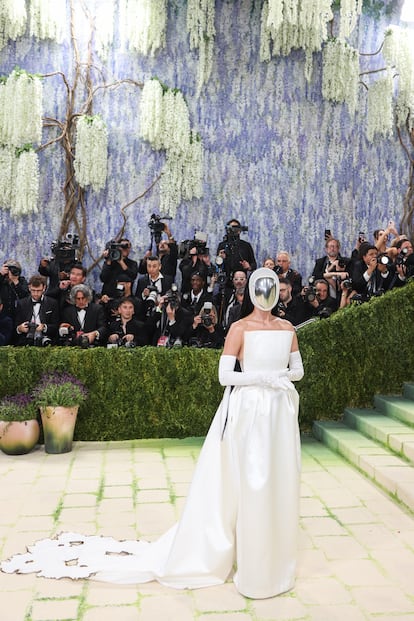
When the staircase finally emptied, after nearly five hours of a seemingly endless procession, the guests departed for dinner inside the museum. Each ticket costs around $100,000 per person (prices are not publicly available). The general public has no access to the gala; at most, they can only peer through a peephole across from the entrance on Fifth Avenue. The accredited press, a very small contingent, is only allowed as far as the staircase, which is crammed with hundreds of photographers teetering precariously with their cameras in a cramped space.
In reality, the Met Gala in recent years, especially the last two decades, has become an increasingly inflated bubble. The ultimate motive is philanthropy, but this relentless pursuit of money could end up being the event’s downfall, and who knows, perhaps even the exhibition space itself. If the Fashion Institute becomes self-sustaining beyond the gala—according to The New York Times, it has been running a surplus for about a decade and saving for the future, and could become self-sufficient in two to four years—and Wintour’s influence diminishes, perhaps the event itself will also fade away, or at least its nature will change. For now, the Bezos family’s involvement seems more like a turning point into a new era of billionaires seeking visibility and public power, and a moment for reflection. But for now, the Met Gala is still very much alive.
Sign up for our weekly newsletter to get more English-language news coverage from EL PAÍS USA Edition









































