
Displaced by Colombia’s conflict, now uprooted again by the earthquake: ‘We arrived with nothing and we’re back to having nothing’
Hundreds of people are facing the prospect of displacement yet again, this time after the quake that destroyed thousands of homes and left more than 300 dead
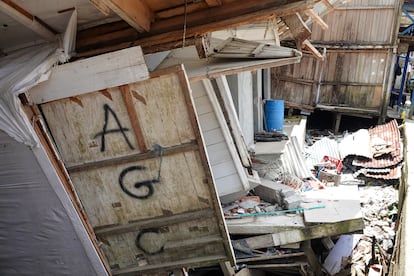

Mario Suárez was already awake when the ground beneath his feet began to shake. He waited a few seconds, but the tremor did not stop. Grabbing his children by the hand, he and his wife rushed outside, where they watched their home crumble before their eyes. They were not alone: the three-story building in the Miraflores neighborhood of Buenaventura housed 22 families, nearly 100 people. All belonged to the Wounaan Nomaan Indigenous community, which had been driven from its ancestral lands four years earlier by the violence of Colombia’s armed conflict.
Two weeks after the August 10 earthquake that struck western Colombia and left more than 300 dead, these families are still living in a makeshift shelter. Their plight reflects that of hundreds of victims of forced displacement who had already lost everything once and now fear having to uproot their lives again amid deep uncertainty.
“We arrived in Buenaventura with nothing, and today we’re back to having nothing. This is a hard economic and psychological blow for the entire community,” Mario says by phone. His name has been changed for security reasons. A member of the Valledupar Indigenous council, he recalls that until a few years ago his community lived peacefully in Bajo San Juan, a Pacific region straddling the departments of Chocó and Valle del Cauca, north of Buenaventura. Everything changed five years ago.
“Armed groups began to move through the area. We tried to resist the recruitment of young people, the disappearances and killings, but in 2022 we couldn’t do it any longer, and that is why we left. We abandoned our homes, the school and our crops,” says Mario.
Several armed groups operate in the region, which remains fiercely contested territory. Colombia’s Ombudsman’s Office and other institutions have documented the presence of the Gulf Clan, the ELN guerrilla group and dissident FARC factions, all seeking to control drug-trafficking routes and access to the Pacific Ocean.
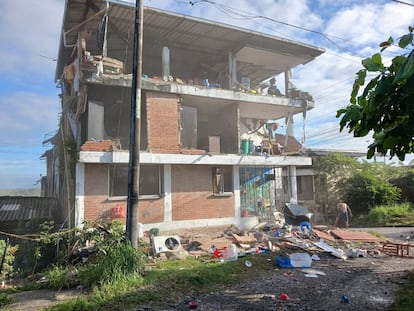
Until August 10, the roughly 20 families who had been forcibly displaced to the Pacific port city were living in a building that once operated as a local radio station. They worked as artisans and made a living from their handicrafts. All of their products were buried beneath the rubble. “We are victims twice over. It is a terribly sad situation,” Mario laments.
In the 15 days since the earthquake, which left their home uninhabitable, the nearly 100 residents of Buenaventura have gone from sleeping on the streets to sheltering in a makeshift refuge not designed for long-term use. The Indigenous leader explains that since their initial displacement, they have been waiting for the national government to relocate them permanently to a municipality in Valle del Cauca, close to the area where they lived before being driven out by armed groups.
This community is not an isolated case. Giovanni Rizzo, director of the Norwegian Refugee Council in Colombia, says the organization has documented several similar situations in the departments of Valle del Cauca and Chocó, both major hotspots of organized violence. Among the affected populations are not only internally displaced people but also Venezuelan migrants.
“The earthquake not only damaged infrastructure, it also deepens vulnerabilities and widens gaps in access to services such as education,” the expert says. The severity of the conflict must be taken into account because of its particular dynamics, he adds. “I met a woman who said she would rather have a roof collapse on her than sleep in the street because of her fear of armed groups.”
The international aid organization has documented several cases of displaced people who fear they may be forced to move once again after the earthquake damaged their homes. According to the Internal Displacement Monitoring Centre and local authorities, Colombia was home to 7.2 million internally displaced people as of last year.
Although the vast majority were forced to migrate because of the armed conflict, an increasing number are being displaced by natural disasters or extreme weather conditions such as droughts or floods. This phenomenon, known as climate migration, is recognized by the United Nations and affects more than 30 million people worldwide. Most displacements occur within the affected country.
This is a concern for Juan Carlos Palacios, president of the neighborhood action committee of La Victoria, located in Quibdó, the capital of Chocó. He himself is displaced. Palacios was born in Bojayá, one of those municipalities etched into Colombia’s collective memory, in this case because of the massacre in a church that claimed the lives of more than 100 people, according to figures from the National Center for Historical Memory.
“I am a victim, but I was lucky this time. My house has minor cracks, but schools in the area collapsed and many neighbors’ homes were destroyed,” he says by phone.
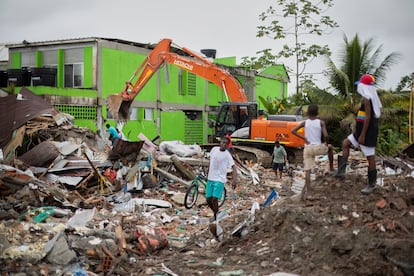
Among those who lost their homes were people who had already been displaced by violence. Some are now weighing whether to move again. “Some people have already moved to other neighborhoods or to relatives because they have nowhere to stay. They have to relocate because renting is very difficult,” says Palacios.
By difficult, he means rents have soared in the city, a trend that has also been reported in other cities, including in Cali. Those who remain in the neighborhood are staying in a shelter that was never equipped for an emergency of this scale. “We have mattresses and pillows, but no blankets. There are no bathrooms and no electricity.” About 40 families are currently living there.
Across the region, survivors of the earthquake are making the same appeal: that local authorities remain engaged beyond the immediate aftermath of the disaster, continue reconstruction efforts and take into account the additional vulnerabilities affecting hundreds of residents.
In the case of the Indigenous council in Buenaventura, Mario is urging authorities to allow the community to resettle as soon as possible and ensure they can remain together. “Some officials wanted to move us to shelters, but they only held two or three families. We must stay together because we risk losing our community organizing process,” he argues.
For his part, Palacios is calling on both authorities and civil society to maintain their support. “The rescue phase is over. What remains is relief efforts and reconstruction, which can take years.”
Sign up for our weekly newsletter to get more English-language news coverage from EL PAÍS USA Edition









































