
Russian drones in Poland and Israel’s attack in Qatar undermine Trump’s international influence
The incidents highlight the failure of the US president’s strategy to achieve peace on two fronts
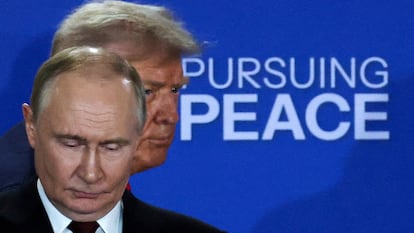

Two blows on the geopolitical chessboard separated by only a few hours have served to highlight the failure to date of Donald Trump’s strategy to achieve peace in the two wars he promised to end as soon as he took office. They have also called into question the Republican’s international credibility and his image as the leader of a strongman club that also includes Russian President Vladimir Putin and Israeli Prime Minister Benjamin Netanyahu, two leaders determined to test his patience.
First, there was the unilateral Israeli strike against Hamas leaders in Doha, the capital of Qatar. The White House later acknowledged that Washington had not been warned of the operation, although the U.S. military did alert Trump, who that evening in an unusual gesture criticized Netanyahu, his great ally in the Middle East (and also, in both their words, a “friend”), for bombing another U.S. ally in the region.
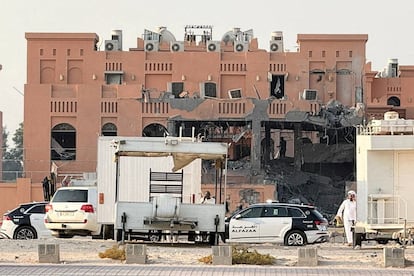
Afterward, Trump shared his “discontent” with the press. “We have to secure the release of the hostages. But I’m very disappointed with how everything unfolded,” he declared, referring to the fact that his special envoy to the Middle East, Steve Witkoff, warned Qatari authorities of the attack, as requested by Trump, when the bombs were already falling on Doha.
Around the same time Trump made those remarks outside a Washington restaurant, news broke that 19 Russian drones had been shot down after entering Polish airspace. This marks Moscow’s first real act of intimidation against a NATO member since the start of the war in Ukraine three and a half years ago, and one that can be interpreted as an escalation of the conflict with unpredictable consequences. Poland shot down the unmanned aircraft with the help of other NATO allies (such as the Netherlands, which provided two F-35s), and Prime Minister Donald Tusk described the incident as “an act of aggression.”
The Kremlin maintains that Warsaw was not “the target,” and neighboring Belarus, a Moscow ally, claims the drones “flew off course.” Until the incident is clarified (NATO Secretary General Mark Rutte said Wednesday that, “whether it was intentional or not, it is absolutely reckless. It is absolutely dangerous,” and pointed out that it was not an “isolated incident”), one thing is clear: Putin continues to play games with Trump without too many consequences.
During the election campaign that brought him back to the White House, Trump promised to end the war in Ukraine on his first day in office: now 233 days have passed, and there has been no progress worthy of the name toward achieving peace between Moscow and Kyiv. It has also been 22 days since Putin and Trump met at a military base in Anchorage, Alaska, a meeting in which the U.S. president not only brought his counterpart out of international isolation and shelved threats to impose new tariffs on Russia to force the Kremlin to alter its course, but also accepted Putin’s main demands to begin talks on ending the war. In total, Russia has occupied about 20% of Ukraine’s territory.
Since then, Putin has been heaping praise on Trump while intensifying his war effort, which, in addition to the invasion of Polish airspace, has included the largest missile and drone attack to date, launched last Sunday. All these military actions appear designed to provoke Trump into toughening his stance on Russia and to make clear that Putin is only willing to end the war in Ukraine on his own terms.
The drone incursion into Poland comes a week after a visit to Washington by Polish President Karol Nawrocki, the ultranationalist historian and amateur boxer with whom Trump shares a personal connection. During that visit, the U.S. president promised that his country would maintain a strong military presence in Poland. “We will support you at all times,” Trump promised.
Polish Foreign Minister Radek Sikorski addressed the Republican during a press conference in Warsaw on Wednesday, demanding that he fulfill those promises. “Putin laughs at President Trump’s peace efforts,” Sikorski declared. “Since Alaska, he has only escalated the war. I hope [the U.S. president] backs up his words with actions.”
While we wait to see whether Sikorski’s wishes are fulfilled and Washington’s reaction to Poland — a country with which the United States shares NATO membership and with which it is therefore bound by a commitment to mutual defense as provided for in Article 5 of the NATO Treaty — we can conclude that Russia’s provocation and Israel’s unilateral actions are undermining the image Trump seeks to project: that of a statesman who came to restore order to the international stage. They are also undermining his aspirations to win the Nobel Peace Prize, an award he believes he deserves for his efforts to end the wars in Gaza and Ukraine.
It’s ironic that on Tuesday, while the Polish army shot down Russian drones, Trump exerted another kind of pressure on the Kremlin — certainly softer, almost armchair-like — by urging his EU allies to impose tariffs of up to 100% on China and India, the main buyers of Russian oil, as part of a strategy to pressure Putin, according to several U.S. media reports.
An EU delegation is currently in Washington to discuss coordinating sanctions between the two allies. According to Reuters, the operation would be completed with the imposition of similar tariffs by Washington, once the EU has taken the first step. If it is proven that the drone crisis in Poland is part of Putin’s plan to escalate the conflict beyond Ukraine, these economic weapons may not be enough.
Sign up for our weekly newsletter to get more English-language news coverage from EL PAÍS USA Edition









































