
NATO warns of risk of escalation after Russian drone incursion into Poland
Polish Prime Minister Donald Tusk believes the incident puts Europe ‘the closest we have been to open conflict since World War Two’
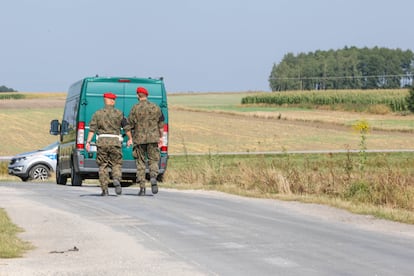
The downing of Russian drones in Polish airspace has once again reminded Europe and NATO that war is at their doorstep and could break through at any moment. Condemnation of Russia’s “dangerous” and “reckless” violation of Polish airspace — the most serious clash between the Atlantic Alliance and Moscow since the start of the Russian offensive in Ukraine in February 2022 — has been resounding and unanimous. And, although caution is still being urged in the face of an incident whose intentionality has not been proven — but which has not been ruled out either — the analysis is consistent: it demonstrates the risk of escalation of a conflict in Ukraine that the Kremlin has no interest in halting.
Therefore, European leaders have insisted, Europe must redouble its efforts to improve its deterrence and defense capabilities, in addition to increasing pressure on Moscow through more sanctions.
“A full assessment [of the incident] is ongoing. But of course, whether it was intentional or not, it is absolutely reckless. It is absolutely dangerous,” NATO Secretary General Mark Rutte warned Wednesday at the end of a meeting of the North Atlantic Council (NAC), the Alliance’s main political decision-making body. The meeting, in Brussels, had been planned for some time. However, following the nighttime incident, the Russian violation of Polish airspace and the downing of the drones with the support of allied forces were the main topics discussed at the request of Warsaw, which invoked Article 4 of the Alliance.
This article establishes consultations between Allies “whenever, in the opinion of any of them, the territorial integrity, political independence or security of any of the Parties is threatened.” This action demonstrates the seriousness of the situation: this is only the seventh time in NATO history that this provision has been used. Before Wednesday, the last occasion was in 2022, just after the Russian invasion of Ukraine, when Estonia, in coordination with Latvia, Lithuania, and Poland, requested its activation.
Polish Prime Minister Donald Tusk has ruled out a “mistake” on Russia’s part, saying that “a significant portion of the drones flew to Poland directly from Belarus.” The incident puts Europe “the closest we have been to open conflict since World War Two,” Tusk warned.
EU High Representative for Foreign Policy Kaja Kallas also denounced the incident. “Last night in Poland, we saw the most serious European airspace violation by Russia since the war began, and indications suggest it was intentional, not accidental,” the head of European diplomacy wrote on the social network X.
Call for prudence
NATO, however, is urging caution. Rutte declined to assess the intent of the incident until the assessment of the facts is complete. In any case, he stressed, “what is clear is that the violation last night is not an isolated incident.”
The Dutch politician hailed the “quick and skillful response” of NATO and the allies: he explained that Polish and Dutch aircraft participated in the operation to shoot down the drones, with support from German and Italian teams.
In a message to the Kremlin, Rutte insisted that Russia must “stop the escalating war” and also “stop violating allied airspace.” Furthermore, the NATO Secretary General — who strongly promoted the agreement reached at the Hague summit in June to increase allied defense spending to 5% of GDP — has insisted on the need to “invest more in defense” in Europe and to build a true “deterrent” and “defence posture along the entire eastern flank.” “Know that we stand ready, that we are vigilant, and that we will defend every inch of NATO territory,” he stated.
It was a message also echoed by European Commission President Ursula von der Leyen from Strasbourg. The incident in Poland occurred hours before she was to deliver her annual State of the Union address, an assessment of her policies at the head of the European executive and a roadmap for the political year now underway. This must focus, she insisted, on redoubling efforts to increase Europe’s defensive capacity while increasing pressure on Russia through sanctions. The nineteenth package is already in full preparation.
“[Russian President Vladimir] Putin refuses to meet President Zelenskiy. Last week, Russia launched the largest number of drones and ballistic missiles in a single attack. Yesterday, there was a missile attack on a village in Donetsk, targeting people waiting to pick up their pensions. And just today, we have seen a reckless and unprecedented violation of Poland and Europe’s airspace by more than 10 Russian Shahed drones,” Von der Leyen said Wednesday.
“Putin’s message is clear, and our response must be clear too,” Von der Leyen stressed, calling for “more pressure on Russia to come to the negotiating table” with “more sanctions” and decisive support for Ukraine. “This is Russia’s war, and Russia must pay.”
At the same time, Von der Leyen announced that the EU will cooperate with Ukraine in drone manufacturing, establishing an “alliance” with Kyiv, whose drone industry is considered cutting-edge, and will advance €6 billion for the joint project.
Von der Leyen has also proposed the creation of an “eastern flank surveillance” system, with investments in “strategic capabilities” that allow for “real-time surveillance so that no movement of forces goes unnoticed.”
European leaders have rallied behind Poland in the face of Russian violation of its airspace, which, according to Spanish Prime Minister Pedro Sánchez, is “unacceptable.” It constitutes, added Danish Prime Minister Mette Frederiksen, whose country holds the rotating European presidency this semester, “a threat to the security of Europe.”
French President Emmanuel Macron expressed similar views, calling on Russia to “end the reckless escalation” of the conflict. “This morning’s barbaric attack on Ukraine and the egregious and unprecedented violation of Polish and NATO airspace by Russian drones is deeply concerning,” said British Prime Minister Keir Starmer. The UK, along with France, is leading the Coalition of the Willing’s efforts to prepare security guarantees for Ukraine once the conflict is over. This, as many European leaders have lamented and as this new “provocation” demonstrates, is still nowhere in sight.
Sign up for our weekly newsletter to get more English-language news coverage from EL PAÍS USA Edition









































