
Poland shoots down several Russian drones after an ‘unprecedented violation of its airspace’
The Polish Army has described the entry of unmanned aircraft into its territory as an ‘act of aggression’ and a ‘threat’ to the security of its citizens
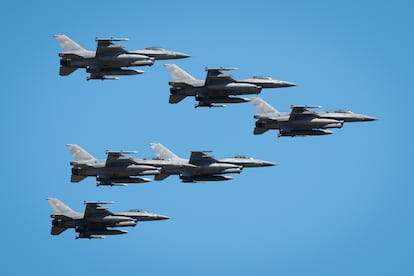

The Operational Command of the Polish Armed Forces reported early this Wednesday that it had shot down several drones overnight that had entered its airspace as part of a new Russian attack against Ukrainian territory. According to a statement from the military command body, after monitoring a “dozen” objects on radar — both by Polish forces and NATO allied countries — it was decided to neutralize those that posed a “threat” to citizens’ safety. The military command described the action carried out by these explosive drones as an “unprecedented violation of Polish airspace.”
Polish Defense Minister Władysław Kosiniak-Kamysz confirmed that Polish fighter jets had used their weapons to destroy “hostile objects.” “We are in constant contact with NATO command,” Kosiniak-Kamysz noted. Prime Minister Donald Tusk expressed himself in the same terms, convening an extraordinary meeting Wednesday morning of the National Security Bureau. “The security of our homeland is our highest priority and requires close cooperation,” stated the country’s president, Karol Nawrocki.
In the early hours of the morning, the Polish Army had announced that, due to the development of a new Russian offensive against targets in Ukrainian territory, aircraft from its air force and those of NATO partners were on alert on a “preventive” basis, as were the deployed air defense systems on the ground.
Just minutes earlier, Ukrainian monitoring channels had reported that several Russian drones had crossed the border and had been shot down by Polish fighter jets. According to Ukrainian air tracking websites, unmanned Geran-type aircraft — a variant of the Iranian Shahed drones used by Moscow in its offensive against Kyiv — first flew over northern and western Ukraine before crossing into European Union and NATO territory. This is the first time that several of these drones have simultaneously entered Poland and continued their trajectory several miles beyond the Ukrainian border.
Their first destination, according to these channels, would have been the Polish city of Zamość, about 70 kilometers (43 miles) from the border. This information has not been confirmed by Warsaw. “Efforts are underway to search for and locate the possible crash sites of these objects,” the Polish military command said in its statement. Polish police have already found a first damaged drone in the town of Czosnówka, near the Belarusian border.
The Polish General Staff has urged citizens that if they find a downed drone or any fragments, they should not approach, touch, or move the device. “Such elements may remain dangerous and must be inspected by sapper patrols,” it warned.
Airport closures
Rzeszów Airport, in eastern Poland about 60 kilometers (37 miles) from the border crossing into Ukraine, announced its temporary closure overnight due to aerial activity. Later, according to a note from the U.S. Federal Aviation Administration, Warsaw’s Chopin International Airport also ceased operations due to “unplanned military activity related to ensuring state security.” The airports of Modlin and Lublin also halted operations.
Dozens of drones took off late Tuesday from southern Belarus and western Russia toward central and western Ukraine. Some Ukrainian monitoring channels counted more than a hundred drones. Russia broke all its previous records in the early hours of last Sunday by sending 810 drones against practically all regions of Ukraine. The impact of one of them on a residential building in Kyiv killed three people, including a woman and her baby.
At around 2:00 a.m. on Wednesday, some of those drones were shot down while flying over the Ukrainian capital itself. The Russian offensive, carried out in groups or swarms, launched a larger-than-usual number of these explosive drones toward cities such as Lviv and Lutsk, in the western region bordering Poland. In a second wave, Russia fired around 40 missiles, also toward the west of the country.
So far in September, Russia has launched nearly 3,000 attack drones against Ukrainian territory.

Since February 2022, Poland has kept its fighter jets on alert to prevent the war from crossing the border. Nevertheless, on several occasions, a Russian drone or fragments of one of these explosive devices have reached Polish soil after a large overnight offensive.
On Tuesday, Minister Kosiniak-Kamysz stated that drones entering through the eastern border should be shot down, although he left the final decision to the Operational Command. Twenty-four hours earlier, the country’s authorities had found the remains of one of these devices in the town of Polatycze, near the Belarusian border.
The violation of airspace by these attack drones represents an escalation in tensions between the West and Russia, unprecedented in the three and a half years of large-scale invasion of Ukrainian territory. The act of “aggression,” as described by the Polish operational command, could potentially invoke Article 5 of the NATO treaty. This clause states that an attack on one member of the Alliance is an attack on all, and therefore ensures collective security.
Sign up for our weekly newsletter to get more English-language news coverage from EL PAÍS USA Edition









































