
EU planning new sanctions on Russia following latest attack on Kyiv
European defense and foreign ministers convene in Copenhagen with the priority of expanding sanctions against Moscow and discussing the fate of frozen Russian assets
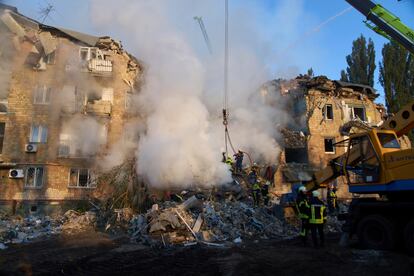

The latest Russian attack on Kyiv has hit the EU very close to home. On the eve of European defense and foreign ministers meeting for the first time since the summer break to discuss how to increase military aid to Ukraine and further pressure Russia with new sanctions, Russian missiles fell again on the Ukrainian capital on Thursday, killing at least 21 people and causing damage to a shopping mall, residential buildings, and the headquarters of the European delegation. This attack reinforces the European premise — in the face of the whims of Donald Trump’s United States — that Russian President Vladimir Putin has no intention of halting the war he launched more than three years ago.
The attack on Kyiv, the EU’s High Representative for Foreign and Security Policy Kaja Kallas said on social media Thursday, “shows a deliberate choice to escalate and mock the peace efforts.” European Commission President Ursula von der Leyen also condemned the attack, which constitutes “another grim reminder of what is currently at stake.” Von der Leyen participated in the White House summit last week to support Ukrainian President Volodymyr Zelenskiy with along several European leaders during his meeting with Trump, from whom they managed to extract a vague commitment that Washington would participate in future security guarantees for Ukraine.
Despite the ambiguity, Trump’s promises have been greeted with optimism in Europe. After all, this is the first time during the Republican’s second term that Washington has been involved in the discussions and preparations, European sources said on condition of anonymity. This was not the case during the initial meetings of the so-called coalition of the willing for Ukraine, between March and July.
A new package of sanctions for September
Faced with the new delaying tactics, which these leaders had already warned Washington about, Europe believes it is time to increase pressure on Russia. This is the only language, they emphasize, that Moscow understands.
The defense and foreign ministers are meeting informally on Friday and Saturday, respectively, in Copenhagen — without making any decisions — with the war in Ukraine as their priority. While the defense ministers will discuss military aid, the foreign policy ministers have an explicit item on the agenda: “Increasing pressure on Russia, including through sanctions and the fight against Russia’s ghost fleet,” states the Danish program, referring to vessels illegally transporting Russian crude oil. The idea, according to EU sources, is to accelerate the sanctions process. Both Kallas and Von der Leyen have expressed their hope that the EU-27 will approve a 19th package of sanctions as soon as possible, even as early as September, just two months after approving the last tranche.
In Copenhagen, the meeting will also seek to gather all possible ideas on how to continue exerting pressure on Russia. This will include, eventually, secondary sanctions, which penalize countries that allow Moscow to evade EU embargoes. The first of these were adopted in the last package, approved in mid-July: among others, the blacklisting of Rosneft’s largest refinery in India, the second largest Russian state-owned company after Gazprom. Several Chinese banks were also singled out for “facilitating sanctions evasion,” in addition to “blocking the export of technology used in drones,” Kallas explained, outlining some details of the measure.
The idea now is to expand on this type of punishment, and to even go further: as Bloomberg reported and sources in Brussels confirmed, some countries will raise the possibility of applying, for the first time, the so-called “anti-circumvention tool,” approved in 2023 as part of the 11th sanctions package and which seeks to prevent third countries from helping Russia avoid sanctions. The mechanism, considered an “exceptional and last-resort measure,” allows the EU to restrict the sale, supply, transfer, or export of certain goods and technologies subject to sanctions to certain third countries and territories deemed to pose a persistent and particularly high risk of circumvention.
More funds for Ukraine
Also on the table is a very open discussion regarding Russian assets frozen since the beginning of the war: around $350 billion, a good portion of which - up to $245 billion - is stored in Europe, primarily at the Belgium-based management entity Euroclear.
“We are advancing the work on the Russian frozen assets to contribute to Ukraine’s defense and reconstruction,” Von der Leyen said, without providing further details.
Currently, the EU is only using the interest generated by these assets to provide financial assistance to Ukraine — most of it for rearmament, and a smaller proportion for reconstruction — and as a guarantee for the loan of up to $50 billion for Kyiv agreed upon at the 2024 G-7 summit in Italy.
Several countries, such as Spain, have long openly proposed using the capital itself, and not just the profits it generates, to aid Ukraine. This proposal, however, has met with strong opposition from other EU partners, especially Belgium, which is deeply fearful of the legal consequences and the impact on international credibility that a decision that would primarily affect a company on its territory could have.
“Legally, seizing that money isn’t easy,” Prime Minister Bart De Wever warned this week from Berlin. “It’s like the goose that lays the golden eggs. We should keep that goose, and eventually, when we talk about a peace treaty, we can put the goose on the table. But until then, it’s best to keep the situation as it is.”
The problem, European sources point out, is that several billion euros are currently needed to meet the commitments made to Ukraine until next year. Therefore, money is being sought under every stone. The debate, these sources point out on condition of anonymity, should not be limited solely to whether or not to use the frozen funds, but could also explore other avenues, such as trying to maximize the returns achieved by the fund that holds the frozen assets with different — and perhaps somewhat riskier — investments than those made so far. This is the first time that this issue, already discussed in June by EU finance ministers, has been formally raised with foreign ministers, although any decision on the matter must be made by the heads of state and government.
While the discussions begin in Copenhagen this Friday, Von der Leyen will begin a multi-day tour of seven of Russia’s neighboring states — Latvia, Finland, Estonia, Poland, Lithuania, Bulgaria, and Romania — to “express the EU’s complete solidarity” and detail “the progress toward building a strong European defense industry, particularly with the SAFE instrument,” the European mechanism of up to €150 billion for joint arms purchases. Brussels must also present EU leaders with a roadmap in October, with a timeline and concrete action plans, to meet the established goal of boosting European rearmament plans by 2030.
Sign up for our weekly newsletter to get more English-language news coverage from EL PAÍS USA Edition









































