
China displays its military might at parade attended by Vladimir Putin and Kim Jong-Un
‘Today, humanity once again faces the choice between peace and war,’ Xi Jinping warned during an event commemorating Japan’s surrender in the Second Sino-Japanese War and the end of World War II
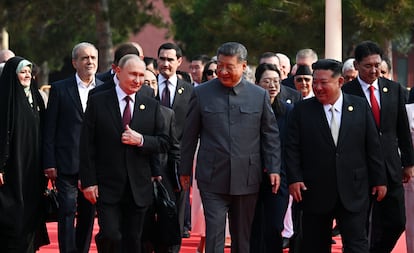
Eighty cannon shots that shook Tiananmen Square marked the beginning of China’s largest display of military muscle in recent years. The parade commemorating the 80th anniversary of Japan’s surrender in the Second Sino-Japanese War (1937-1945) and the end of World War II kicked off in Beijing at exactly 9:00 a.m. Wednesday, local time. Chinese leader Xi Jinping presided over the celebrations — flanked by his Russian counterpart, Vladimir Putin, and North Korean leader Kim Jong-Un — on the same gallery overlooking the square from which Mao Zedong proclaimed the People’s Republic in 1949. “Today, humanity once again faces the choice between peace or war, dialogue or confrontation, shared benefit or a zero-sum game,” Xi proclaimed during his speech.
For nearly an hour, troops, tanks, submarines, combat aircraft, drones, and missiles of all kinds, including the latest hypersonic models with nuclear capability and intercontinental range, marched in perfect synchronization in an event designed to showcase the military might of the world’s second-largest power.
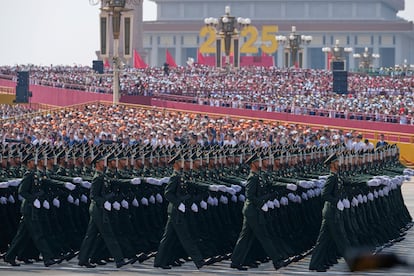
The event, which paralyzed the Chinese capital, had been choreographed down to the last detail for months. As had the distribution of guests. On the podium, Xi had one of his closest allies, the Russian president, seated to his right, and to his left, the North Korean leader, who is visiting China for the first time since 2019. Their presence, along with that of other leaders such as Iranian President Masoud Pezeshkian and Belarusian President Aleksandr Lukashenko, turned the ceremony into a high-voltage geopolitical event that reinforces the message that Beijing stands as a point of reference for those who challenge the international order promoted by Washington.
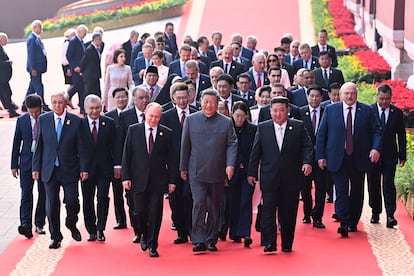
Inside the Forbidden City, Xi and his wife, Peng Liyuan, welcomed the 26 heads of state and government who had traveled to the Chinese capital for the celebration. The last two were Kim and Putin. The Chinese president was especially friendly with his North Korean counterpart, whom he greeted with a broad smile and an affectionate handshake. He patted Putin, “his old friend,” a couple of times on the back. After taking a family photo, Xi led the procession toward the monumental gateway to the former imperial palace, the Gate of Heavenly Peace (a literal translation of Tiananmen). Cameras carefully captured the moment when Xi, Putin, and Kim walked side by side, climbing the stairs of the imposing structure almost in unison. An image laden with symbolism, which reinforces the idea that has been projected in recent days.
The parade culminates a week in which China has shown its face as a true alternative power axis, following the holding of the Shanghai Cooperation Organization (SCO) summit over the weekend. This other event in Tianjin was also attended by some 20 international leaders, with a significant presence from the Global South. Among them were Indian Prime Minister Narendra Modi and heads of international organizations, such as UN Secretary-General António Guterres. However, none of these leaders were present at the parade. Nor did any top-level leader of the European Union attend, with the exception of Slovak Prime Minister Robert Fico. Serbian President Aleksandar Vucic also traveled from Europe.
During his speech, Xi thanked foreign governments and “international friends” who supported and assisted the Chinese people in “their resistance against Japanese aggression.” This is how China officially names the commemoration of September 3, which, he emphasized, was the “first complete victory in China’s history.”
“History warns us that the destiny of humanity is deeply interconnected. Only if countries and nations treat each other equally, live together in harmony, and support each other will it be possible to maintain common security, eradicate the causes of war, and prevent the repetition of historical tragedies,” he warned.
The culminating moment came shortly after, with the start of the parade itself. Dozens of perfectly aligned formations awaited on Chang’an Avenue, at one end of Tiananmen Square. Xi, leaning out of the sunroof of his car and wearing the olive-green uniform that distinguishes him as chairman of the Central Military Commission, inspected each of the formations. “Comrades, good work!” he exhorted as he passed. “We follow the Party’s leadership, and that is how we are able to win battles!” the soldiers echoed with a shout of loyalty. And again: “Justice will triumph, peace will triumph, the people will triumph!”
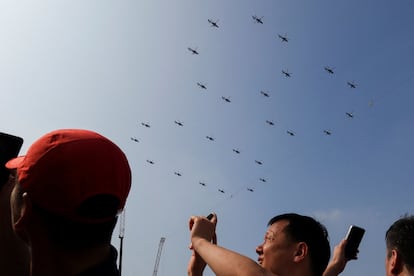
The heat was stifling: 29 degrees Celsius (84 degrees Fahrenheit) and 80% humidity. A fine mist clouded the horizon, where a swarm of helicopters hovered over the square in a figure-of-eighty formation. As the troops began to parade, a spyglass allowed one to glimpse Xi in the center of the stage. Putin approached him and they discussed something, while Kim, on the other side, fanned himself. Then Xi turned to Kim and pointed out the weapons display. This oscillation between Xi and Kim, chatting with his closest strategic allies, continued throughout the event. They pointed here and there. Only they know the content of those conversations.
As the tanks rolled past, the ground rumbled, and the vibrations reached the press stands. It’s overwhelming to see the 45 columns marching as if they were a single person projected into infinity; the submarines and unmanned aircraft, silent, with sinuous yet deadly shapes, evoke the wars of the future. A voice announces the appearance of each new element. The audience exclaims a long, resounding “Oooh!” when the latest missile models are presented: the Jinglei 1 and 3, and the Dongfeng 61 and 31, each one more immense than the last. “Key instruments of the country, cornerstone of stability,” the voice says. “Oooh!” is heard again. “Presented jointly for the first time, they showcase the ‘three-dimensional’ strategic nuclear force of our military on land, sea, and air, constituting the strategic blueprint for safeguarding national sovereignty and defending the nation’s dignity.”
Sign up for our weekly newsletter to get more English-language news coverage from EL PAÍS USA Edition









































