
Humanitarian aid enters Gaza, but UN warns it’s still not enough: ‘What Israel needs to do is very simple’
International organizations call on Benjamin Netanyahu’s government to open all border crossings with the Strip and accelerate the delivery of supplies
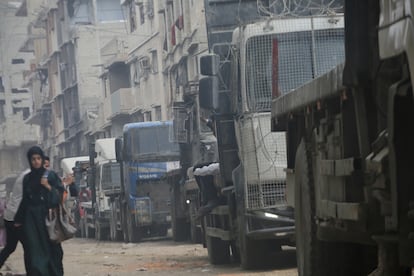
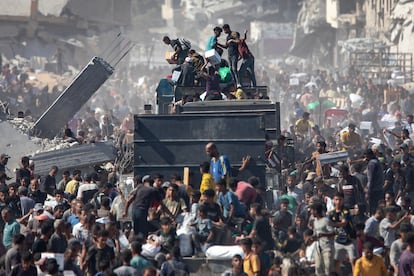
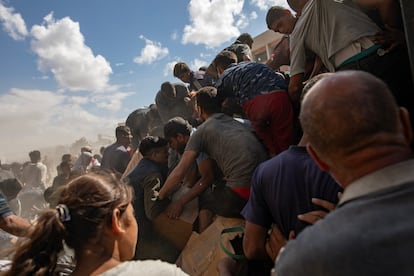
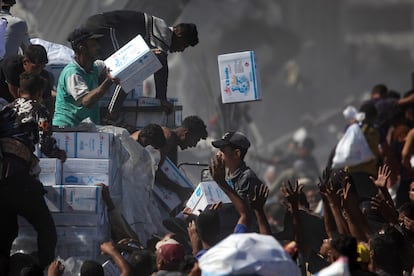
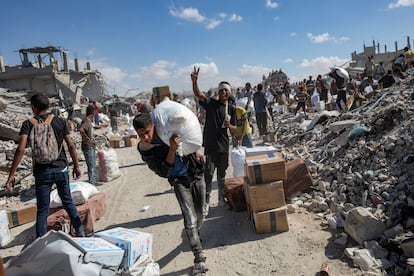
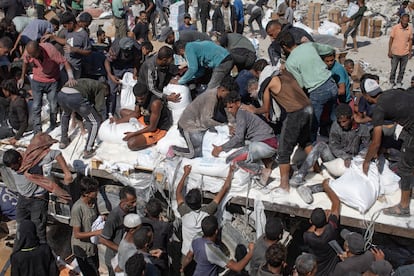
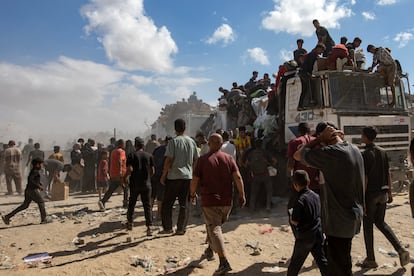
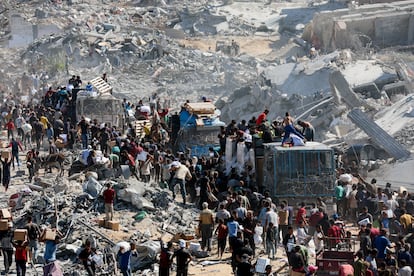
A long line of trucks waited on the Egyptian side of the Gaza crossing Sunday, in Rafah, to head toward the only two border crossings Israel has opened for the entry of humanitarian aid into the Gaza Strip: Kerem Shalom and Al Auja. Thanks to the ceasefire agreement that came into effect on Friday, 400 Egyptian Red Crescent trucks carrying supplies and another 50 carrying fuel began crossing the border by mid-afternoon. An unspecified number of vehicles from other humanitarian organizations, such as the U.N. World Food Program, also entered Gaza. Although the exact number of trucks that have entered the Gaza Strip is unknown, the figure is close to the number envisaged in the first phase of the agreement (600 per day and another 50 carrying fuel), but not quite reaching it. Images from Gaza today emerged of Gazans perched on aid trucks, celebrating their arrival with food packages in their hands.
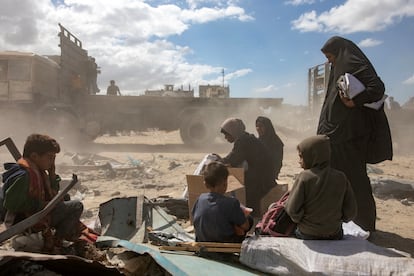
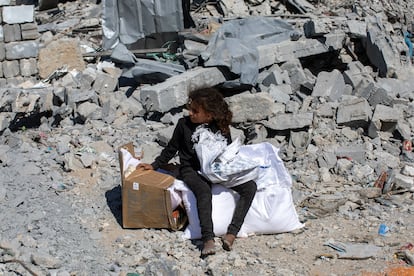
Although these heavy vehicles carrying supplies are far greater in volume than those arriving before the ceasefire came into effect, their contents remain insufficient, the United Nations and other humanitarian organizations have warned. They believe a chasm separates the needs created by two years of the Israeli offensive — with a declared famine in the north and 2.1 million people reduced to destitution — from the aid that has begun to arrive.
These supplies, UNICEF spokesperson James Elder told the BBC, fell short of what is needed. Chris McIntosh, humanitarian response advisor for the NGO Oxfam in Gaza, noted that the influx of supplies must be “a steady flow,” which has not yet been achieved. A spokeswoman for the UN World Food Programme assured on Saturday that the promised increase in the number of trucks “has not yet occurred.”
Humanitarian organizations have criticized, among other things, the fact that the Israeli authorities have not yet removed, or at least eased, several of the obstacles that slow down the process of bringing in aid. For example, the strict military inspection protocol for the contents of trucks.
Benjamin Netanyahu’s government has also not ordered the opening of other border crossings — especially in the particularly devastated north of the Strip — that were previously used for the entry of goods and remain closed. This would facilitate the distribution of aid, as vehicles would not have to navigate the obstacle course of traveling across Gaza from south to north along its devastated roads.
For the UNICEF spokesperson, “what Israel needs to do is very simple”: open “five or six border crossings” to allow up to 1,000 trucks a day to have “multiple entry points” into the Palestinian territory. The U.N. refugee agency (UNRWA) has also called for the opening of all border crossings into the Strip to allow “a normal flow of humanitarian aid” to Palestinians in need. Israel had authorized UN agencies on Friday to deliver aid to the Strip, starting this Sunday.
At the same time that aid is increasing and steps are being taken to reestablish its traditional distribution system — executed by U.N. agencies and NGOs coordinated by the United Nations — the controversial Gaza Humanitarian Foundation (GHF) project, the shadowy organization created by Israel with U.S. support, appears to have begun its withdrawal from the enclave.
Images circulated on social media this past weekend show the apparent dismantling of one of its distribution centers, while the other three are closed. They are located in an area from which the Israeli military has not yet withdrawn and where Palestinians are prohibited from entering.
At these four food distribution sites, 2,500 Gazans were killed while seeking food, according to sources within the Gaza Strip government, which is controlled by Hamas. The GHF was precisely intended to become an alternative to the international aid system coordinated by the United Nations.
A question mark
One of the lingering questions about the future of aid in Gaza is whether Israel will hinder UNRWA’s participation in aid distribution. Israel has sought to exclude the agency from humanitarian aid, not only in Gaza but also in the other occupied Palestinian territories, East Jerusalem and the West Bank.
After attempting to link UNRWA to Hamas, without providing evidence, Israel banned it from working in East Jerusalem in January and prohibited its officials from having any contact with it. Although its local employees continue to work in Gaza, the agency has yet to bring a single truck into the Strip during the three days of the ceasefire, according to spokesman Jonathan Fowler.
Fowler explains by phone from one of its warehouses in Jordan that UNRWA is the humanitarian organization with the most extensive distribution network in the Gaza Strip, with 12,000 employees. The spokesperson claims that his organization has “enough food to feed all Gazans for three months,” which Israel has prevented UNRWA from bringing in. For decades, the agency has centralized humanitarian assistance to Gazans, more than 70% of whom are refugees.
Fowler emphasizes that the U.N. Humanitarian Coordination agency (OCHA) — which includes NGOs — has not been directly involved in negotiating the humanitarian aspects of the ceasefire. The UN does know that an agreement has been reached to “allow, in principle, the entry of 170,000 tons of humanitarian aid into Gaza,” but its agencies are unaware of the details.
Fowler also highlights another aspect: the number of trucks entering the Gaza Strip doesn’t tell the whole story.
The 600 vehicles provided for in the agreement — the text doesn’t mention them, but refers to the “minimum” stipulated in the previous January ceasefire — are roughly the number that entered the territory each day before the start of the Israeli offensive, which marked its second anniversary last Tuesday. The difference is that back then, the Gaza Strip’s agricultural fields were intact — now 95% have been destroyed or are in areas occupied by the military — there were herds of livestock, functioning farms, and its approximately 4,000 fishermen were working. Gaza was partially self-sufficient in terms of food.
“These trucks,” explains the UNRWA spokesperson, “would now provide the bare minimum necessary to ensure the survival of the population.” In addition, he asserts, “the criteria used by the Israeli authorities and the United Nations to count them are sometimes different.” Israel often required that the vehicles be half-empty, to facilitate inspection of their cargo. “If 100 trucks enter and Israel requires them to be half-empty, how many are counted? 100 or 50?” the spokesperson asks.
Sign up for our weekly newsletter to get more English-language news coverage from EL PAÍS USA Edition









































