
Media and political earthquake in Italy over sale of ‘La Repubblica’ and ‘La Stampa’, the two main opposition newspapers
The Agnelli family group, which owns the outlets, is negotiating with a conservative Greek magnate who is close to Donald Trump, while Giorgia Meloni makes light of the deal and publicly attacks journalists

The Italian media and political landscape is experiencing a seismic shift with the potential sale of two historic newspapers, La Repubblica and La Stampa, the country’s second and third best-selling newspapers after Corriere della Sera, and currently the two main progressive opposition media outlets to the government of far-right leader Giorgia Meloni. La Repubblica and other media outlets belonging to the GEDI group, such as the Italian edition of the Huffington Post and three radio stations (M20, Deejay, and Capital), could end up in the hands of the Antenna group, headed by Greek businessman Theodore Kyriakou, a conservative and ally of U.S. President Donald Trump. Kyriakou is also a partner in Greece of Saudi Crown Prince Mohammed bin Salman, whose PIF fund holds a 30% stake in Antenna Greece BV.
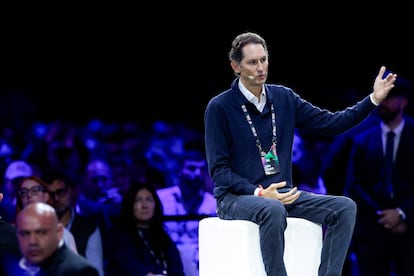
The Greek magnate, however, has stated that he is not interested in La Stampa, which would be sold separately, either before or after the transaction, although it is unclear to whom. The two newspapers are the best-known publications of the GEDI group, owned by the Agnelli family, historical owners of FIAT, through the company Exor (which also owns 43% of The Economist), and chaired by John Elkann Agnelli. In total, it has 1,300 employees who now fear staff reductions and a change in editorial line.
Kyriakou, previously unknown in Italy, was one of the guests at the exclusive state dinner that Trump hosted in Qatar last May. In Washington, he is a member of the Atlantic Council, a think tank that organized an event last September in which Meloni participated via videoconference.
The possibility of a change in editorial line by both newspapers, which are highly critical of Trump and also of Moscow, led to the intervention Monday of the Russian embassy in Rome, which welcomed the sale and hopes that with the new owners they will cease to be “megaphones of rampant anti-Russian propaganda.”
The privately held Antenna Group said in a statement that it “has always shown respect for journalistic independence and pluralism,” but fears of a profound transformation of the Italian media landscape are palpable. The upheaval has also been deeply felt by the Italian progressive movement, particularly in Turin, the Piedmont region, and the entire northwest of the country, as La Stampa has been a symbol of their identity for over 150 years.
However, in recent years it became clear that GEDI, which acquired the group in 2019, was gradually dismantling it and failing to stem its losses. Between continuous cutbacks and abrupt shifts in editorial line at La Repubblica, which caused it to lose readers, the sale of the weekly L’Espresso, another symbol of the group, was particularly traumatic. The sale of GEDI Digital, the audiovisual division of the newspapers’ websites, was also highly significant. La Repubblica currently has three million unique users online and La Stampa 1.1 million, while the print editions have a distribution of around 50,000 copies.
After months of rumors, Johan Elkann Agnelli confirmed to employees on Wednesday that he has signed an exclusive preliminary agreement for a €140 million ($165 million) sale to Kyriakou. The 51-year-old businessman, from a family of shipowners with naval and real estate interests, has a presence through his Antenna group in media outlets in Greece, Cyprus, Turkey, several Eastern European countries, Australia, and the United States, primarily in the audiovisual sector. In total, he owns 37 channels. If the sale is finalized, La Repubblica and La Stampa would be his first newspapers. Hence, the growing suspicion that his real interest lies in the group’s three radio stations, the only profitable businesses, as a first step toward later entering the Italian television sector. Some reports indicate that the move into Italy also points to the purchase of Sky Italia, which is projected to post a €258 million ($303 million) loss in 2024.
Workers demand job security
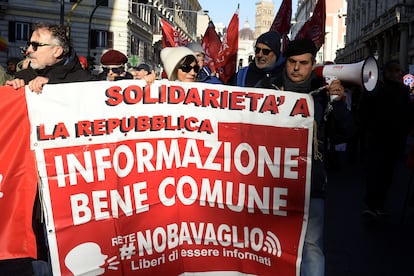
For now, negotiations for the signing have been extended by two months, until the end of January, largely to avoid announcing the sale before January 14, when La Repubblica marks its 50th anniversary. A celebration is planned, though it is increasingly beginning to feel more like a funeral. The Rome-based newspaper, founded by Eugenio Scalfari, is a cornerstone of Italian journalism and a leading voice of the left. During Silvio Berlusconi’s years in power, it became the country’s leading outlet for opposition and for exposing scandals. La Stampa was also a prominent newspaper at that time, and despite being owned by an industrial family, it has always been known for its defense of social rights and has reflected a liberal culture.
The workers’ main demand at this time is that the GEDI group require the buyer to include the so-called social safeguard clause, which under Italian law allows a sale to include a set of protections for the workforce. In this case, those safeguards would involve maintaining current staffing levels, preserving the editorial line, and committing not to resell the outlets in the short term.
“These are a series of guarantees that worry us greatly, especially because the seller, John Elkann, hasn’t shown any concern for them so far. In the meetings we’ve had with the company, they’ve told us it’s something we’ll have to negotiate later with the buyer,” explains Alessandra Ziniti, a member of the editorial committee of La Repubblica, over the phone. “But we’ll do everything possible to ensure that Elkann, now that he’s leaving the publishing world, doesn’t run off with the money, but rather thinks about the families of 1,300 employees,” she concludes. The staff expects a response from the company within 48 hours.
The government has met with the staff and supported their demand for guarantees, although its room for maneuver is limited. Meanwhile, several reports indicate that before making this move, the Greek magnate ensured he had Meloni’s approval. In any case, the government has called for transparency in the operation to guarantee that no actors from outside the EU are involved, a clear reference to Mohammed bin Salman. The Antenna group has confirmed that it will make the purchase with its own capital, and the Saudi prince, accused by the CIA of ordering the murder of Washington Post journalist Jamal Khashoggi, will not participate in the acquisition.
Newspaper staff have already begun a series of strikes, clashing with Elkann, whom they accuse of having concealed the deal for months. In the case of La Stampa, the Agnelli family’s newspaper, the blow is even more symbolic for the city, which sees it as a betrayal. Numerous letters from indignant and saddened readers have been pouring in. Even the archbishop, Roberto Repole, has intervened to express his opposition to the deal.
A controversial video defending Juventus
It has also been deeply painful that, amid rumors that Juventus FC, another jewel of the Agnelli family, was up for sale, Elkann appeared in a video on Saturday wearing a club sweatshirt to reject the idea: “Juve, its history, its values, are not for sale.” “That’s fine for soccer, but not for our newspaper and its more than 150 years of history. History that can be sold without a second thought, without even worrying about to whom [...] La Stampa has been part of the same family and the same large industrial group since 1926, a group that is gradually being broken up, destroying value and values,” the newspaper’s editorial committee said on Monday.
The Agnelli family bought La Repubblica in 2019 from its long-time owner, Carlo De Benedetti (who subsequently founded another newspaper, Domani, to which part of the staff moved), but the crisis in the sector and much-criticized management have finally led the family to divest themselves of the entire media conglomerate. This will be particularly damaging for La Stampa, after years of synergies: “We are part of a group with many intertwined activities, and all the digital aspects — video, social media, podcasts — are centralized, and if we separate, we will lose them, even though they are a crucial part of the sector’s future,” explains Paolo Barone, from the editorial committee.
The entire Italian political class has expressed solidarity with the affected journalists and called on the government to guarantee the independence of newspapers and media pluralism. However, despite the current situation of the two newspapers, Giorgia Meloni unleashed a tirade on Sunday night at her party’s youth gala, attacking La Repubblica and some of its journalists: “Today the PD [Democratic Party] is outraged because the Elkanns want to sell the GEDI group and there would be no guarantees for the workers, but when the Stellantis factories [a car brand owned by the same family] were closing and it was the workers who were losing their jobs, everyone was silent, including [Maurizio] Landini [leader of Italy’s largest trade union, CGIL], who gave interviews to La Repubblica.”
The newspaper’s board rejected these accusations as “completely false.” Furthermore, Meloni lashed out at columnist Michele Serra for criticizing her party’s youth wing festival. The Italian prime minister described Serra as a symbol “of an isolated and rabid left” lacking “moral, cultural, and political substance.”
Sign up for our weekly newsletter to get more English-language news coverage from EL PAÍS USA Edition









































