
Peru’s Congress votes to remove Dina Boluarte
The politician refused to defend herself before Parliament in a fast-track process to remove her from office over the deep wave of violence overwhelming the country’s streets
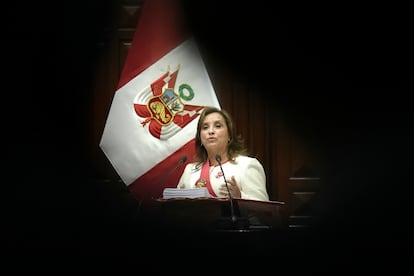

Peru’s Congress approved the removal of President Dina Boluarte in the early hours of Friday morning after launching an expedited impeachment process. The legislature had summoned the head of state to appear immediately — that same night — to present her defense before the vote, but she refused, calling the procedure “unconstitutional.”
The four motions, filed under the constitutional charge of “permanent moral incapacity,” were passed thanks to votes from right-wing parties and Popular Force (FP), which had until now supported Boluarte. The president of Congress, José Jerí — a lawyer accused of rape — is the politician set to replace her. He will lead the country until the next elections, scheduled for April 2026, and the presidential handover, set for July 28.
After her removal, Boluarte appeared flanked by her cabinet to highlight her record and display her achievements. The motions to remove Boluarte had been initiated Thursday morning by the Popular Renewal (RP) bloc — the party led by Lima’s ultraconservative mayor, Rafael López Aliaga, known as “Porky” — citing the deep wave of violence suffocating Peruvians. Hours earlier, on Wednesday night, the popular cumbia band Agua Marina had been attacked during a performance at a military facility. Four members of the group were shot in the chest and leg.
Boluarte, who took office after Pedro Castillo’s failed self-coup in December 2022, had until now maintained tight control over Congress — the country’s most discredited institution, according to polls. The decisive factor in her downfall was the vote of the Popular Force, the right-wing party led by Keiko Fujimori, the daughter of former dictator Alberto Fujimori.
Neither the deaths of some 50 protesters, nor her secret absence from office to undergo a rhinoplasty and cosmetic procedures, nor the alleged favors traded for luxury jewelry and watches, nor suspicions of shielding fugitives from justice had managed to unseat her. Boluarte now faces her most difficult hours due to her inability to curb the crime wave battering Peru.
Congress — which had kept her afloat under a survival pact lasting until 2026 — finally withdrew its support. Her presidency, which began on the wrong foot after she broke her promise to call early elections, sparked waves of demonstrations from the southern highlands toward the capital. The harsh repression by security forces dispersed them for a time, but they reignited by mid-2024 amid a surge in extortion and contract killings that have paralyzed urban transport and threatened businesses across sectors.
In recent weeks, young people — self-described as Generation Z — had once again taken to the streets. But it was the recent attack on the cumbia band Armonía 10 that finally triggered the current crisis. The Popular Renewal bloc, which had previously saved Boluarte more than once, filed a new motion to vacate the presidency. As hours passed, other major caucuses joined in: Popular Force, Alliance for Progress, and the coalition of Together for Peru, Voices of the People, and the Teachers’ Bloc. In total, four motions of vacancy were submitted. After nearly three years in power, with no resignation in sight, Boluarte now finds herself on the brink — and with nothing left to hold on to.
Thus Congress removed a president whose popularity barely hovered within the margin of error and whose speeches never resonated with the people. A president who failed to navigate the diplomatic arena, recalling her ambassadors from Mexico, Colombia, and Honduras after trading barbs with their heads of state. A president who strained relations with the Inter-American Human Rights System and repeatedly defied its orders, as when she did nothing to prevent the controversial release of the autocrat Alberto Fujimori at the end of 2023.
Boluarte will also be remembered for enacting the amnesty law favoring military personnel who committed human rights violations between the 1980s and 2000. One of the sadly infamous images of her presidency is her warm greeting of Juan Rivero Lazo, former head of the Army intelligence service, sentenced to 25 years in prison for the Barrios Altos massacre, as an honored guest at the Presidential Palace. She will also be remembered for her collection of indifferent and distorted statements about reality: “Puno is not Peru” or her advice to “not answer unknown calls” to avoid being extorted.
With her departure, Peru remains mired in instability: it has seen seven presidents in the last nine years.
Sign up for our weekly newsletter to get more English-language news coverage from EL PAÍS USA Edition









































