
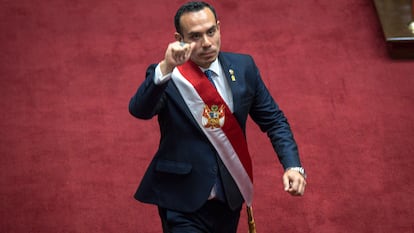
Peru’s interim president, José Jerí, is on a campaign to save his image
The leader has completed one month in office after the removal of his predecessor, and he enjoys a 55.9% approval rating thanks to his mastery of social media platforms

Three days after a protester was shot dead by a policeman at a street demonstration, Peru’s interim president, José Jerí, carried the platform bearing the image of the Lord of Miracles through the streets of Lima. Clad in a purple robe and wearing a religious medal, Jerí was one of the devotees who bore the 900-kilogram image of the crucified Jesus Christ on their shoulders. This procession dates back to the 17th century, when an earthquake struck the country and the mural—painted by a slave—remained standing. This miracle is commemorated every October in the largest religious gathering in Peruvian Catholicism.
Jerí’s first public appearance after succeeding Dina Boluarte following her removal from office on October 10 was perceived by a large segment of the population as a display of hypocrisy and indifference to the suffering of others. But it was also seen as a gesture of gratitude from a politician who ended up becoming president without even having garnered enough votes to be elected to Congress.
Jerí started with everything stacked against him—the seventh president since 2016 belongs to a discredited political class and is a target of a youth movement that has taken its anger to the streets—but he has opted for a strategy that works, from Washington to Lima: the “influencer” president. After his first month in office, the most recent poll by CPI, one of the country’s leading polling firms, gave him a 55.9% approval rating. This is an extraordinary figure compared to the 3% with which Dina Boluarte left office.
How can we explain this contrast between two politicians who were not victorious at the polls? While Boluarte set the bar too low, several analysts agree that Jerí has distinguished himself by resorting to old formulas such as a tough-on-crime rhetoric and a populism that mixes religious feelings with patriotic exaltation, amplified thanks to social media.
While Boluarte deleted her X account once she assumed power, Jerí has displayed a mastery of social media platforms, where his team tracks his every move. But he has also been helped along by a TikTok impersonator named Martín Palacios, who has paved the way for Jerí with a reggaeton pelvic thrust that has gone viral and given the president an unexpected dose of charisma. The impact of his parody has been so great that it has trivialized the most sensitive issue for Jerí: a sexual assault complaint that was dismissed amid irregularities.
According to political scientist Carlos Meléndez, Latin America currently has four millennial presidents: Nayib Bukele in El Salvador, Daniel Noboa in Ecuador, Gabriel Boric in Chile, and Jerí in Peru. “All four possess this media sensibility of the selfie and the timely tweet. Three of them share a common goal: to take ownership of the issue of public security, a structural weakness in Latin American societies,” explains this researcher from the University of Lisbon. “At one end you have Bukele (the established hardliner) and at the other Jerí (the apprentice). They have similar aspirations and talking points, but different skills for achieving their objectives,” he adds.
Nicknamed “Pajerí” for his subscription to pornographic accounts—which he has since unfollowed—the interim president has adopted a style of politics similar to Bukele’s. Amid a surge in crime, with extortionists terrorizing the country, his first move was to pose for photos with high-ranking members of the Armed Forces—even before forming his cabinet—and visit the country’s most overcrowded prisons, adopting a harsh stance toward criminals. Weeks later, he declared the fifth state of emergency in the provinces of Lima and Callao in the last three years. “We will move from defense to offense in the fight against crime,” promised the leader, who turns 39 this Thursday.
But the crime statistics—unlike his popularity ratings—do not support his strategy. According to the National Computerized Death Registry (Sinadef), 147 homicides have been reported during his one-month administration; the feeling of insecurity persists, and those most affected are transportation workers and small business owners who are gunned down daily by organized crime.
Former Deputy Interior Minister Julio Corcuera believes that Jerí’s visits to neighborhoods—always in a crisp white shirt with rolled-up sleeves—have created the impression of a willingness to work. However, he clarifies that these efforts alone are insufficient and, without coordinated intelligence work, will have little impact. “When this presence (both in the media and on the ground) doesn’t translate into a real decrease in crime, it lends credence to the argument that it’s just a media stunt,” the security expert points out.
In an opinion column titled “The Oppressive State Is a Rapist Male,” former congresswoman Rocío Silva Santisteban describes Jerí as a criollo politician with a “pompous voice and patriarchal demeanor” who has become a meme (Pajerí) due to his base desires. “Beyond the crude mockery and outrage of the citizens, Jerí has installed himself in the Presidential Palace with actions that further entrench him within his homosocial fraternity as an exaltation of virility,” she argues. “It’s not so difficult to draw a contrast with Boluarte.”
Since his 2021 election campaign, under his Somos Perú (We Are Peru) party, José Jerí has demonstrated that populism—the old-fashioned kind—is one of his weapons. He recorded a campaign ad with former boxer Jonathan Maicelo, where—looking noticeably heavier—he promised to knock out crime, corruption, and corrupt members of Congress. He recently greeted the players of Universitario de Deportes, the club that has won the Peruvian soccer title for the last three years, via video call. Furthermore, he has flown over the city in a helicopter and walked down Abancay Avenue in downtown Lima during protests against him.
Her foreign policy has also served to distance himself from his predecessor. Jerí has created divisions with his decision to delay the issuance of safe passage to Betssy Chávez, a former prime minister under Pedro Castillo who is accused of being one of the co-authors of Castillo’s failed self-coup in late 2022, and who was taking refuge in the Mexican embassy in Peru. In just a few days, Peru severed relations with Mexico, expelled the head of the diplomatic mission, and declared Mexican President Claudia Sheinbaum persona non grata. Furthermore, it expelled the Cuban ambassador, Carlos Zamora, for allegedly being an intelligence operative, and resumed contact with the Bolivian government.
Will José Jerí survive until July 2026, when he is due to hand over power? Carlos Meléndez warns that “since the crisis of presidential instability began, no occupant of the Presidential Palace can guarantee they will finish their term.” Even so, the election campaign could offer him some respite: it diverts public attention and reduces demands for accountability, unless a scandal or a major crisis erupts.
While groups from the southern highlands, certain transportation unions, Generation Z, and a large number of self-organized citizens have continued their cry of “out with them all,” Peru’s fourth youngest president—after Felipe Santiago Salaverry, Alan García, and Manuel Pardo y Lavalle—has announced that this Tuesday he will begin a three-month tour of all the country’s regions. “We are going to listen to the people’s concerns and expectations,” he said. A month ago, a presidential candidate who slandered the citizens of the Puno region had to be escorted out by a contingent of police to avoid being lynched. It remains to be seen how Jerí, the influencer who entrusts himself to the Lord of Miracles, will fare.
Sign up for our weekly newsletter to get more English-language news coverage from EL PAÍS USA Edition









































