
The pulse of Peru’s youth threatens entrenched power
Generation Z, representing one in four voters, is at the forefront of protests against a rotten system
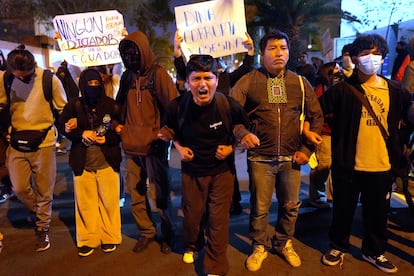
Jean Villanueva’s father is a bus ticket collector in Lima, working on one of those vehicles that move amid honking horns and fear. He is one of the targets of the mafias that collect extortion fees from ticket checkers and drivers — people who, like so many others, leave home every day without knowing if they will return. Pessimism and weariness are spreading in Peru, but Villanueva, a 29-year-old accountant, prefers not to wait for the country to change on its own. He is shouting. He is clenching his fists. He is always on the front lines. He is convinced that young Peruvians are the only ones who can restore hope to the country. His generation, the one that fills the streets of cities around the world, has grown tired of waiting.
“We need new leadership,” says Villanueva at a Starbucks in downtown Lima. A little over a month ago, the table where he sits was covered in a cloud of tear gas. Police used clubs to chase protesters into this open-air shopping center. He still bears the marks from that day on his hands, buttocks, and head. “I was carrying a megaphone, exercising my legitimate right to protest, and the police came at me and threw me to the ground,” he recalls. Violence against protesters has become a constant in recent years, with more than 50 deaths since 2022.
The entrenched powers-that-be look askance at young people like Villanueva, the so-called Generation Z, those under 30. They are the ones leading massive protests in disparate countries like Indonesia, Kenya, Nepal and Morocco, spreading the word to each other, as happened with the Arab Spring and years ago in Chile, or even in Peru itself. Their causes are diverse, but they all demand some kind of break, better public services, or an end to corruption. They demand change. Now. They organize on social media, and one of their symbols is a pirate flag with a skull wearing a straw hat. And, in Peru, there is an enormous additional reason for unrest. Young people between 15 and 29 years old are the largest voting bloc in the country: more than 25% of the electorate, more than any other age group.
The fall of Dina Boluarte last Friday surprised almost everyone. It surprised the Prosecutor’s Office, which had to rush to issue precautionary measures to prevent her from leaving the country. It also surprised thousands of young people who had spent weeks preparing a large march across the country to demand her resignation. With Boluarte hiding in her home, they have unwittingly achieved their first objective. But many more remain to be claimed. They want José Jerí, the new interim president, to resign. They want laws repealed. They want a dialogue to be established to participate in the country’s direction. They want those responsible for the deaths of protesters to be prosecuted. They want an “independent and fair” congressmember to assume the presidency until the April elections. They want the powerful to stop stealing. They want criminals to stop killing. This Wednesday they will take to the streets of Lima again. Until they achieve this.
“There are those who are willing to go all the way. To light everything up,” warns Yackov Solano at that same table. The 22-year-old university student, who wears a black bandana and a military-green bomber jacket, is one of the most visible faces of this youth movement made up of dozens of groups capable of mobilizing “brothers and sisters” across the country. “Unfortunately, corruption has become normalized here, but we’ve reached a point where we young people are saying, ‘No, enough,’” Solano argues.
Adults accuse them of living disconnected lives, glued to their screens, binge-watching series, trapped by online games and social media. But they were the ones who brought virtual discontent to the streets. They were the ones who stood up to police officers determined to silence them. A reform that would have forced self-employed workers to contribute to pension fund administrators got them up and protesting: the move meddled with the future of a generation that barely has enough to live on, much less to entertain dreams. According to the Organization for Economic Cooperation and Development (OECD), Peru has the fifth-highest proportion of young people in the world who neither study nor work. The number of “NEETs”(Not in Education, Employment, or Training) stands at around 1.5 million.
The reform was thwarted, but it wasn’t just about pensions. Many of these young people, says political scientist Omar Coronel, especially those from the most low-income sectors, are marching for the most basic thing of all: a peaceful life. “They aren’t safe anywhere. They can’t go to school or work in peace. They’re not the youth they used to be; they’re much more confrontational and resilient,” he says. “We participated in the 2020 protests in a very similar setting to the current one, and five years later we find ourselves doing the same thing. We were apprentices then, but that has changed. Now we’re much more aware,” emphasizes Yackov Solano, who is the son of a nurse and an accountant.
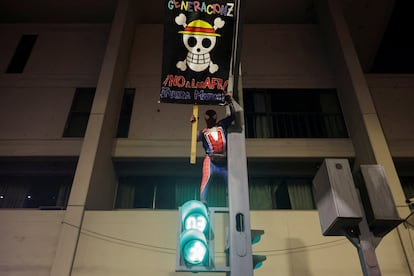
Peru’s Generation Z has its own symbols. Between giant rats and the typical posters with the face of the current president, new emblems of struggle have emerged: skulls with straw hats, bandannas, and samurai swords. “If Che Guevara or Karl Marx were icons of revolution in the 20th century, today anime occupies that symbolic place,” says writer J.J. Maldonado, author of two books that explain the present: Messianic Narrative: Animes to the Rescue of Fiction and A Pop Galaxy Called One Piece.
In these young people’s protests, One Piece has become an emblem. The Japanese manga series, created at the end of the last century by Eiichiro Oda, a nonconformist who gave up his architecture studies to write and draw manga, is a cultural phenomenon with 15 films, 50 video games, and more than a thousand episodes. It is the story of adventurous boys who face pirates for hidden treasure, a tale filled with themes such as freedom, justice, rebellion against power, and corruption. “We have endured more than a decade of political instability. No more. The time is now,” says Generation Z in their statements.
Kevin Puelles, the manager of the Fotos de Lucha (Photos of Struggle) platform, has been documenting the protests in Peru since 2022. This psychologist, who uses his camera to record the abuses of the armed forces, points out that October 15 will be a day to take the pulse of the country. “Outside of Lima, the echo of the mobilizations is muted, but not muffled. There is an expectation that university students will take to the streets,” he explains. The memory of the dead keeps tensions alive. The extent of the protests will depend on the level of mobilization in other regions of Peru beyond the capital. Puelles is hesitant. “At least in Trujillo, Cusco, and Puno, it doesn’t exist,” he asserts. It is still a phenomenon under construction. For now, Carlos Castillo, Archbishop of Lima, has already given his blessing: “There are no terrorists here, but people with rights. They have much to say to humanity.”
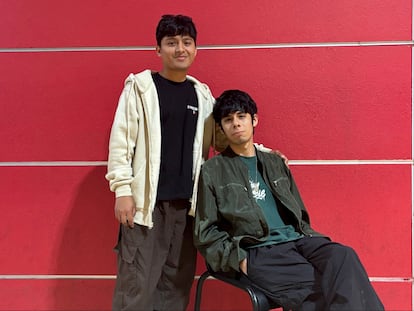
Villanueva and Solano, with backpacks and their bangs covering their foreheads, met at a demonstration and fell in love. Since then, they’ve walked together among banners and activists. They are the portrait of a generation that is breaking the molds imposed by their elders. “I told my congregation I was bisexual and I felt a lot of support,” Villanueva confesses. “Our minds are much more open,” his companion agrees. “Maybe I think like a dreamer,” Solano emphasizes, “but our generation can be the great change that Peru needs.”
Sign up for our weekly newsletter to get more English-language news coverage from EL PAÍS USA Edition









































