
Peru’s interim president declares state of emergency in Lima and Callao: ‘Wars are won with actions, not words’
José Jerí says the government is moving ‘from defense to offense in the fight against crime.’ The decree authorizes the Armed Forces to act against protesters
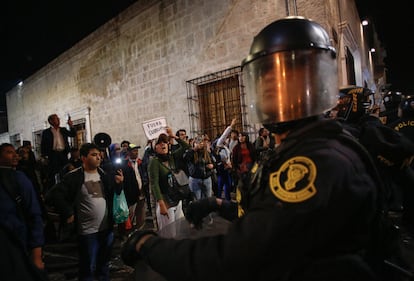

With a very brief address to the nation, Peru’s interim president, José Jerí, announced on Tuesday night the start of a state of emergency for Lima and Callao — one of the country’s most populated areas after the capital — in response to the surge in crime. The measure had been known since last week, but it still needed to be made official.
“Wars are won with actions, not words,” the president declared. “Unlike on other occasions, this cannot simply be an abstract, subjective declaration that doesn’t serve ordinary citizens,” Prime Minister Ernesto Álvarez had said the previous week.
But Jerí’s speech, which lasted only a few minutes, left more than one question hanging in the air. When citizens expected to hear a set of concrete measures directly from him, Dina Boluarte’s successor chose instead to deliver striking phrases without further explanation.
“Crime has grown disproportionately in recent years, causing enormous pain for thousands of families and also harming the country’s progress, but this is over. Today we begin to change history in the fight against insecurity in Peru,” Jerí said from the Government Palace, accompanied by his ministers. He explained that the state of emergency would take effect at midnight this Wednesday and remain in force for 30 days in Metropolitan Lima and Callao: “We are moving from defense to offense in the fight against crime — a fight that will allow us to restore peace, tranquility, and the trust of millions of Peruvians.”
Since assuming the presidency on October 10, after Boluarte was removed from office, Jerí has focused on projecting the image of an authority determined to take a hardline stance against the unrest. He has visited prisons, appeared in police operations, flown over the capital in a helicopter, and even — an act considered provocative — walked through downtown Lima during protests demanding his resignation.
During Boluarte’s administration, several states of emergency were declared, but none proved effective. As a result, 59% of Peruvians consider insecurity and crime to be the country’s most serious problems, according to a survey by Peru’s National Institute of Statistics and Informatics (INEI) conducted in the first quarter of 2025. Extortion has severely affected urban transportation — an estimated 180 drivers and fare collectors have been killed throughout 2025 for refusing to pay protection money to local mafias.
One of the most divisive issues of the state of emergency is the curfew. The artistic community spoke out a few days ago, asking Jerí not to leave the many people who make their living at night — in bars and nightclubs — without work. The decree, published after Jerí’s address, does not include this measure. Artists, particularly musicians, have become prime targets for extortionists. The attack on the cumbia band Agua Marina drew national media attention, and just a few days ago two members of a timba group were gunned down in Callao.
“The National Police will maintain control of internal order, with support from the Armed Forces to confront criminal activity and other acts of violence,” reads the decree. This means that military personnel will patrol the streets alongside police officers. Moreover, they will be authorized to act jointly to suppress demonstrations against the government. More than one analyst has warned that this is the true motive behind the state of emergency: to extinguish the flames of popular unrest and weather the political storm.
Among the main provisions is a ban on two people riding together on motorcycles. Prison security will also be tightened, as authorities have warned that many criminal acts are being planned from inside penitentiaries. Prison visits will be restricted, electricity in cells will be cut off at times, and illegal telecommunications antennas will be destroyed.
Meanwhile, the killing of rapper Eduardo Ruiz Sáenz at the hands of an undercover police officer has cast a shadow over Jerí’s mandate, as he leads the country toward elections scheduled for next April. The judiciary has admitted a habeas corpus petition in favor of officer Luis Magallanes, which could result in his immediate release. Police chief Óscar Arriola stated that Magallanes had fired the shot that killed Ruiz. Later, however, Interior Minister Vicente Tiburcio contradicted him, saying the case remains under investigation.
Sign up for our weekly newsletter to get more English-language news coverage from EL PAÍS USA Edition









































