
Haiti braces for the possible end of TPS for more than 300,000 citizens in the United States
As humanitarian conditions continue to worsen in the Caribbean country, Thursday marks the deadline to present arguments to the appeals court that will decide whether to allow the Trump administration to eliminate immigration protections
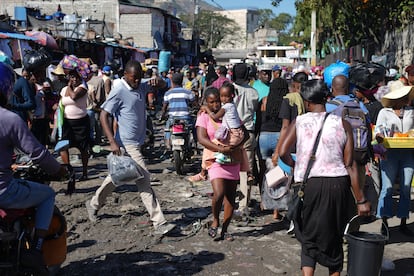

Amid a political and humanitarian crisis so severe that the word “catastrophic” no longer seems enough, 2025 in Haiti was also marked by deportations. Last year, nearly 270,000 citizens were sent back to Haiti after being expelled from neighboring Dominican Republic. Now, the Caribbean nation is once again holding its breath at the possibility of a similar wave of returns — this time involving migrants expelled en masse by the Donald Trump administration.
The future of more than 300,000 Haitians who live and work in the United States under the protection of Temporary Protected Status (TPS) will be decided by a federal appeals court sometime after this Thursday, when the deadline for submitting arguments expires and the three‑judge panel begins deliberations.
Originally, Haiti’s TPS — a special residency permit granted to citizens of countries that the Department of Homeland Security (DHS) deems unsafe for return — was set to end on February 3. The protection, in place since the 2010 earthquake that devastated the Caribbean nation, was blocked on February 2 by a district judge. The Trump administration, which over the past year has ended TPS for nearly every country that previously held this protection — creating more than a million and a half new undocumented immigrants — appealed the decision, both before Judge Ana Reyes, who has received death threats following her ruling, and before the appeals court. Depending on the panel’s decision, the case could still reach the Supreme Court.
For the DHS and the Trump administration, Haiti no longer meets the conditions required for TPS designation, though they have never clearly explained why — and that claim contradicts what is known about the country’s humanitarian situation. This is why Judge Reyes blocked the termination of TPS, and it would be reasonable to expect that, if the actual living and security conditions in Haiti are taken into account, the appeals court would uphold her decision. However, a recent ruling by another panel allowing the elimination of TPS for Nicaragua, Honduras, and Nepal has created a very real fear that Haitians — who make up nearly a quarter of all current TPS beneficiaries — may be next to lose their protection.
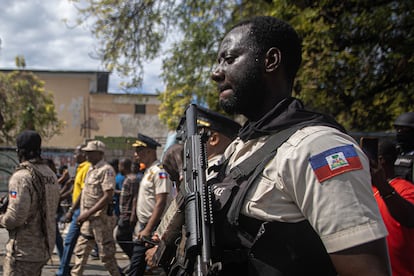
From Port‑au‑Prince, Mwiti Mungania, the Haiti director for the humanitarian NGO International Rescue Committee (IRC), warns of what possible deportees from the United States could face if TPS ends. “There is an overlap of violence, displacement, and hunger. Basic services are very limited, from water and supplies to healthcare and food. Furthermore, communities live in fear because they don’t know when gangs will come for them or their neighbors,” says Mungania.
The experience of Haitians deported from the Dominican Republic offers a glimpse of what might lie ahead. Given the gangs’ control of the country, the capital’s airport is unreliable, and those deported arrive in the north. They must then find a way to reach the south, where Port-au-Prince and the majority of the population reside.
Due to scarcity and insecurity, this journey is an ordeal, with people left at the mercy of criminal groups that run extortion checkpoints along the highways. Once back in their hometowns, many find their houses occupied and become internally displaced. Finding work is also difficult, and nearly the entire population depends on humanitarian aid. Mungania says that in many of the cases he has witnessed, Haitians have chosen to return to the Dominican Republic, judging the risk of another deportation to be lower than the risk of trying to rebuild their lives in Haiti.
Haitians deported from the United States, who have begun arriving but in much smaller numbers — just over 1,000 in the last year, according to Mungania — would face this same ordeal, and be especially attractive targets for gangs. “If you’re perceived as having money, you’re more at risk of extortion and other security risks,” he says.
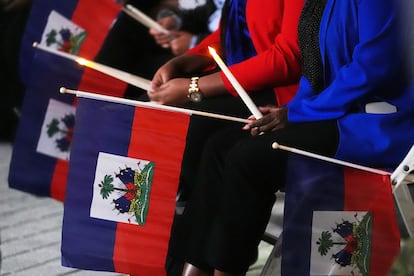
The humanitarian conditions in Haiti — where one in 10 of the country’s 11 million inhabitants is displaced — are extensively documented by nongovernmental organizations and by the United Nations. Adding to the crisis is the fact that, after a caretaker government ended on February 7 and reluctantly handed power to a prime minister backed tacitly by the United States but constrained at home with no elections in sight, Haiti now finds itself under the shadow of three U.S. vessels that arrived in the bay of Port‑au‑Prince days earlier.
In the United States, calls to preserve TPS for Haitians are accompanied by arguments about the community already established in the country. On Tuesday, New York Attorney General Letitia James — who has been unsuccessfully targeted by the Trump administration — led a coalition of 17 other attorneys general in defending the legal status of the hundreds of thousands of Haitian migrants whose future lies in the courts, many of whom have lived and worked in the United States for more than a decade. James and the coalition argue that ending TPS for Haitians would endanger the safety, health, and economy of communities across the country and upend the lives of families who have been in the U.S. for years.
“Every day, Haitian immigrants contribute immensely to New York, from working in our schools and hospitals to running successful small businesses,” said Attorney General James. “This administration’s continued efforts to strip away the legal status of hundreds of thousands of Haitians will put families in danger and tear apart our communities. I will keep fighting to protect immigrants’ rights and ensure Haitians with TPS can continue living, working, and raising their families safely in this country.”
The appeals panel’s decision has no specific deadline; the judges can issue their ruling at any time starting this Thursday. But while they deliberate, Haitians, both in their country and in the United States, wait with fear and helplessness.
Sign up for our weekly newsletter to get more English-language news coverage from EL PAÍS USA Edition









































