
The end of TPS threatens thousands of Haitians in Miami: ‘Returning is a death sentence’
More than 300,000 Haitians will lose their legal status in the US in February. Most reside in South Florida and have been contributing to the local economy for years

When Jonese Dérious thinks about the end of Temporary Protected Status (TPS) for Haitians, she doesn’t see a political debate, but the very real possibility of losing everything she has built with years of effort, including her home and her children’s future. Dérious, a single mother of two children who are U.S. citizens, is one of hundreds of thousands of people who could be left in immigration limbo after the Trump administration’s decision to end TPS for Haiti.
“This is a disaster for me. I’m the only person in charge of my children. I work to pay the bills, and they have no one else to care for them. I have no family in Haiti. My father died when I was already living here. My children cry every time I tell them we have to think calmly because we don’t know what’s going to happen,” says Dérious, 52.
For years, Dérious cleaned hotel rooms, but then she took a croupier course and now works at a casino north of Miami. Three years ago, she bought a house in Port St. Lucie, north of Palm Beach on the peninsula’s east coast, where prices were more affordable. She says that between her job and the house, she pays about $15,000 a year in taxes. “We work very hard for this, and we deserve better treatment. We came looking for a better life. If my country were doing well, I wouldn’t have come,” she says.
At the end of last month, the Department of Homeland Security (DHS) announced that Haiti no longer meets the requirements for TPS, which expires on February 3, 2026. The government maintains that allowing Haitians to remain temporarily in the United States is “incompatible with national interests” and urged beneficiaries who do not have another legal path to “prepare to leave the country,” including through self-deportation via the CBP Home app, which offers a free flight and $3,000 until the end of the year.
The decision affects 350,000 Haitians, most of them living in South Florida, who have been left without clear options to regularize their status after the recent suspension of other immigration benefits such as naturalization, residency, and asylum for citizens of a list of countries that included Haiti. In Miami, the decision has created alarm among families, employers, and community leaders.
Miami-Dade County is home to the largest Haitian diaspora in the United States. The first Haitians sought refuge in South Florida starting in the 1960s, fleeing the dictatorship of François Duvalier, a trend that intensified in the 1970s and 80s during the rule of his son, Jean-Claude Duvalier. Haitians transformed entire urban areas, such as the Little Haiti neighborhood northeast of Miami, creating an enclave with enormous cultural and demographic impact. It is estimated that some 130,000 people born in Haiti and nearly 300,000 with Haitian roots live in the county. Creole is the third most spoken language in Florida, after English and Spanish, and it appears on ballots and official Miami-Dade County communications.
TPS is an immigration program that allows people from countries experiencing exceptional circumstances, such as armed conflict, natural disasters, or severe humanitarian crises, to live and work legally in the U.S. The Caribbean nation has had TPS designation since the 2010 earthquake, which left hundreds of thousands dead and injured and more than a million displaced. The designation is reviewed periodically and renewed every 18 months. The last extension was granted by former president Joe Biden in August 2024, valid until February 2026.
Haiti is experiencing a profound crisis of insecurity, hunger, and institutional collapse. Following the assassination of President Jovenel Moïse in 2021, armed gangs have taken control of large swathes of the country, including much of the capital. The violence has displaced more than a million people, according to human rights organizations, while international efforts have failed to stabilize the situation. A Human Rights Watch report from June documented thousands of deaths from gang violence, as well as hundreds of injuries and kidnappings. Although the United Nations deployed a multinational security force partly funded by the United States, it has not been able to contain the crisis, according to the organization.
Serious consequences for the economy
In South Florida, community and business leaders warn that the end of TPS will have immediate consequences. Paul Christian Namphy, director of the Family Action Network Movement (FANM), a Miami-based community advocacy organization, argues that “without the work of immigrants here, without this labor force, the Florida economy would be unable to function.”
Namphy points out that “to say it is against the national interest” for Haitians to remain in the United States “couldn’t be further from the truth.” “Haitians contribute billions of dollars each year to the U.S. economy. They pay billions of dollars in federal, state, and local taxes. These workers are essential to the economy of Florida and the country,” he adds.
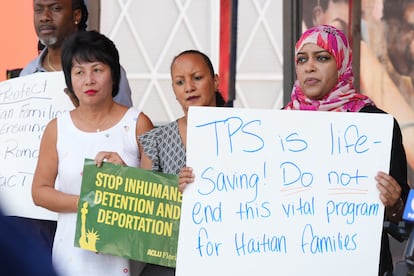
Namphy was one of the activists, politicians and community leaders who gathered in early December at the Little Haiti Cultural Complex, northeast of Miami, to condemn the government’s decision, calling it unfair and dangerous for thousands of families who have lived and worked legally in the United States for decades.
The economic consequences in Miami-Dade will be severe, warns Candice Mondesir of the Haitian American Chamber of Commerce, who points out that many Haitian immigrants in South Florida work in critical sectors such as healthcare, education, construction, services, and retail. “The impact of ending TPS will be significant.”
“These people have been here for many years, they have homes, businesses, they pay Social Security, taxes. What will happen to their retirement plans and 401(k), their savings, their Social Security?” she points out.
Leslie Frane, executive vice president of the Service Employees International Union (SEIU), which represents some two million workers, especially in the health sector, points out that Haitians “are essential workers who sustain our economy, especially in home care, nursing homes and hospitals, where staff shortages are pushing” families and the system to the limit.
“Stripping migrant workers of their work permits not only harms Haitian families, but also affects patients, employers, and the communities that depend on their care. They deserve dignity and stability, not fear and uncertainty. The way the Trump Administration has treated them is despicable,” she added.
Without a country to return to
Beyond the economic impact, the uncertainty is taking a profound emotional toll. Farah Larrieux, a 46-year-old Haitian businesswoman with TPS, works as a community organizer with a group of beneficiaries who she says “are depressed because they don’t know what they’re going to do.”
“Many of these people no longer identify Haiti as their country. Many have lost their homes; others escaped assassination attempts,” says Larrieux, who has lived in the U.S. for 20 years. “All these people are here because they were forced to come, because a terrorist group has taken over the country. They came to save their lives. For many, returning to Haiti now is, in practice, a death sentence, making them vulnerable to extortion and kidnapping.”
For her, the decision transcends any debate. “This isn’t public policy, this is cruelty and racism. Because Trump thinks he can do whatever he wants because it involves Haitians. He thinks Haiti is—excuse my French—a ‘shithole country,’ that he can lie about us and there will be no consequences. He thinks the American people aren’t going to care; nobody is going to care about Haitians. We have to inform, educate, and raise awareness among the American people about the situation,” she adds.
“We’re not talking about Haiti here, we’re talking about Miami,” Larrieux insists. “About hospitals, airports, hotels, schools, and communities that depend on these people every day.”
In June, the DHS sought to shorten the latest TPS extension by six months, arguing that the situation in Haiti had improved enough to make it safe to return. However, San Francisco federal judge Edward Chen blocked the attempt in September, stating that revoking the protections would send these individuals “back to conditions so dangerous that even the State Department advises against travel to their home countries.” In the case of Haiti, the State Department advises against travel to the nation due to the severe security situation, including kidnappings, terrorist activity, and social unrest.
For Namphy, the answer lies in a fundamental political solution: “We need immigration reform that will allow people to continue living and working here legally. The economy needs it, and people deserve it too.”
He further emphasizes that the responsibility now rests with elected leaders. “There are people of immigrant origin in Congress, in the Senate, in the Florida Legislature, in Miami-Dade County, and in city halls. They have to decide whether they will support their constituents, who are in danger today, or whether they will do the bidding of those who want to harm us. And if they don’t decide to support us, in the next election we will elect someone willing to do so.”
Sign up for our weekly newsletter to get more English-language news coverage from EL PAÍS USA Edition









































