
Haiti, a wartorn country where the gangs are ‘better coordinated than the public forces’
The island’s authorities have been using suicide drones for eight months to target armed groups, and the attacks have left at least 30 civilians dead, including children
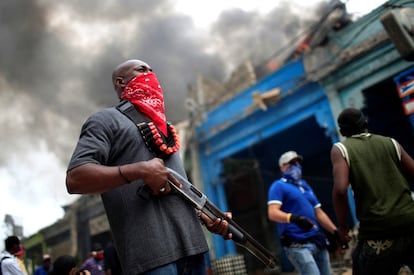

On September 20, at around 8:25 p.m., Haitian police sent two suicide drones into the Simon Pelé neighborhood of Port-au-Prince. The target was to assassinate Albert Stevenson, known as Djouma, the leader of one of the gangs that control the city. They planned the attack that Saturday because they knew he would be celebrating his birthday. The operation ended with the deaths of eight children between the ages of two and 10, six more kids wounded, at least three civilians killed, and four gang members dead. According to local sources, Stevenson escaped unharmed. Five days after the incident, Anthony Franck Laurent Saint Cyr, president of the Presidential Transitional Council, warned the UN General Assembly in New York that peace “is the greatest urgency” for his people: “This is Haiti today, a country at war. A contemporary Guernica.”
This is the third drone operation that has resulted in civilian injuries or deaths since Haitian authorities began using them on March 1. Since then, at least 30 innocent people have been killed, nearly 300 gang members have been taken out, and 400 more have been injured. Most of these are low-ranking gang members. “The targets are middle- or low-ranking officials; they’re not attacking the top brass,” laments Pierre Esperance, director of the National Network for the Defense of Human Rights. “That’s why criminals are roaming freely and acting so arrogant. The gangs wouldn’t be so arrogant if they didn’t have the complicity of the authorities,” he explained to EL PAÍS by phone.
On September 6, a similar mission ended with the deaths of 11 civilians, and on August 19, in the capital’s Kenscoff commune, another drone killed at least two police officers and other civilians. Romain Le Cour Grandmaison, director of the Haiti program at the Global Initiative, fears there may be many more. “The lack of transparency on the part of the authorities means we don’t have official data at hand. This count is known because the affected families reported the casualties, but these drones have surely caused the deaths of many more civilians than we are aware of.”
An analysis conducted by Insight Crime at the end of June acknowledged that legal concerns about the use of drones persist due to the increase in reports of civilian casualties. For Pierre Esperance, the real problem with this technology is that “it is not being selective” and that there is a “total lack” of transparency and accountability. Le Cour, however, is much more critical: “The use of drones is a desperate measure and a very large escalation in the way we confront gangs, without a real or coordinated strategy. It is a danger, rather than a defense innovation, and even from a tactical point of view, it has served absolutely no purpose.” Both regret that there is no official count either.
UNICEF, on the other hand, has data on children in the Caribbean country. The United Nations Children’s Fund estimates that 2.85 million children—a quarter of the child population in Haiti—face consistently high levels of food insecurity and reported this Wednesday the deaths of 10 children in just 10 days. “For too long, Haitian children have been trapped in cycles of violence. These incidents have once again torn families apart and destroyed any sense of security for children, who should simply be able to learn, play, and grow up in peace,” the UN agency said in a statement. The sky-high rates of hunger, a 24% increase in homicides, and poverty have forced more than 1.3 million people—one in 10 Haitians—into internal displacement.
The role of the international community
The news of the latest drone-caused massacre broke during the UN General Assembly, where countries including the United States, Canada, Kenya, the Dominican Republic, and the Haitian authorities themselves spoke out about the crisis. Pope Leo XIV urged the international community on several occasions to “create the social and institutional conditions that will allow Haitians to live in peace.”
A few weeks ago, Mexico welcomed around 100 Haitian soldiers for training, Canada announced $43 million in aid, and the United States proposed a new mission composed of 5,500 troops to succeed the current Multinational Security Support Mission (MSS), which had promised more than 2,500 Kenyan officers but has only contributed 1,000, with modest results. “Any help is important, but they need a plan; a strategy,” Le Cour concludes. “Haitian gangs are much better coordinated than the international public forces that are confronting them.”
Esperance is deeply disappointed with the international community’s role so far and advocates for strengthening Haitian institutions. “I don’t think there’s a real intention to put an end to the gangs. Everyone makes statements saying there is, but what we see on the ground is that the police force (which has barely 2,500 officers) isn’t being strengthened,” he explains. “The problem is institutional. Our institutions are collapsed, and we need to work on governance and justice alongside security. We can’t stand idly by, waiting for help to arrive from outside.”
Haiti’s Transitional Presidential Council was mandated to hand over the reins to an elected government by February 2026, which would also imply upcoming elections, something that the academics consulted flatly deny, although Saint Cyr announced Thursday that “electoral colleges” have already been identified and funding is in place. “That’s really what’s missing today, and I think Latin America and the Caribbean can do much more to support this transition,” Le Cour notes.
“Gangs, a de facto political power”
One of the main obstacles to addressing Haiti’s security crisis is the very nature of the gangs. While virtually none of them are politically motivated, but rather seek territorial control, in practice they are filling in the gaps in the state. Thus, some experts question whether it should be addressed as an armed conflict and even whether negotiations with the gangs are a possibility. “This is an extremely sensitive issue for the country. So far, there is no consensus or political inclination toward negotiations, but solutions must be rethought more deeply,” Le Cour explains.
The French academic insists that gangs are filling the state’s voids. “They have become a de facto political power. Today, a large part of the country is governed almost 100% by criminal groups.” Thus, the population living under the control of these militias obeys their rules and pays extortion fees. “This unfortunate legal ambiguity is an obstacle to conflict resolution.”
In Haiti, doctors are fleeing, hospitals are being looted, sexual violence is a daily occurrence, and there seems to be no end in sight. During his address at UN headquarters in New York, Laurent Saint Cyr portrayed the reality of a country in crisis before world leaders. “Hunger threatens millions of lives, conflicts are multiplying, and extreme poverty is intensifying, causing forced migration that shakes international stability and tests the solidarity of nations,” he said. Just four hours away by plane, he added, “one of the gravest human tragedies in the hemisphere is unfolding… These enemies are a threat to Haiti and the entire region. Peace cannot wait.”
Sign up for our weekly newsletter to get more English-language news coverage from EL PAÍS USA Edition









































