
United States subjects Maduro to psychological terror: ‘The wrath of God will fall upon you like thunder’
Military operations in the Caribbean have been accompanied by a strategy of pressure through intimidating messages
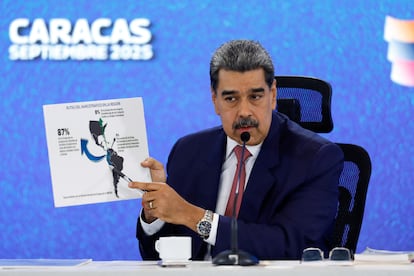

When Donald Trump was asked if he was planning an attack inside Venezuelan territory in the war he is waging against drug trafficking, he responded with “you’ll see,” with an enigmatic eyebrow and gesture of the mouth. American operations in the Caribbean have generated a psychological war that seeks to make the threat against Nicolás Maduro credible and to exert pressure within his inner circle. After three attacks on vessels — in which at least two were destroyed with the loss of their crew according to the White House — and with the U.S. military presence near territorial waters off the Venezuelan coast, bilateral tensions are growing as part of a war of narratives and intimidating rhetoric that Chavismo has taken note of.
“It’s not tension, it’s military aggression,” said Venezuelan President Nicolás Maduro. Trump has released footage of the boats destroyed by his military. Chavistas — at least in the first case that occurred in early September — claim it was a video created using artificial intelligence, and Maduro has called for an investigation into the incident. On the ground and in terms of rhetoric, the conflict has escalated.

The prospect of an invasion or of attacks on a larger scale than those carried out against three boats allegedly loaded with drugs are minimal, even with the U.S. naval deployment in the Caribbean. Former U.S. defense official Franklin Mora, in an interview with CNN, pointed out this week that the military capabilities the United States has deployed, which include a submarine, destroyers, cruisers, and between 4,000 and 5,000 marines, are not sufficient to invade a country like Venezuela. “I don’t think this is a military invasion. It’s more of a psychological operation that seeks to intimidate and incentivize the military through fear to remove Maduro from power.”
According to Mora, a former deputy assistant secretary of Defense for the Western Hemisphere at the U.S. Department of Defense, the teams deployed in the Caribbean could be used to conduct surgical operations to destroy airstrips used by drug traffickers instead of intercepting ships, as air travel is the main route for drugs to exit Venezuela.
The intimidating narrative has been built in unison. Republican Senator Bernie Moreno has predicted that Maduro will not remain in power beyond 2025. His fellow party member Mario Díaz-Balart has said that the Chavista leader has only three options: “Leave now, end up like [Manuel] Noriega in a U.S. prison for the rest of his life, or basically be reduced to dust in a plastic bag.” But Diosdado Cabello has also warned that if they attack the government, Chavismo will target opposition leader María Corina Machado, who is in hiding. “Diosdado Cabello, don’t even think about touching María Corina Machado. The United States and the entire world are watching. If anything happens to her, you and your accomplices will have nowhere to hide, and the wrath of God will fall upon you like thunder,” Díaz-Balart responded in social media exchanges over the past few days.
Cabello himself revealed the intimidation strategy, although he remains on guard. “They issue threats, and the current phase is the bogeyman: psychological warfare, which is almost always based on lies, manipulation, and fake news, seeking to divide internal forces because it makes things easier,” he said a few days ago on his television show, Con el Mazo Dando.
Secretary of State Marco Rubio is the man to whom Trump appears to have delegated his fight against drug trafficking in Latin America. A fight that no longer focuses on drug seizures and regular actions against cartels, which the Republican administration has designated as terrorist organizations, but on “blowing them up.” Rubio has also been more direct and threatening toward Maduro, whom he has accused of being a criminal and a fugitive from U.S. justice and asserting that he is not a legitimate president.
Nayib Bukele, has also joined the campaigns of intrigue with which the United States seeks to exert pressure — and, above all, generate confusion — on Chavismo. In recent days, the El Salvadoran president’s messages have aligned with those of Machado and opposition leaders in exile, who assume that the Maduro government’s days are numbered. “This is over. You are not alone. They are,” Bukele said in a video last week. Chavismo’s persecution apparatus, however, continues to arbitrarily arrest members of the opposition.
Chavista response
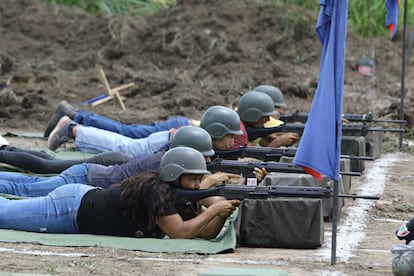
The Venezuelan government has also come out to show off its weapons. Photographs of civilians wielding rifles and receiving military training are part of the offensive. High-ranking officials have also displayed their fitness and skill at shooting ranges, as demonstrated a few days ago by Freddy Bernal, governor of the state of Táchira, a former police officer and Maduro loyalist, as a way of asserting their readiness for an armed struggle, should one arise.
With each passing day, Chavismo displays its willingness to confront aggression on the ground, although it has repeatedly stated that “Venezuela is subjected to psychological warfare.” Maduro has appeared amid a formation of hundreds of soldiers and police officers in training to demonstrate his strength in the face of any threat. Chavismo claims to have recruited more than 8.2 million Venezuelans during the enlistment sessions held in early September, adding to a corps of 4.5 million already recruited militia members. These are ordinary citizens whom the Chavista apparatus is trying to subject to military training. Defense Minister Vladimir Padrino has also appeared in a camouflaged tent demonstrating the deployment of troops to the country’s main borders.
Wearing a field uniform and with hours of sleeplessness under his eyes, Padrino also recently accused the United States of conducting a psychological warfare exercise against the country, but also warned that Venezuela is at “maximum readiness” and that if Washington decides to attack them, the country’s “potential” will be transformed into “national power.” The minister asserted that both the National Armed Forces and the Venezuelan people are willing to “give their lives.” This weekend, he accused Washington of intensifying aerial surveillance over Venezuela, citing an increase in espionage flights. “Now they’ve gone from a daytime pattern to doing it at night and in the early morning, and they tripled intelligence and reconnaissance operations against Venezuela in August.”
Sign up for our weekly newsletter to get more English-language news coverage from EL PAÍS USA Edition









































