
Venezuela on high alert amid escalating Trump pressure
The White House is deploying missiles in the Caribbean while sending continuous, alarming messages to Chavismo
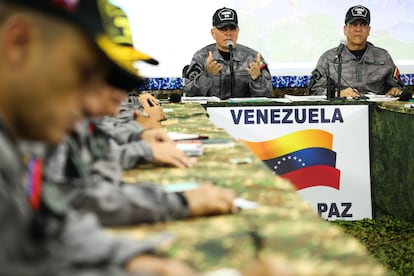

U.S. pressure on Venezuela is beginning to take its toll on the Miraflores Palace, the Venezuelan presidential residence. “We have never experienced anything like this. There is a lot of confusion,” says someone close to Venezuelan President Nicolás Maduro. The atmosphere has grown tense. Warnings are coming from every direction.
Late Friday, U.S. President Donald Trump announced the sinking of a new vessel that had departed from the Venezuelan coast and, shortly afterward, a former Trump official posted a cryptic message on social media directed at Maduro’s pilot, Bitner Javier Villegas. “Happy birthday, ‘General’ Bitner!” the message read, accompanied by two photos: one showing Bitner in full military regalia with rank insignia and medals, and another split image in which the pilot is seen speaking with an unidentified person. In reality, there was nothing very cryptic about it: Marshall Billingslea is a former assistant secretary for Terrorist Financing at the U.S. Treasury Department, implying that Bitner had struck some kind of deal with them.
Maduro does not want to enter into armed conflict, and he made that clear to Trump in a letter following the first U.S. Navy attack on a boat carrying 11 people. “President, I hope that together we can defeat the falsehoods that have sullied our relationship, which must be historic and peaceful,” Maduro wrote in the letter to Trump, according to Reuters. “These and other issues will always be open for a direct and frank conversation with your special envoy [Richard Grenell] to overcome media noise and fake news,” the letter continues. Grenell was the negotiator who, in January, brokered with Venezuelan leaders a prisoner exchange and laid the groundwork for the renewal of Chevron’s oil licenses.
Maduro wants to sideline Secretary of State Marco Rubio, the highest-ranking U.S. official who maintains highly aggressive rhetoric against the Chavista regime. Rubio is a personal friend of opposition leader María Corina Machado. “To date, this channel [Grenell] has functioned flawlessly,” Maduro insisted. Despite all the tensions between the two countries, the deportation of undocumented migrants from the United States to Venezuela has continued.
¡Feliz cumpleaños “General” Bitner! pic.twitter.com/P6dEeJvETH
— Marshall S. Billingslea (@M_S_Billingslea) September 19, 2025
Paranoia is running high among the Chavista leadership, the top officials of Venezuela’s ruling party who are aligned with Hugo Chávez’s ideology. The internet is flooded with reports of mass defections in the Chavista military, secret conversations between Maduro’s inner circle and the White House to hand him over, and plans for a transition once the Chavista government is deposed. Most of these claims are impossible to verify. A narrative is building that something imminent is about to happen. Meanwhile, the U.S. fleet in the Caribbean is as real as it gets — assault ships and nuclear submarines ready to strike vessels leaving Venezuela, allegedly carrying drugs.
Trump claims that this is how he will end drug trafficking to his country. However, upon closer examination, this is the least suitable area in the world for such an operation. The Sinaloa Cartel moves thousands of kilos of drugs daily from Guayaquil, Ecuador, or from Tijuana, which, together with San Diego, forms a historic narcotics trafficking hub. Venezuela handles a significant flow, but it is minor on a global scale. Analysts agree that this deployment supports the theory that Maduro is not only a president but also a drug trafficker — something that has not been proven — and that he will have to answer to U.S. justice.
Chavismo has been engaged in a tug-of-war with Washington for at least six years. Political negotiations, prisoner release agreements, oil licenses, NGO work permits, and respect for the opposition — of which little remains — have all been subjects of discussion between the two countries. Maduro or Diosdado Cabello, the regime’s number two, could maintain a strong anti-imperialist rhetoric one day and sit down with White House envoys the next. It was a pendulum game.
Now, things are different. “There is no open channel of communication with Trump’s people right now,” says someone familiar with those talks. This worries the Chavistas, who for the first time since the Bolivarian Revolution — which evolved into a one-party state — genuinely fear armed conflict. Maduro, Cabello, and even Jorge and Delcy Rodríguez, the main political operators in Miraflores, distrust Trump’s intentions. The specter of invasion casts a shadow that chills those within the palace.
Chavismo is preparing as if war were imminent. First, they are watching potential traitors. Second, they are recruiting as many fighters as possible. The numbers given by Maduro amount to millions of soldiers and militiamen, but they cannot be verified, and no images distributed through Chavista communication channels confirm their accuracy.
In mid-September, the armed forces trained residents of poor neighborhoods to use firearms. These areas were once strongholds of Chavismo, the same ones that brought Hugo Chávez to power with a message against the privileged and for the benefit of the poor. That idyll is now broken. Chavismo, taking into account the results of last July’s elections, has abruptly lost support. In fact, most Venezuelans who have emigrated to Spain, the United States, and other Latin American countries — seven million, according to the United Nations — came from these neighborhoods.
Additionally, Chavismo is conducting maneuvers in the Venezuelan Caribbean. Instagram posts have shown fighter jets and images of Maduro, Diosdado, and Defense Minister Vladimir Padrino rallying the troops. Even one of Chávez’s brothers, Adán, gave a martial arts demonstration. At this point, Maduro and his circle see a real possible enemy on the horizon, one that is sending threats with missiles and propaganda. Confusion reigns at the Miraflores Palace.
Sign up for our weekly newsletter to get more English-language news coverage from EL PAÍS USA Edition









































