
Marco Rubio imposes Trump’s narrative in Mexico amid regional escalation
The State Secretary normalized the deadly US strike on a Venezuelan boat in the Caribbean while hailing the ‘historic cooperation’ with the Sheinbaum administration
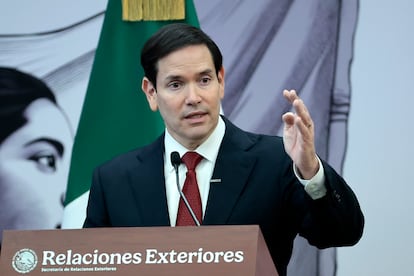

Donald Trump’s administration can one day launch a missile at a boat coming from Venezuela, killing its 11 crew members, and the next, publicly declare from the heart of the Mexican executive branch—a regular target of its threats—that there will be more attacks of this type. This is while U.S. State Secretary Marco Rubio, with the Mexican foreign minister standing at his side, hails “the historic cooperation” the U.S. has achieved with Claudia Sheinbaum’s administration. Each of these acts fits into the narrative Trump has imposed on the region, reduced to one basic premise for the U.S. president: whether in the form of tariffs or gunfire, the baton of command remains in his hands.
From his first day back in the White House, Trump signed a decree to designate six Mexican cartels and two gangs, the Venezuelan Tren de Aragua and the Central American Mara Salvatrucha, as terrorist organizations. When the president ordered the U.S. armed forces to combat drug cartels abroad in early August, alarm bells quickly rang in Venezuela and Mexico. Trump’s two measures paved the way for a long-held dream of the Trumpist hardliners: a military intervention under the guise of fighting drug trafficking.
This new foreign policy of aggression claimed its first fatalities on Tuesday. In international waters off the Caribbean, an alleged drug boat carrying 11 people blew up after a direct strike from the United States. This alleged shipment is the only justification Trump has given for killing the crew, whom he accuses of being part of the Tren de Aragua. The president has also offered no legal basis for the attack beyond his own presidential orders: “There was massive amounts of drugs coming into our country to kill a lot of people, and everybody fully understands that. Obviously, they won’t be doing it again,” he said Wednesday without further explanation.
This same normalization strategy is what Rubio applied, speaking from the Mexican Foreign Ministry. Like a Trojan horse, the Secretary of State declared: “It could happen again, tomorrow or in a week.” “These are not simply individuals committing a crime; they are organizations; they are a direct threat to national security. (...) These are cartels that are earning billions of dollars, so they don’t mind losing one or two shipments. That doesn’t work,” explained Rubio, who, while discussing about the attack on the Venezuelan vessel, perfectly described the modus operandi of any Mexican cartel.
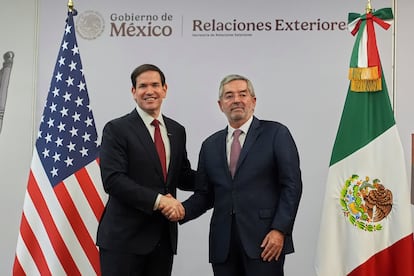
“The president of the United States is going to wage war on narcoterrorist organizations,” Trump’s deputy summed up, speaking in perfect Spanish with a Cuban accent, as he stood next to Juan Ramón de la Fuente. The Mexican foreign minister avoided answering questions from journalists who insisted on the precedent set in the region by the return of this arms diplomacy. “Mexico’s position on this issue is very clear; it is based on our constitutional principles of foreign policy, which are clearly defined in Article 89 of our Magna Carta, and on respect for international law and the international conventions and treaties in force on the matter,” De la Fuente stated simply, in the same tone set by Sheinbaum of not contradicting the United States, much less in public.
The Mexican president combines her strategy of non-confrontation with a firm position that incursions by U.S. armed forces in Mexico is absolutely off limits. “The United States is not going to come to Mexico with the military, there will be no invasion,” she has emphasized on several occasions. Sheinbaum, who has waved the white flag from the beginning, takes every opportunity to highlight her premise of “cooperation yes, submission never.” This strategy, accompanied by the surrender of 55 drug lords to the U.S., the militarization of the border, and massive seizures of fentanyl, has worked, so far, in curbing Trump’s impulses.
Until this week, the president has continued to insist that Sheinbaum won’t accept his help in confronting the cartels “that run the country” because she is “scared.” In this new version of the old tale about the knight rescuing the damsel in distress, the Republican president has introduced a message that has resonated with a segment of Mexico’s political opposition: that the country needs U.S. help to deal with criminal groups.
However, that was not the message emphasized on Wednesday by Marco Rubio and Juan Ramón de la Fuente. The State Secretary went so far as to declare that “never in the history of both countries have we seen the level of cooperation that we have right now, – cooperation at a level that respects integrity and the sovereignty of both countries, but at the same time, this cooperation has led to concrete outcomes.”
“When it comes to our cooperation,” he added, ”there’s no other government that’s cooperating as much with us in the fight against crime as the Government of Mexico and President Sheinbaum’s administration.
Sign up for our weekly newsletter to get more English-language news coverage from EL PAÍS USA Edition









































